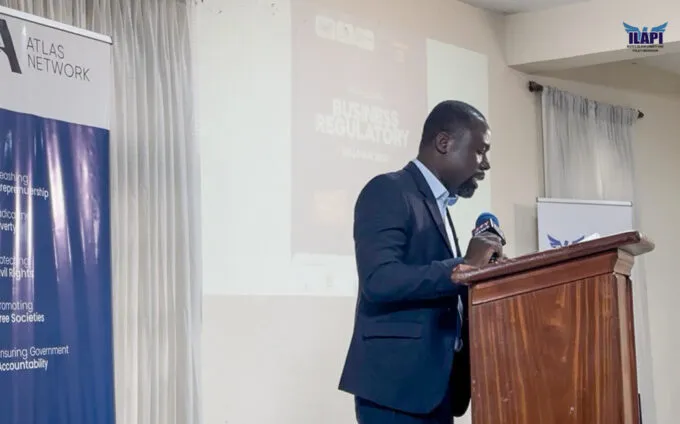
The Institute for Liberty and Policy Innovation (ILAPI) has warned that Ghana’s complex regulatory environment is undermining the growth, formalization and job creation potential of Micro, Small and Medium Enterprises (MSMEs).
The policy think tank said overlapping regulations, lengthy administrative processes, high compliance costs and inconsistent enforcement are placing significant financial and administrative burdens on businesses, particularly micro and start-up enterprises.
The concerns were contained in the 2026 ILAPI Policy Insight, based on a study of 800 MSMEs operating in the manufacturing, information and communications technology (ICT), and tourism sectors between September 2024 and July 2025.
Speaking at a press conference in Tema, ILAPI Senior Research and Policy Analyst, Mr. Stephen Dansu, said the regulatory environment had become a major constraint on businesses that lack the resources to navigate multiple compliance requirements.
Regulatory Burdens Threaten MSME Growth
According to ILAPI, Ghana’s regulatory framework is characterized by duplicated institutional mandates, excessive documentation, opaque procedures, inconsistent enforcement and prolonged registration and licensing processes.

The institute said these challenges increase the cost of doing business and divert scarce resources away from productive activities such as investment, expansion and job creation.
Mr. Dansu noted that MSMEs account for about 92 percent of businesses in Ghana and contribute nearly 70 percent to Gross Domestic Product (GDP), making their performance critical to the broader economy.
“These enterprises are expected to generate employment, increase tax revenue, and support economic growth. But the current system makes it difficult for them to formalize and scale”.
ILAPI Senior Research and Policy Analyst, Mr. Stephen Dansu
He said the burden was particularly severe for micro and start-up businesses that often operate with limited capital and administrative capacity.
High Compliance Costs Discourage Formalization
The ILAPI study found that the average cost of registering a business with the Registrar General was GH¢1,100. At the Metropolitan, Municipal and District Assemblies (MMDAs), permits averaged GH¢1,275, while licenses averaged GH¢1,600. Some businesses reported paying as much as GH¢3,000 for licenses alone.
ILAPI argued that these costs, combined with multiple registrations, permits and certifications, could consume resources that businesses would otherwise use to expand operations or employ additional workers.
The institute said the regulatory burden also discourages some entrepreneurs from formalizing their businesses. According to the study, some operators choose to remain informal to avoid the financial and administrative demands associated with compliance.
ILAPI warned that continued informality limits businesses’ access to formal credit, government contracts and larger markets, creating a cycle in which enterprises remain small and productivity remains constrained.

Overlapping Mandates Create Delays
The institute also identified overlapping institutional mandates as a significant challenge facing MSMEs. Businesses surveyed reportedly had to deal with several government agencies for similar approvals, often without clear coordination among the institutions.
ILAPI said this creates confusion, delays and opportunities for unofficial payments, while making it difficult for entrepreneurs to predict the time and cost involved in obtaining regulatory approvals.
Mr. Dansu further pointed to inconsistent enforcement as another major concern. He said businesses can face different interpretations and applications of regulations across districts and over time, making compliance difficult to plan for.
The lack of transparency surrounding some procedures, he added, creates room for discretion and increases uncertainty for entrepreneurs. ILAPI argued that the regulatory challenge extends beyond the immediate cost faced by individual businesses and could affect Ghana’s broader economic competitiveness.
The institute noted that Ghana is seeking to attract investment and expand its participation in intra-African trade under the African Continental Free Trade Area (AfCFTA).
However, it warned that an inefficient domestic business environment could undermine efforts to make Ghanaian enterprises more competitive and enable them to take advantage of emerging regional markets.
The institute therefore maintained that regulatory reform should be treated as an important component of Ghana’s broader economic transformation agenda.
ILAPI Calls for Unified Digital Platform
To address the challenges, ILAPI has recommended a comprehensive review of regulations affecting MSMEs. The institute wants government to eliminate duplicated requirements, harmonize permits across agencies and introduce simpler compliance procedures that reflect the capacity of smaller businesses.

It also proposed the creation of a unified digital platform through which businesses could apply for multiple licences, permits and approvals without having to visit several institutions. According to ILAPI, such a platform could reduce administrative delays, improve transparency and lower the overall cost of regulatory compliance.
“We need a system that supports the businesses we expect to drive jobs and growth. Right now, the process is asking too much from those with the least capacity to give”.
ILAPI Senior Research and Policy Analyst, Mr. Stephen Dansu
Call for Coordinated Government Action
ILAPI’s findings come amid renewed efforts by government and development partners to support MSME development and expand private-sector participation in Ghana’s economy.
The institute acknowledged that MSMEs continue to face other challenges, including limited access to finance, markets and technology, but maintained that regulatory reform is necessary to ensure that these businesses can overcome those constraints.
It urged Parliament, the Ministry of Trade and Industry, and local government authorities to work together to streamline regulatory processes and develop the proposed digital platform.
ILAPI argued that simplifying the regulatory environment would encourage more businesses to formalize, improve access to opportunities and create conditions for sustainable expansion.
For the institute, addressing regulatory barriers is essential if Ghana is to unlock the full potential of its MSMEs, strengthen job creation and build a more resilient and inclusive economy.
READ ALSO: Ghana Fully Funded Evacuation of Nationals From South Africa, Ablakwa