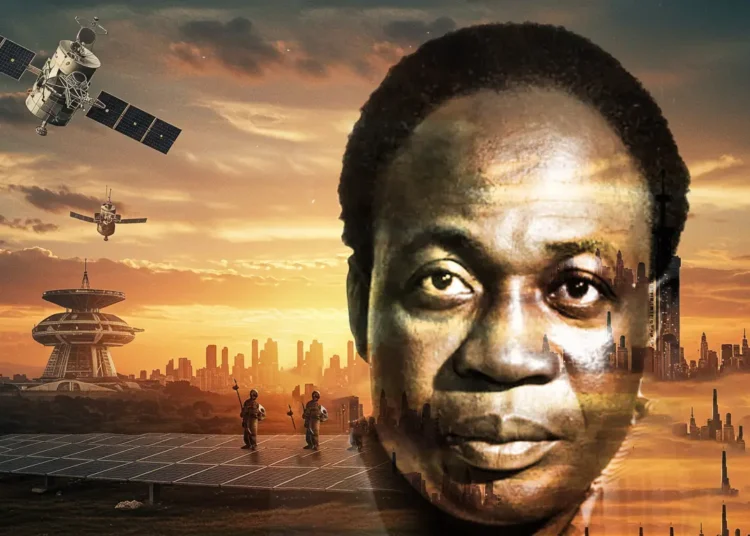
As Ghana marks Founder’s Day, renewed calls to examine Kwame Nkrumah’s development ideas are colliding with a striking feature of the modern economy: more than six decades after his government sought to reduce dependence on raw commodity exports, gold, cocoa and crude oil still dominate Ghana’s foreign-exchange earnings.
Bank of Ghana data show merchandise exports reached US$18.28 billion in the first half of 2026, with those three commodities accounting for about US$16.5 billion, or just over 90 per cent.
The comparison does not mean Ghana’s economy has stood still. Services, finance and domestic production have expanded significantly since the 1960s. But the composition of merchandise earnings still exposes Ghana heavily to international commodity prices, production shocks and a narrow group of export sectors.
That structural question has returned to the fore on Founder’s Day. University of Ghana historian Prof Samuel Ntewusu has called for Nkrumah’s policies to be examined critically for lessons relevant to contemporary development rather than treated merely as ceremonial history. “Celebration is not an event,” he said.
The economic relevance is clear: Ghana’s current New Economy agenda is again promising production, value addition, jobs and a broader export base.
Commodity Windfall Strengthens Ghana Without Diversifying It
Ghana’s external position is currently strong. The country recorded a US$8.81 billion trade surplus in the first half of 2026, while the current account surplus reached US$5.10 billion. Those buffers support reserves and reduce immediate foreign-exchange pressure.

Yet the source of that strength matters. Gold exports generated US$12.50 billion, up 49.0 per cent from a year earlier. The increase was driven almost entirely by price: the average realised gold price rose 49.7 per cent, while export volumes slipped 0.5 per cent.
Cocoa beans and products generated US$2.29 billion and crude oil US$1.71 billion. By contrast, “other exports”, including non-traditional exports, declined 4.5 per cent to US$1.79 billion.
The result is an external sector that is healthier in cash-flow terms but remains highly concentrated. A commodity-price upswing can strengthen the trade balance quickly, but it does not by itself create the diversified production structure that reduces vulnerability when prices reverse.
Seven-Year Plan Targeted the Same Structural Weakness
Nkrumah’s Seven-Year Development Plan for 1963/64 to 1969/70 explicitly sought to change what it described as the colonial structure of Ghana’s international trade. The strategy was to process cocoa, timber and other raw materials locally, expand basic industry and gradually make unprocessed commodities less dominant in exports.
That objective linked industrialisation directly to the balance of payments. Processing resources domestically was expected to retain more value inside Ghana, create employment and reduce dependence on imported manufactured goods.
The historical record also cautions against treating the plan as a ready-made template. Its implementation encountered collapsing cocoa prices, rising external debt, shortages, inflation and weaknesses in administrative and financial capacity.
Structural transformation requires not only ambition, but financing discipline, technology, management, competitive firms and credible project selection.
Today’s Manufacturing Gap Keeps the Question Alive
Ghana’s current planning documents show that the underlying challenge remains recognised by government. The Ministry of Trade, Agribusiness and Industry’s 2026–2029 medium-term plan identifies manufacturing value added at about 11 per cent of GDP as a weakness and targets 15 per cent by 2029.
The same plan estimates that only about 10 per cent of agricultural output is processed locally and sets a target of 40 per cent by 2029. That gap matters because producing more cocoa, cassava, tomatoes or minerals does not deliver structural transformation if most value is created after the product leaves the farm, mine or country.
Recent Vaultz analysis of Ghana’s New Economy consultations has made the same distinction: macroeconomic stabilisation creates room for transformation, but does not guarantee it. The harder task is converting capital, infrastructure and policy support into competitive firms capable of processing local inputs and selling into domestic, African and global markets.
New Economy Will Be Judged by Export Composition
Government’s emerging New Economy programme places production, private investment and value addition at the centre of the next phase of policy. Ghana has also renewed its push to move from raw mineral exports towards domestic processing, while economic zones and industrial parks are being positioned as platforms for manufacturing and exports.
The decisive measure will not be the number of factories announced or the size of an investment envelope. It will be whether Ghana’s export basket actually changes.
A successful transformation would mean non-traditional and manufactured exports taking a larger share of foreign-exchange earnings, more agricultural output being processed locally and commodity sectors feeding domestic industrial value chains rather than functioning mainly as sources of raw exports.
Nkrumah’s Seven-Year Plan belongs to a very different economic and political era, and its model cannot simply be transplanted into 2026. But the structural problem it identified remains measurable in today’s trade data. Ghana’s commodity windfall has strengthened the external accounts. The longer-term test is whether that stability finances an economy that eventually needs the windfall less.
READ ALSO: Government Set to Procure Furniture to End Double-Track System