Hon. Ato Forson, Minister, for Finance has highlighted that the unprecedented rally in global gold prices throughout 2025 provided a massive boost to the nation’s fiscal position, delivering record-breaking export earnings that have fundamentally reshaped external buffers.
This price surge, catalyzed by a volatile cocktail of international geopolitical risks and aggressive bullion accumulation by global central banks, has positioned gold as the cornerstone of Ghana’s macroeconomic recovery.
As the primary driver of the nation’s trade balance, the yellow metal’s ascent to historic highs has allowed the government to capitalize on favorable trade terms, effectively shielding the domestic economy from “external shocks” and “global volatility” that characterized the previous year.
“With prices far exceeding their long-term historical averages, gold has emerged as the most reliable and immediate instrument for accelerating reserve accumulation without increasing public debt or introducing distortions into domestic markets. The outlook for gold prices provides a solid foundation for policies that strengthen external buffers, reduce vulnerability to external shocks, and support long-term financial stability.”
Hon. Ato Forson
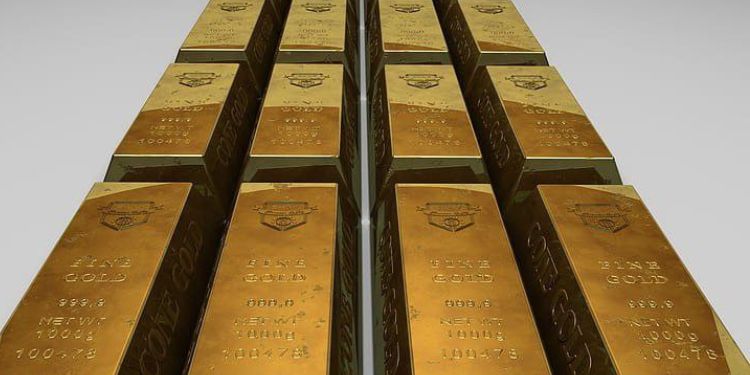
Building on this momentum, the 2025 fiscal year concluded with gold export receipts reaching a staggering leap compared to previous periods, as the average price per fine ounce remained at historic levels.
These developments provided the necessary liquidity to bolster the Ghana Accelerated National Reserve Accumulation Policy (2026-2028), a strategic framework designed to utilize gold as “the most reliable and immediate instrument” for increasing national wealth.
By leveraging these “elevated and favourable” medium-term price projections, the government is moving to consolidate its reserve-management framework, ensuring that the current price cycle translates into long-term financial stability without the traditional reliance on increasing public debt.
Strategic Buffer Accumulation and Currency Stability

The impact of these reserves on the Ghanaian economy has been transformative, providing a “solid foundation” for the cedi’s relative stability.
By the close of 2025, Ghana’s Gross International Reserves (GIR) climbed significantly, representing a healthier margin of import cover than in previous years.
This “robust reserve accumulation” has allowed the Bank of Ghana to manage exchange rate volatility more effectively, contributing to a notable appreciation of the cedi against the US dollar.
These external buffers have acted as a crucial insurance policy, reducing the country’s “vulnerability to external shocks” and providing the central bank with the firepower needed to maintain a market-driven exchange rate without the need for frequent, costly interventions.
Formalization of the Artisanal Sector (GoldBod)

A critical component of this revenue windfall has been the formalization of the artisanal and small-scale mining (ASM) sector through the Ghana Gold Board (GoldBod).
In 2025, the state moved to “harness the momentum” of high prices by centralizing gold buying and curbing smuggling, ensuring a greater portion of gold-based inflows were channeled into the formal economy.
This policy shift reinforced the “resilience and persistence” of the current growth trajectory.
By acting as the sole aggregator, GoldBod has not only improved traceability but has also ensured that the benefits of the global price rally are captured directly by the national treasury, further strengthening the state’s reserve-management framework.
Long-term Fiscal Resilience and Debt Management

Looking ahead, the sustained elevation of gold prices offers a unique “runway” for the government to stabilize its debt-to-GDP ratio, which saw a decline by late 2025.
The surplus generated from gold exports has provided the fiscal headroom necessary to fund national development without the “distortions” of high-interest external borrowing.
As Hon. Ato Forson presented the 2026-2028 accumulation policy, it became clear that the government views gold as a “strategic pillar.”
This approach ensures that even if other commodities face price softening, the gold sector remains a “robust and resilient” engine capable of withstanding future global volatility while supporting sustainable, non-debt-creating growth.
READ ALSO: bán Accuses Ukraine of Targeting Hungary’s Energy System