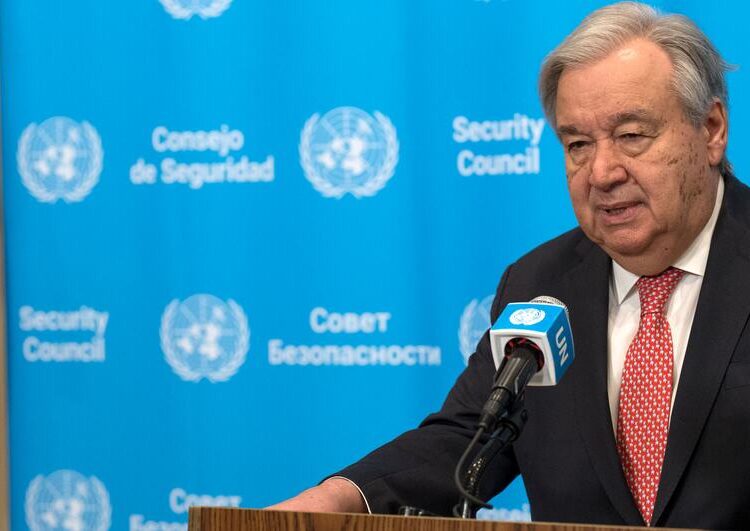
United Nations Secretary-General, António Guterres has cast a glaring spotlight on the massive imbalance in international climate finance by criticizing the global community’s failure to invest adequately in Africa’s green transition despite its unparalleled renewable capacity.
This sharp critique highlights a persistent institutional bias where capital flows continue to favor developed markets over the regions where the structural need and economic potential are greatest.
By raising these critical questions, the global body is forcing international financiers and policymakers to confront an uncomfortably inequitable distribution of resources that risks leaving an entire continent behind.
“Africa has extraordinary potential to become a major player in the clean energy future. current investment patterns do not reflect the continent’s resource endowment or strategic importance to the energy transition.”
United Nations Secretary-General, António Guterres
Addressing delegates at the London Climate Action Week, the UN chief underscored a troubling financial discrepancy that threatens to undermine collective global climate goals.
He drew a sharp line between Africa’s deep wealth in raw transition materials and its ongoing economic marginalization, framing this dynamic as a striking contradiction at the heart of the global energy transition.

This systemic investment deficit leaves vast green energy projects stalled, creating a developmental roadblock on a continent simultaneously struggling with deep domestic energy shortages and rapid population expansion.
The Mechanics of the Clean Energy Paradox
The core of the issue lies in raw empirical data that outlines a stark geographic mismatch.
The African continent possesses an astonishing 60 percent of the world’s premier solar resources alongside nearly 30 percent of the critical mineral reserves required globally to power low-carbon technologies.
Yet, despite holding many of the key ingredients required for the energy transition, the continent attracts a mere 2 percent of worldwide clean energy investment flows.

This staggering misalignment reveals that the financial architecture governing global decarbonization is fundamentally decoupled from physical resource distribution.
The disparity represents not only a development challenge for Africa but also a missed opportunity for the global economy. Investors are locking capital into mature Western and
Asian markets, creating a lopsided allocation of capital that leaves the world’s most promising green frontier severely underfunded.
Unpacking Systemic Bottlenecks and Strategic Deficits
To understand why this imbalance persists, energy bloggers and market analysts look closely at the structural barriers that deter global asset managers from deploying capital into African jurisdictions.
Chief among these is the inflated perception of country risk, which leads to prohibitive costs of capital that make otherwise viable utilities financially unsustainable.
Foreign exchange fluctuations, localized political uncertainties, and a historical lack of standardized regulatory frameworks across sovereign borders further compound investor hesitation.

Consequently, international developers demand steep risk premiums, which drives up interest rates on loans for infrastructure projects.
This dynamic means that even when a project boasts superior solar irradiance or immediate proximity to essential transition minerals, the upfront financing hurdles prevent it from ever breaking ground.
The global financial system effectively penalizes African nations with sovereign credit downgrades and elevated borrowing rates, locking them out of standard commercial debt markets.
Bridging the Investment Gap: A Blueprint for Capital Realignment
Overcoming this structural bias requires a coordinated, multi-tiered overhaul of both international finance structures and domestic policy frameworks.
First, multilateral development banks must scale up their operations by utilizing first-loss guarantees, blended finance instruments, and comprehensive currency hedging facilities to dramatically lower the risk profile for private institutional asset managers.
By absorbing initial political and economic shocks, public international capital can de-risk regional infrastructure and catalyze secondary private sector investment flows.
Concurrently, regional governments across the continent must implement predictable, transparent energy regulations, such as clear feed-in tariffs and legally protected power purchase agreements, to build long-term corporate confidence.
Furthermore, expanding localized refining and industrial processing of critical minerals rather than exporting raw ores can retain substantial economic value within African borders.
By building a robust internal value chain, African nations can transform their raw materials into high-value manufacturing hubs, naturally pulling in equity from international corporations seeking secure supply chains.
Only through these concerted macro-economic reforms can the global energy economy transform Africa from an underfunded frontier into a central engine for global clean energy generation.
READ ALSO: IOC Unveils New Roadmap for Selection of 2036 Olympic Host