
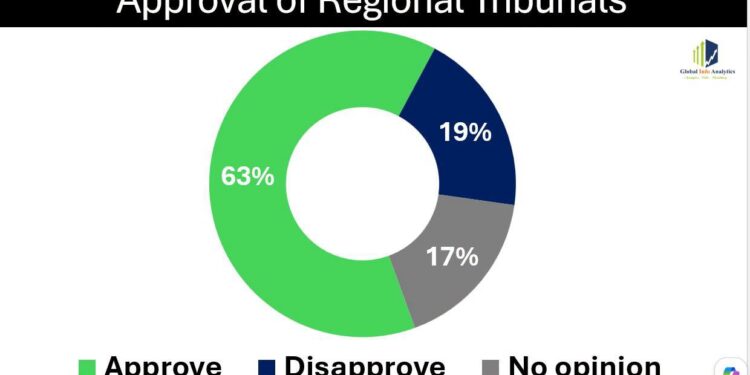
A new telephone poll conducted by Global InfoAnalytics has found that 63 percent of Ghanaian voters approve of the decision to establish public tribunals, while 19 percent disapprove and 17 percent hold no opinion on the matter. Executive Director Musa Dankwa released the findings, which come weeks after Parliament passed the Tribunals Bill, 2026, amid intense political controversy.
According to Mr Dankwa, the special telephone poll surveyed voters between July 15 and July 24, 2026, capturing public sentiment in the immediate aftermath of the bill’s passage through Parliament. “The Special telephone poll of voters carried out between 15th and 24th July 2026 shows majority of voters approve of Tribunals,” he said.
The poll found that approval for the tribunals runs particularly high among specific voter segments, with clear majorities recorded across several key groups. “The poll shows clear majority among NDC voters, floating voters and other political party supporters,” Mr Dankwa said.
However, the survey revealed a more divided picture among supporters of the opposition NPP and those unwilling to disclose their political affiliation, where support existed but fell short of an outright majority.

Regional Breakdown Shows Ashanti Backing, Bono and Ahafo Divided
Mussa Dankwa’s findings also broke down support by region, revealing that the Ashanti Region recorded the majority backing for the tribunals, while two other regions showed more mixed results. “In Ashanti, the majority of voters support the tribunal. Only Ahafo and Bono region do not have a clear majority support, but plurality do support the tribunals,” he said.
The survey results follow the passage of the Tribunals Bill, 2026, which Ghana’s Parliament officially approved on July 17, 2026, after intense legislative debate that ultimately ended in a walkout by the Minority Caucus.
The legislation was introduced to activate previously dormant provisions under Articles 126 and 142 of the 1992 Constitution, establishing a modern two-tier public tribunal system designed to operate alongside Ghana’s traditional courts.
According to background details on the legislation, the bill aims to address a chronic case backlog within the judiciary while expediting the delivery of justice across the country.
A Two-Tier Structure With Distinct Jurisdictions
The legislation restructures public specialised courts into a clearly defined two-tier configuration. Regional Tribunals, operating at the High Court level, will handle complex criminal matters including narcotics, fraud, illegal mining and tax offences.
District Tribunals, functioning concurrently with Circuit Courts, will manage lesser criminal cases, though treason and capital offences remain explicitly excluded from their jurisdiction.
A Tribunal Oversight Committee has also been established alongside the Judicial Council to handle administration, guidelines and supervision across both tiers of the new system.
Under the new framework, every tribunal will feature legally qualified chairpersons sitting alongside citizen panel members, creating a hybrid governance structure for these specialised courts.
The President will appoint tribunal chairpersons based on advice from the Judicial Council, while the Chief Justice will appoint the citizen panel members serving alongside them.

The legislation preserves constitutional due process protections by ensuring that every tribunal ruling remains subject to appellate review, addressing concerns about unchecked judicial authority within the new system.
The bill’s passage triggered significant political division within Parliament, with the Minority Caucus staging a walkout after their proposal to delete Clause 4, which permits non-lawyers to sit on tribunal panels handling criminal matters, was defeated by a vote of 135 to 16.
Critics and Organised Labour have raised concerns that the new tribunal system echoes the parallel court structures established during Ghana’s PNDC era in the 1980s, which became associated with severe human rights abuses during that period.
The former Vice President and the New Patriotic Party’s 2028 flagbearer, Dr Mahama Bawumia, has even called on President Mahama not to sign the bill into law until broader consultation with all relevant stakeholders
In response, the Majority Caucus and the Attorney-General have emphasised that the current system operates strictly within the constitutional judiciary, incorporating robust legal safeguards absent from the earlier PNDC-era tribunals.
Bill Now Awaits Presidential Assent
With Parliament’s approval secured, the Tribunals Bill has been forwarded to the executive branch and now awaits presidential assent before it can be formally written into law. This step remains a critical procedural requirement under Ghana’s constitutional framework before the legislation takes full legal effect.
The Global InfoAnalytics findings offer an early indication of how Ghanaian voters have received the tribunal legislation, revealing broad public support despite the sharp political divisions that characterised the bill’s passage through Parliament.

The regional and demographic breakdown suggests that support for the tribunals extends beyond strict party lines, with even NPP-affiliated voters showing plurality backing despite their party’s formal opposition to the bill during parliamentary proceedings.
As the bill awaits presidential assent, these poll findings may factor into broader public discourse around the tribunal system’s legitimacy, particularly as government continues to defend the legislation against comparisons to Ghana’s historically controversial PNDC-era tribunal courts.
READ ALSO: Andy Burnham Must Restore Stability to Britain – Prof. Catherine Ellis