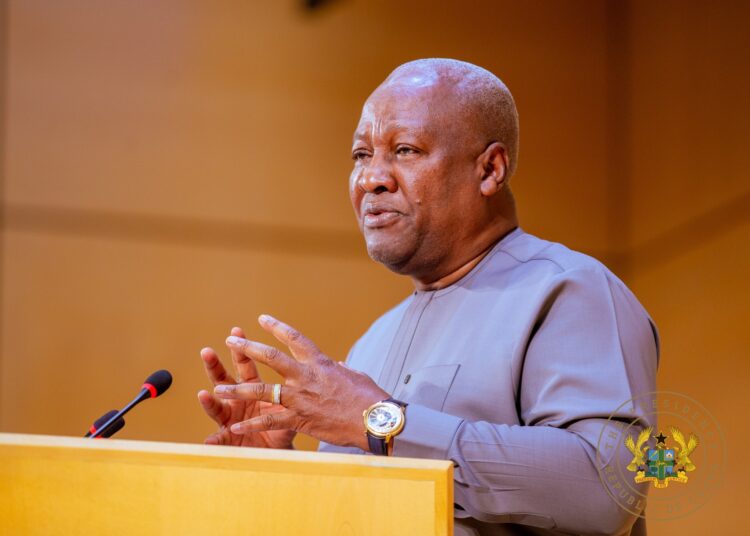
President John Dramani Mahama has told the boards and chief executives of Ghana’s state institutions that their failure to meet basic reporting obligations is unacceptable, singling out audited accounts, performance contracts, quarterly reports and annual general meetings.
He delivered the rebuke at the SIGA Governing Boards and CEOs’ Conference in Accra on Thursday. The President rejected any suggestion that these obligations amount to bureaucratic ritual, describing them instead as the basic instruments through which ownership, oversight and accountability actually operate.
His concern is that entities which skip them leave government blind to risk until it has already landed on the public purse, a danger the report’s balance sheet figures make concrete.
The scale of the exposure
State-owned enterprises held aggregate assets of GH¢407.85 billion at the end of 2025 against liabilities of approximately GH¢282 billion. Majority joint venture companies held GH¢96.69 billion in assets against GH¢82.7 billion in liabilities.

The category of other state entities tells a different story. Those institutions held assets of roughly GH¢341.6 billion against liabilities of GH¢382.75 billion, leaving them more than GH¢141 billion in the red. Combined with their aggregate deficit of GH¢10.48 billion for the year, Mahama said the position requires immediate intervention rather than monitoring.
One indicator moved the other way sharply. Recoverable irregularities identified in the Auditor-General’s report fell from GH¢15.57 billion in 2024 to GH¢2.24 billion in 2025, a reduction the President called remarkable.
Where the reporting improved
The 2025 State Ownership Report covers 162 of the 175 entities on the Cabinet-approved State Equity Portfolio, coverage of about 89 percent, comprising 53 state-owned enterprises, 36 joint ventures and 73 other state entities.
Of the 162 financial reports analysed, 108 rested on audited financial statements, amounting to 66.67 percent and the highest proportion ever used in a state ownership report. That represents a substantial advance on the 53 audited statements available for the 2024 edition.
The corresponding reliance on management or draft accounts fell from 99 entities in 2024 to 54 in 2025. President Mahama credited the shift to clear presidential direction, sustained engagement by SIGA and greater attention from boards and management, while refusing to treat it as an arrival.

Where compliance still fails
The President then listed the gaps. Only 61 entities submitted audited financial statements by the statutory deadline of 30 April, leaving a significant number filing late or still working from draft accounts.
Of the 148 entities expected to sign performance contracts, 72 did so, and 71 submitted quarterly reports. Just 37 of the 177 entities expected to hold annual general meetings or annual stakeholder meetings complied.
Employment data submissions moved backwards, falling from 142 entities in 2024 to 137 in 2025. “These compliance gaps are unacceptable,” President Mahama told the conference.
He rejected any framing of these obligations as bureaucratic ritual. Audited accounts, performance contracts, quarterly reports and annual general meetings are the basic instruments through which ownership, oversight and accountability actually operate, and an entity that skips them has removed itself from the system that holds it to account.

Consequences attached
President Mahama set out what he expects from here. Every entity required to produce externally audited financial statements must do so on time.
Performance contracts must be fully executed, quarterly reporting must be timely, annual general meetings and stakeholder engagements must be held regularly, and all material financial and operational risks must be disclosed completely.
He warned that audit findings must trigger swift corrective action, with boards tracking resolution, assigning responsibility and preventing recurrence. Repeated infractions, he said, will be treated as evidence of governance failure and must carry consequences.
The President asked SIGA to strengthen monitoring, publish clear performance assessments, recognise strong performers and report persistent non-compliance promptly to the Presidency and relevant appointing authorities.
He then attached a personal consequence for those who obstruct that process, saying any board or chief executive who persistently places an entity beyond lawful oversight demonstrates an unwillingness to account for public assets, and that such conduct will weigh decisively in decisions about their continued tenure.
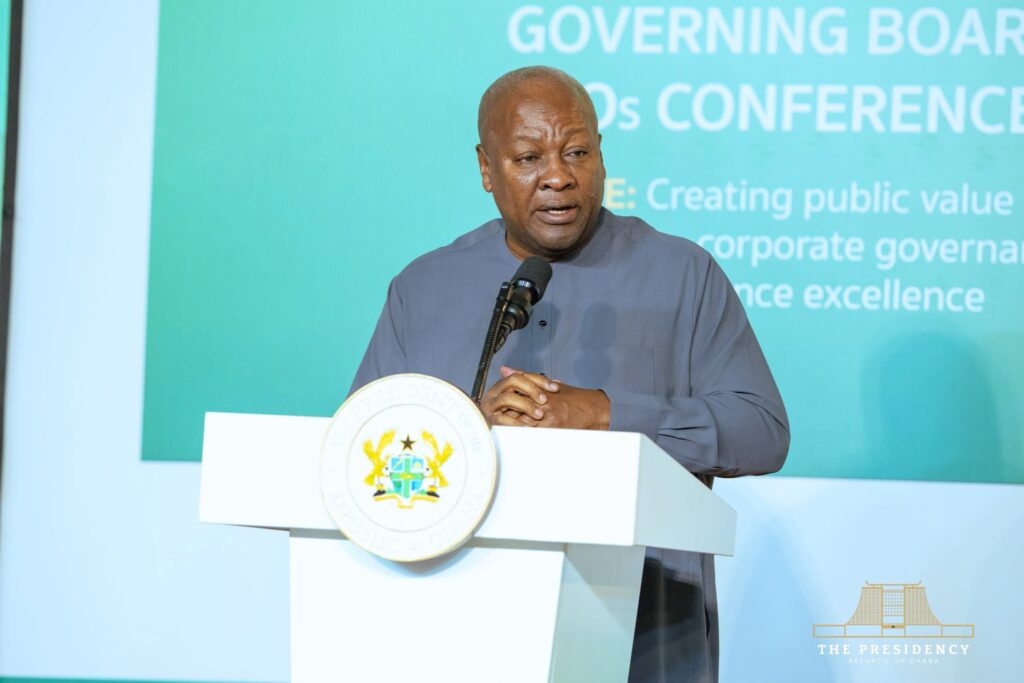
President Mahama also directed each board to agree with management, within the next reporting cycle, on a limited set of measurable priorities spanning financial performance, service delivery, governance, risk, audits, compliance and contributions to national development, with SIGA tracking them and making performance visible.
The logic running through it is simple enough to state and harder to satisfy. An institution that cannot substantiate its financial position with audited figures cannot credibly claim to be creating value, whatever its leadership says about the work it does.
READ ALSO: Fitch Upgrades Ghana Banks as Credit Profiles Stage Major Recovery