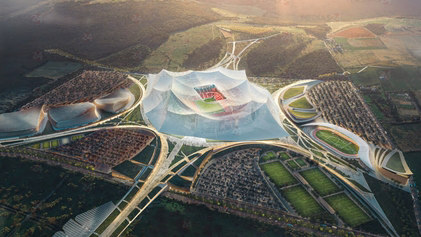
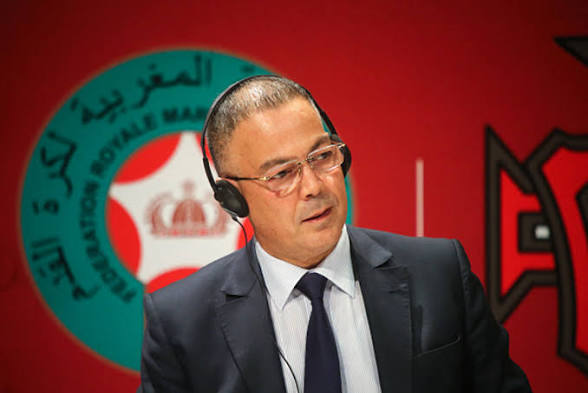
Morocco has stepped up its claim to host the 2030 FIFA World Cup final after Royal Moroccan Football Federation president Fouzi Lekjaa declared that the showpiece will be staged at the planned Hassan II Stadium in Benslimane, near Casablanca.
Lekjaa made the claim during an electoral campaign event for Morocco’s Authenticity and Modernity Party in Bouznika on Thursday.
His statement has reignited the heightened contest between Morocco and Spain over the location of the tournament’s biggest match. “The province of Benslimane, in the Casablanca region where the stadium is being built, is the one that will have the honour of organising the 2030 World Cup final,” Lekjaa said.
His declaration suggests Morocco believes it has secured the coveted fixture, although FIFA has made it clear that no official decision has been taken. The world governing body reiterated that the venue for the final “will be decided in due course.”
That position directly contradicts the certainty expressed by Lekjaa and means the race remains open, with Spain continuing to push for the final to be played at one of its major stadiums, most notably the Santiago Bernabéu in Madrid.
Spanish Football Federation president Rafael Louzán has previously argued that Spain should host the final.
The 2030 World Cup will be jointly hosted by Morocco, Spain and Portugal, with Argentina, Paraguay and Uruguay staging one centenary celebration match each. FIFA appointed the three main hosts at its Extraordinary Congress in December 2024.
Hassan II Stadium strengthens Morocco’s case
Morocco’s confidence is closely linked to the ambitious Hassan II Stadium project in Benslimane, about 60 kilometres from Casablanca.
The venue is planned to hold approximately 115,000 spectators and is expected to become the world’s largest football-specific stadium once completed.

The proposed stadium is therefore being positioned as a natural stage for the world’s biggest football match. Its scale would give Morocco a powerful argument against Madrid, whose renovated Santiago Bernabéu remains one of the strongest alternatives.
However, Lekjaa’s announcement should not be interpreted as FIFA confirmation. In August, FIFA rejected reports that president Gianni Infantino had already promised Morocco the final, describing such claims as “false and misleading” and saying the decision would be made at the appropriate time.
Morocco’s recent record as a major football host nevertheless again strengthens its credentials. The country hosted the 2025 Africa Cup of Nations and the 2026 Women’s Africa Cup of Nations, with FIFA president Infantino describing the latter as a “huge, huge success” after Cameroon defeated Malawi in the final in Rabat.
The country is also preparing to host the FIFA U-17 Women’s World Cup later this year, with the 24-team tournament scheduled for October 17 to November 7.
Morocco has been awarded hosting rights for the women’s U-17 World Cup through 2029, giving it sustained experience in staging FIFA competitions.
Spain-Morocco Battle Enters Decisive Phase
If Morocco eventually wins the contest, it would represent another landmark moment for African football. The 2030 tournament will make Morocco only the second African country to host a men’s FIFA World Cup after South Africa staged the 2010 edition.
Spain, meanwhile, has a compelling case of its own. The Bernabéu is one of the world’s most iconic football venues and has undergone extensive redevelopment, while Spain also possesses the infrastructure and tournament experience expected of a World Cup host.

The final decision ultimately belongs to FIFA, not either of the competing football associations. FIFA’s current position means Lekjaa’s statement is a declaration of confidence rather than an official confirmation.
For now, however, Morocco has put itself firmly at the centre of the conversation. If Lekjaa’s prediction proves correct, the Hassan II Stadium could become the stage for the defining match of the 2030 World Cup and give Africa its second opportunity to host a FIFA World Cup final.
READ ALSO: No State Enterprise Can Set Pay Outside the National Framework, Mahama Declares