
The Ghana Free Zones Authority (GFZA) has doubled down on its commitment to export-led industrialization, with the Authority’s leadership conducting a high-stakes performance audit of Ghana’s emerging manufacturing hub in Afienya.
This comes after the Chief Executive Officer of the GFZA, Dr. Mary Awusi, led a multi-disciplinary management team to the Bright Industrial Park to assess the operational health of three critical enterprises that are reshaping Ghana’s trade balance with the West.
“The visit comes at a pivotal moment for the Authority, as it seeks to move beyond mere licensing toward active ‘aftercare’ and operational troubleshooting.
“Accompanied by directors of Compliance, Monitoring, and Estate Management, Dr. Awusi’s tour provided a rare glimpse into the factories that are currently fueling Ghana’s manufacturing resurgence in the renewable energy and garment sectors”
GFZA
According to the Authority, the first stop on the CEO’s itinerary was Zema New Energy Ghana Limited, a facility that represents a historic milestone for the country’s industrial landscape. As Ghana’s first high-efficiency photovoltaic cell factory, Zema specializes in monocrystalline TOPCon solar cells.

GFZA noted that this was not merely an assembly plant but a high-tech manufacturing node that positions Ghana as a contributor to the global green energy supply chain. After just one year of operation, the facility has already scaled its workforce to over 300 employees.
However, the true scale of the company’s ambition was revealed during discussions with management, who confirmed that the factory is preparing to move to a 24-hour production schedule as it approaches full capacity – “contributing significantly to renewable energy advancement and industrial growth.”
Afienya’s 100% Export Mandate
The delegation then turned its attention to the apparel sector, visiting Jiudine Ghana Corporation Ltd. and Qian Feng International Corporation Ltd.
Both companies serve as prime examples of the “Free Zones success story,” operating on a model that sees 100% of their production exported to high-value markets in the United States and Europe.
Jiudine Ghana, a garment manufacturer with a 450-strong workforce, has become a vital link in the global fashion supply chain, producing ready-made garments that meet the stringent quality standards of Western retailers.

“The CEO’s engagement with Jiudine focused on how the Authority can further support workforce development to ensure that Ghanaian labor remains competitive on the global stage. Discussions also focused on production capacity, export performance, and the company’s contribution to job creation within the enclave”
GFZA
The scale of operations intensified at Qian Feng International, a leading cap manufacturer. With 900 employees already on the payroll, the company is currently the heavyweight of the Bright Industrial Park. Their expansion plans are among the most aggressive in the sector, with a target to nearly quadruple their workforce to 3,500 employees by 2028.
“Management highlighted their manufacturing processes, quality control systems, and expansion plans aimed at increasing exports and strengthening competitiveness in global markets”
GFZA
While the tone of the visit was largely celebratory, Dr. Mary Awusi was clear that the Authority’s support is contingent upon professional discipline. Throughout the tour, the CEO emphasized that the generous incentives provided under the Free Zones regime – including tax holidays and duty-free imports – must be matched by a total commitment to the Authority’s regulatory framework.
By involving the heads of Monitoring and Compliance in the visit, Dr. Awusi signaled that the GFZA is shifting toward a more hands-on oversight model.
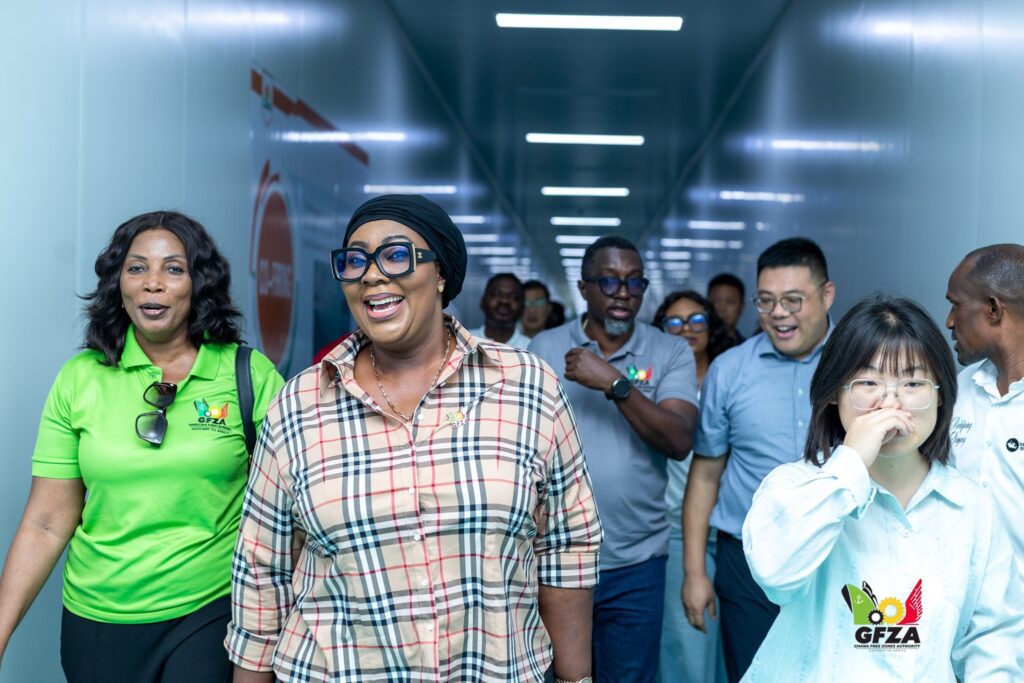
The visit concluded with a commitment to address the operational “bottlenecks” identified by the factory managers, ensuring that the Afienya enclave remains a friction-less gateway for international trade.
READ ALSO: Republic Bank Hits GH¢287.9m Profit