Author: Kay Codjoe, Market Research Consultant and Volunteer Associate at the IMANI Centre for Policy and Education
From 70% in opposition to 86.65% in power, the debate over cocoa pricing has become emotional when it should be mathematical. The dominant claim is that the government promised GHS 6,000 per bag, won power on that basis, and now pays GHS 2,587. Therefore, betrayal.
That argument omits the formula behind the promise. The commitment was 70 percent of the world market price. The GHS 6,000 figure emerged when cocoa was trading near US$7,200 per metric tonne during an unprecedented price spike. Seventy percent of that peak, converted at the exchange rate at the time, produced the headline number.
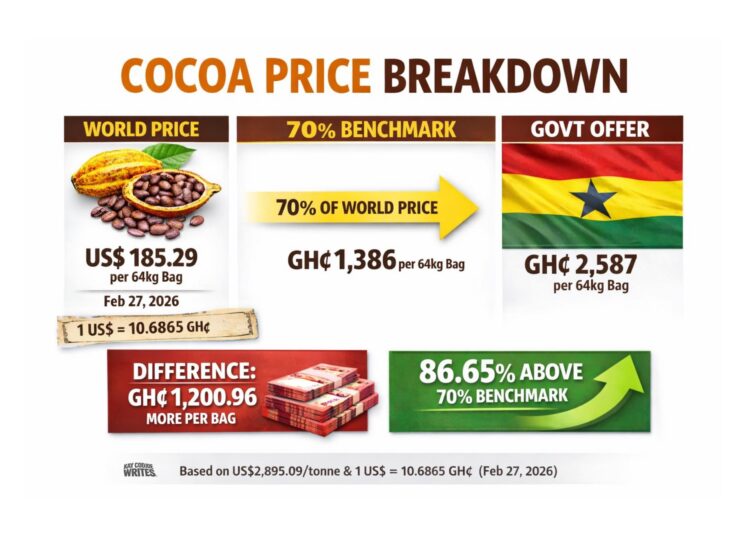
Markets changed. As shown clearly in the attached breakdown, the benchmark world cocoa price as of February 27, 2026 is US$2,895.09 per metric tonne. At 64kg per bag, there are 15.625 bags in a tonne.
US$2,895.09 divided by 15.625 equals US$185.29 per 64kg bag. Now apply the campaign formula: Seventy percent of US$185.29 equals US$129.70 per bag. Using the Bank of Ghana interbank mid rate of 10.6865 cedis to the dollar on the same date, US$129.70 converts to approximately GH¢1,386 per bag.
That is what 70 percent of today’s world market price produces under transparent inputs. The current government farm gate price is GH¢2,587 per bag. The difference is GH¢1,200.96 higher than the 70 percent benchmark. In percentage terms, GH¢2,587 is 86.65 percent above the strict 70 percent-of-market calculation under current prices.
Critics argue that trust was broken because farmers heard 6,000 and expected continuity. That concern deserves acknowledgement. Farmers plan around price signals. They borrow, invest, and vote based on them. However, price formulas tied to world markets cannot remain fixed when global prices fall by more than half.
COCOBOD operates within financial constraints. It carries debt obligations and forward sales commitments. Maintaining a farm gate price tied to peak global prices while the market declines risks severe liquidity stress, unsold stock, and further borrowing.
The comparison with Ivory Coast is instructive. They set a high guaranteed price. When global prices declined, exporters resisted buying. The state intervened with substantial subsidies to sustain the guarantee.
Officials later acknowledged the approach was unsustainable, and prices were eventually adjusted downward. That episode illustrates the limits of maintaining elevated guarantees when markets shift.
If the promise was 70 percent of the world price, then the standard is clear: apply that formula to today’s market conditions, not to a temporary peak.
Locking in a boom-era figure and branding every market-driven adjustment as “cheating farmers” may excite partisan ignorance, but cocoa does not trade on miracle tears or parliamentary choirs.
Trust matters. So does solvency. If the government is paying above the benchmark despite falling global prices, this is no longer about betrayal but sustainability.
The real question is whether the system can maintain that premium without strain. Markets move, and promises tied to markets must move with them; commodity markets answer to numbers, not outrage.
READ ALSO: President Mahama Defends Cocoa Price Reforms in 2026 SONA