
The Ghana Investment Promotion Centre (GIPC) has reinforced Ghana’s status as the primary gateway for Asian capital entering West Africa in a high-level briefing, where the Deputy Chief Executive Officer of the GIPC, Mr. Abdul Razak Baba, hosted a multi-sectoral Indian business delegation to align on new investment frontiers.
According to the GIPC, this engagement, held in Accra, comes at a pivotal moment as Ghana aggressively pursues its “Industrial Reset,” shifting focus from the mere importation of finished goods to the localized manufacturing of industrial and consumer products.
“The Indian delegation, which included heavyweights from the Manufacturing, Agriculture, Infrastructure, Renewable Energy, and Fast-Moving Consumer Goods (FMCG) sectors, arrived in the capital seeking more than just trade deals.
“Their mission is to explore deep-seated partnerships, joint ventures, and technology transfers that could redefine Ghana’s industrial landscape for the next decade”
Ghana Investment Promotion Centre
Mr. Abdul Razak Baba opened the session by underlining the GIPC’s evolved role – transitioning from a mere registration body to a proactive facilitator of “credible partnerships,” and provider of investor support in 2026.
He briefed the delegation on the legislative and regulatory frameworks that protect foreign interests, including the streamlined processes for company registration and licensing that have been digitized to reduce human interference and corruption. He also highlighted “Ghana’s priority sectors, regulatory requirements, and after-care services.”

A central theme of the Deputy Chief Executive Officer’s address was Ghana’s geographic and political advantage.
He urged the Indian industrialists to look beyond Ghana’s borders and view the country as the logistical headquarters for the 400-million-strong ECOWAS market and the 1.3 billion consumers accessible under the African Continental Free Trade Area (AfCFTA).
For Indian firms, setting up a factory in Ghana is no longer just about the Ghanaian consumer; it is about duty-free access to the entire African continent.
Incentivizing Innovation
GIPC noted how the discussion delved deep into the specific fiscal and non-fiscal incentives available to Indian firms, particularly those entering the Renewable Energy and Smart Infrastructure spaces.
With Ghana’s commitment to a green energy transition by 2030, the Centre mentioned its enhanced tax holidays and capital allowance incentives for firms that bring in energy-efficient technologies and solar assembly plants.
The Indian delegates expressed a strong appetite for Joint Ventures, specifically in the area of Agri-Tech. As Ghana rolls out its Farmer Service Centres and moves toward large-scale irrigation in the North, the need for Indian expertise in low-cost, high-efficiency farm machinery and smart irrigation systems has never been higher.
The delegation further explained how technology partnerships can be expected to bring innovations that reduce post-harvest losses and improve crop yields for both smallholders and commercial estates. They expressed interest in distributorships as well as local manufacturing, to evolve smart infrastructure, energy efficiency, and agri-tech in Ghana.

However, the GIPC observed that the most reassuring part of the briefing for the Indian investors was the emphasis on “After-Care Services.” The GIPC has recognized that the biggest hurdle for foreign investors is often the “post-investment” phase – navigating local bureaucracies, customs challenges, and utility connections.
Mr. Baba assured the delegation that the Centre would provide a dedicated support system to ensure that “once a factory is built, it stays operational and profitable.”
By offering a skilled workforce and a stable democratic environment, he positioned Ghana as the most de-risked environment for Indian capital in West Africa. The Deputy Chief Executive Officer encouraged the firms to leverage this stability to build long-term sustainable businesses that contribute to the country’s digitalization and industrialization goals.
The Ghana-India Relationship
As the meeting concluded, it was clear that the relationship between the two nations is shifting toward a “Production-First” model.
According to the Ghana Investment Promotion Centre, the cross-sector proposals brought forward by the Indian delegation – ranging from renewable energy grids to FMCG processing plants – offer a roadmap for sustainable investment that moves away from the volatile commodity trade.
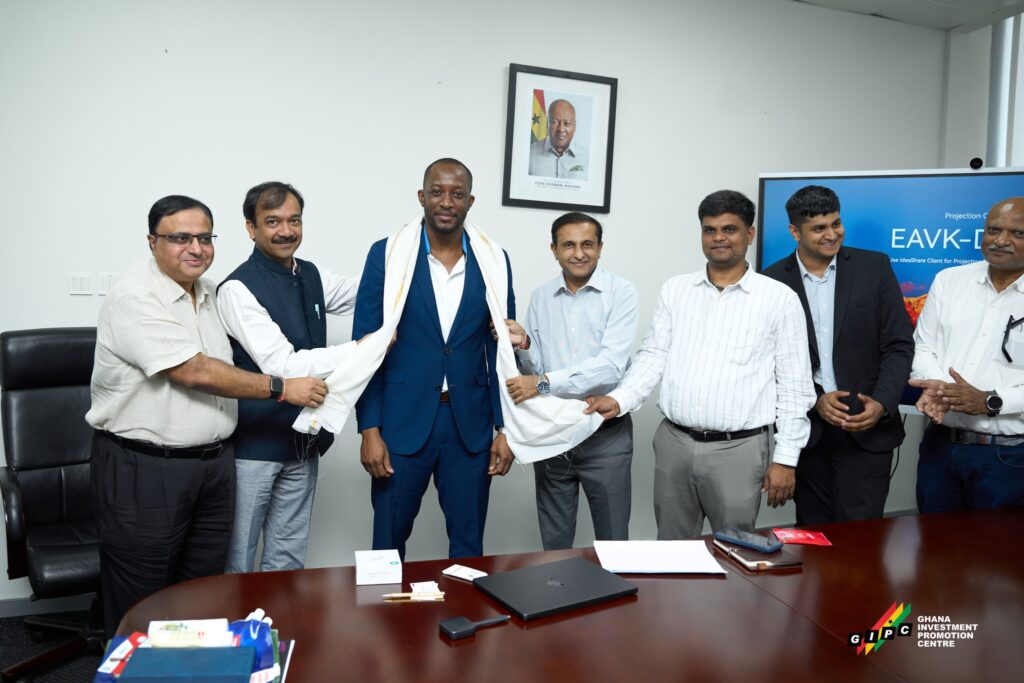
However, the GIPC was firm on the need for these proposals to align with local content requirements and partners, incentive frameworks, and national development goals. Mr. Baba reiterated that the acceleration of Ghana’s industrialization depends on these foreign partnerships being integrated with indigenous suppliers and domestic talent.
As these proposals move toward formalization, the GIPC stands ready to act as the bridge between Indian innovation and Ghanaian opportunity.