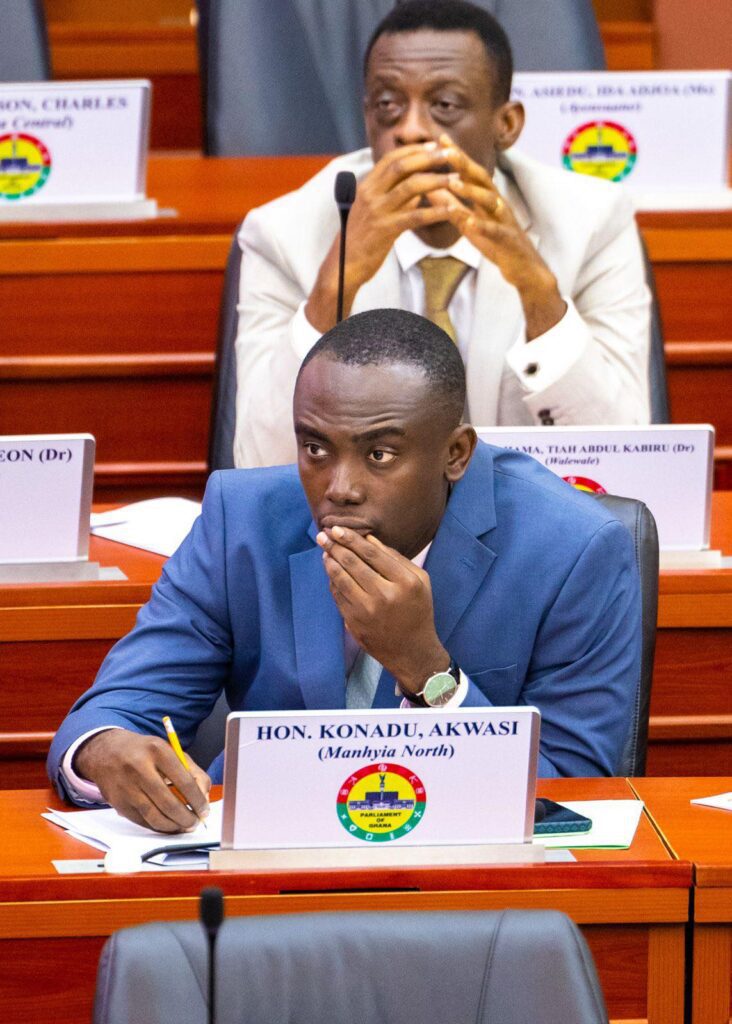
Hon. Akwasi Konadu, the Member of Parliament for Manhyia North and Deputy Ranking Member on the Lands and Natural Resources Committee, has sounded a clarion call regarding the harrowing results of the latest Fraser Institute Annual Survey of Mining Companies.
The report serves as a damning indictment of the current domestic extractive landscape, revealing that Ghana’s Investment Attractiveness Index plummeted from a score of 56.98 (46th out of 82) in 2024 to a concerning 55.21 (53rd out of 68) in 2025.
This downward trajectory is characterized not merely as a statistical fluctuation but as a signal of deeper structural and governance failures that threaten to erode the nation’s competitive edge in the global minerals market.
“These declining indices signal deeper structural and governance failures. The decline is due to the NDC government policy inconsistencies, a weak mining governance framework, and other factors. Uncertainty unsettles investors.”
Hon. Akwasi Konadu

The decline is multifaceted, touching upon both policy perception and the fundamental geological appeal that once made the nation a “Gold Coast” for investors.
According to the legislator, Policy Perception Index also witnessed a dip from 54.95 to 53.65, while the Mineral Potential Index traditionally a stronghold for the country slipped from 58.33 to 56.25 over the same period.
This erosion of confidence is attributed to a volatile mix of “NDC government policy inconsistencies” and a “weak mining governance framework” that has left international observers wary of the long-term security of their capital.
Policy Flip-Flopping and the Lithium Controversy

A primary catalyst for this reputational damage, according to Hon. Konadu, is the “lithium fiasco” which saw strategic mineral agreements become “political footballs” in the legislative house.
The lithium lease agreement, which was initially stymied in 2024 by nationalist rhetoric from the then-minority, was reintroduced in October 2025 with “altered fiscal terms and reduced projected benefits for Ghana.”
This cycle of parliamentary obstruction followed by renegotiation under pressure creates a perception that “agreements aren’t secure” and that “fiscal terms are politically negotiable rather than legally predictable.”
In the capital-intensive world of mining, stability clauses and regulatory transparency are non-negotiable requirements for entry.
When a government oscillates on strategic mineral agreements, capital naturally flows toward jurisdictions with “insulated rule of law” and “secure power.”
The MP warns that “Ghana’s mining regime is politically unstable and subject to opportunistic reversals,” a sentiment that is now reflected in the country’s lower standing on the global Policy Perception Index.
Security of Tenure and the Galamsey Crisis

Beyond the halls of Parliament, the “brazen takeover of concessions by galamsey operators” represents a physical threat to the industry’s viability. Licensed concession holders are increasingly facing “armed resistance in some districts” and “weak enforcement follow-through” from state agencies.
Hon. Konadu argued that when lawful concessionaires cannot protect their mineral rights due to “political interference in anti-galamsey operations,” the state effectively cedes its sovereign control over its most valuable resources.
This lack of security sends a “stark message to investors” that their legal rights are only as robust as the “government’s will to enforce them.”
The Fraser survey consistently highlights security of tenure as a core determinant of a country’s attractiveness. The current “rising lawlessness in the mining industry” suggests that without a decisive return to the rule of law, the country will continue to lose ground to regional competitors who offer a more disciplined and secure environment for large-scale extractive operations.
Impact on Ghana’s Mining Sector and Economic Future
The ramifications of this decline extend far beyond mere rankings; they signal a potential “capital flight” that could starve the sector of the exploration funds necessary to sustain production levels.
As investment shifts toward more predictable environments, the country risks losing its status as a premier African mining hub, leading to diminished tax revenues and job losses in mining-dependent communities.
The lack of “properly laid out policy on minerals” means that even as global demand for green minerals like lithium rises, Ghana may struggle to attract the high-quality partners needed to maximize the value of these resources.
Furthermore, the “weakening of the governance framework” discourages the integration of advanced technologies that could improve environmental standards.
If the current trend of “policy volatility” persists, the cost of doing business in Ghana will rise, making marginal projects unfeasible and leaving the state with a smaller share of a shrinking pie.
Hon. Konadu emphasizes that the only way to restore the nation’s luster is to insulate the mining regime from “partisan political advantage” and prioritize “predictability and the rule of law” as the foundational pillars of the industry.
READ ALSO: Government to Account for Last Minute Appointments Review