President John Dramani Mahama has initiated a landmark strategic alliance with United Arab Emirates (UAE) President, His Highness Sheikh Mohamed bin Zayed Al Nahyan, to overhaul Ghana’s energy infrastructure and bolster national energy security.
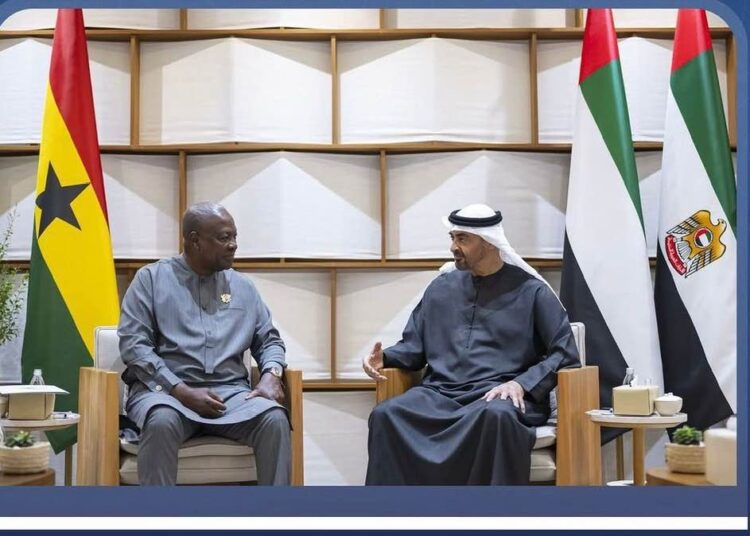
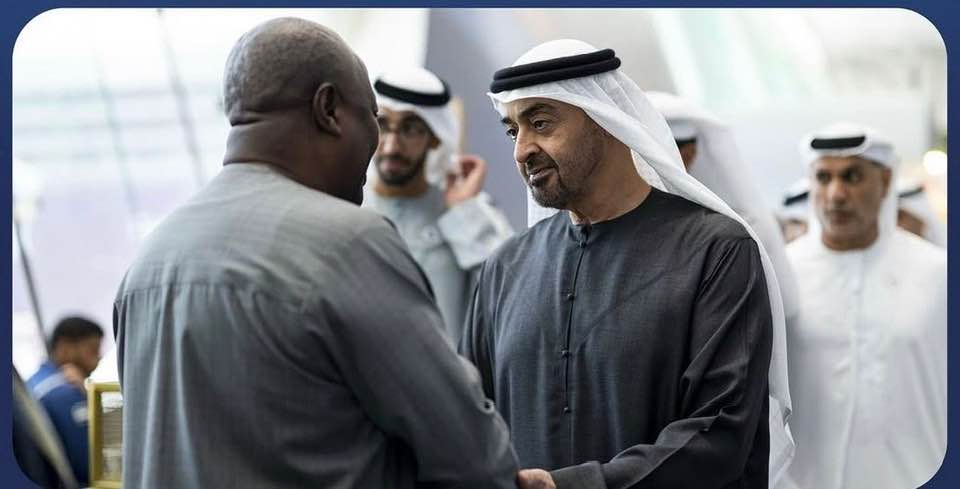
Meeting on the sidelines of the prestigious “Make it in the Emirates 2026” summit held at the Abu Dhabi National Exhibition Centre, the two leaders reached a consensus on the urgent need to deepen bilateral ties through large-scale capital investments and technical exchange.
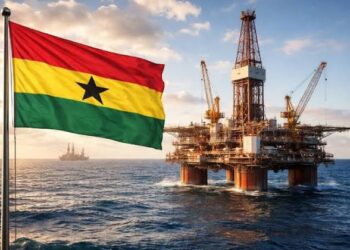
Central to these high-level discussions was a proposal for the UAE to finance and develop advanced oil and gas storage facilities within Ghana, a move intended to position the West African nation as a resilient hub for petroleum products in the sub-region.
“The leaders addressed the ongoing conflict in the Middle East and acknowledged the UAE’s difficult position as a buffer zone. Both expressed hope for a swift resolution to US-Iran hostilities and stated that restoring peace would let the global community refocus on sustainable development and innovation.”
Mrs Joyce Bawah Mogtari, Presidential Adviser and Special Aide
The bilateral engagement extended beyond immediate infrastructure, touching upon the complex geopolitical landscape of the Middle East and its impact on global energy markets.

Recognizing the UAE’s strategic yet challenging role as a “buffer zone” amid regional tensions, President Mahama expressed profound solidarity with Abu Dhabi while both leaders voiced their collective hope for a cessation of US-Iran hostilities.
They maintained that a shift toward peace is the primary prerequisite for the global community to pivot away from conflict management and toward the pursuit of sustainable development and technological innovation.
This diplomatic alignment underscores a shared vision where geopolitical stability serves as the foundation for economic prosperity and collaborative energy ventures.
Expanding the Frontier: Oil, Gas, and the Shift to LNG
The cornerstone of this renewed partnership lies in the modernization of Ghana’s midstream and downstream assets.
By inviting UAE investment into storage facilities, Ghana aims to mitigate the volatility of global crude prices and ensure a consistent domestic supply. However, the dialogue between Mahama and Al Nahyan transcended traditional fossil fuels.
A significant portion of their strategy involves “diversifying energy portfolios” to reduce the historical “over-reliance on crude oil.”
This involves a programmatic transition toward Liquefied Natural Gas (LNG), which serves as a cleaner bridge fuel for industrialization.
The integration of UAE’s sophisticated logistics and extraction technologies is expected to streamline Ghana’s gas-to-power value chain, providing cheaper and more reliable electricity for the manufacturing sector.
The Green Transition: Solar Power and AI Integration
In alignment with global climate goals, the two leaders emphasized a robust shift toward renewable energy sources, specifically solar power.
By leveraging the UAE’s status as a global leader in renewable capacity, Ghana seeks to harness utility-scale solar projects to de-carbonize its national grid.
This “green transition” is not merely about environmental stewardship but also about technological sovereignty.
The discussions highlighted a mutual interest in “innovation, technology, and artificial intelligence” to optimize energy distribution.

Utilizing AI to manage smart grids will allow Ghana to integrate intermittent solar power more efficiently, reducing waste and improving the overall reliability of the energy sector for both urban centers and rural communities.
Socio-Economic Impacts and Regional Stability
The UAE President’s description of Ghana as a “peaceful partner” and a “secure, stable democracy” reflects the high level of confidence Gulf investors have in the Ghanaian political climate.
This partnership is poised to enhance Ghana’s energy sector by creating thousands of highly skilled jobs in the renewable energy and tech-driven sectors.
Furthermore, the collaboration on trade and investment is expected to stimulate the broader economy, allowing for the “mutual growth” the leaders envisions.
As Ghana adopts the “Make it in the Emirates” philosophy of indigenous value addition, the energy sector will transition from an extractive-based model to an innovation-led powerhouse.
Ultimately, this alliance ensures that Ghana remains a “stable democracy” that is not only energy-secure but also a pioneer in the African green energy revolution.