The Republic of Congo is set to hold its presidential election on March 15, 2026.
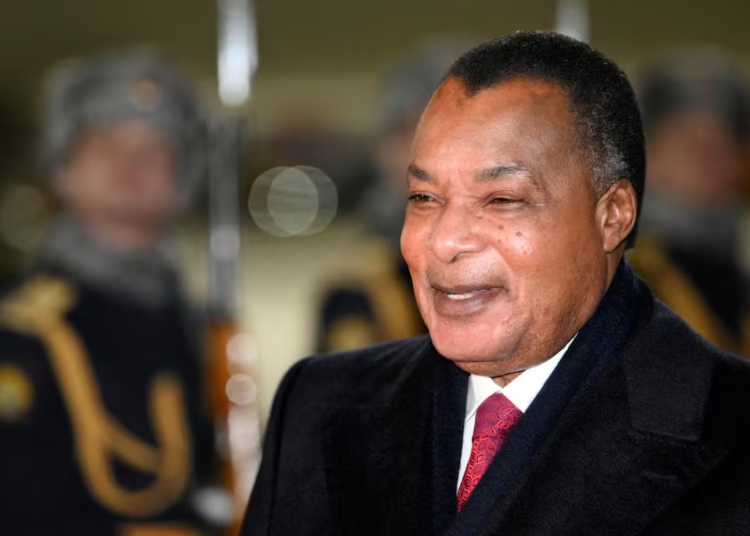
The election is expected to secure another term for and reaffirm the authority of incumbent President Denis Sassou Nguesso.
The Institute for Security Studies indicated in their recent findings that the outcome of the election is unlikely to change the country’s political trajectory.
“Elections in Congo-Brazzaville have followed a consistent pattern, featuring a first-round victory by the incumbent, a fragmented opposition and a crackdown on civic space and dissent.”
Institute for Security Studies
Since first assuming power in 1979 under a one-party system, Sassou Nguesso has maintained a firm grip on the nation’s political structures.
He returned to the presidency after the 1997 civil war and the constitutional reforms in 2015, most notably the removal of age limits and a reset of term limits, have enabled him to extend his rule. This includes successive electoral cycles in 2016 and 2021.
These reforms have drawn criticism from opposition figures and civil society alike, who argue they consolidate power in the upper echelons of the ruling Parti Congolais du Travail / Congolese Party of Labour (PCT) and weaken the prospects for competitive politics.
Election Dynamics and Political Landscape
The Republic of Congo, with its capital in Brazzaville, is a Central African nation covering about 342,000 square kilometres and home to roughly 5.5 million people.
Formerly a French colony known as French Congo, the country gained independence from France in 1960 and has since experienced a complex political history marked by periods of single-party rule, democratic transition, and civil conflict.
French remains the official language, reflecting its colonial legacy, while Lingala and Kituba, also widely spoken, serve as important languages of everyday communication.
Over the decades, the Republic of Congo has developed a political system heavily influenced by its oil-based economy and long-serving leadership, shaping its modern governance and national identity.
Incumbent President Denis Sassou Nguesso is expected to win again since the ruling Parti Congolais du Travail (PCT) holds an entrenched position. The absence of a cohesive opposition also plays a role.
Since 1979, Sassou Nguesso has been the dominant political force. After losing the multi-party election of 1992, he reclaimed power through civil conflict and has remained effectively unchallenged in subsequent polls.
Electoral cycles in the Republic of Congo have repeatedly delivered first-round victories for the incumbent, often with wide margins. For example, in 2002 and 2009, he received more than 85% and 78.6% of the vote, respectively.
These results were criticised by opposition parties and international observers as uncompetitive. Subsequent constitutional changes have only reinforced this dominance.
The 2015 amendments removed age limits for presidents and reset term counts. This has allowed Sassou Nguesso to extend his rule beyond what prior constitutional frameworks would have permitted.
Following the 2016 election, opposition leaders Michel Mokoko and André Okombi Salissa were arrested for “undermining internal state security.” In 2021, voters in some areas complained that their names were not on the electoral list.
Remadji Hoinathy of the Pretoria-based Institute for Security Studies think tank asserted that the upcoming election is “a mere formality.”
Congo’s Socio-Economic and Political Realities Ahead of the Elections
As the Republic of Congo prepares for the 2026 presidential election, President Denis Sassou Nguesso’s long tenure is seen as a source of stability, especially given the recent coups and unrest in neighboring countries.
President Sassou Nguesso has led the country for nearly 42 years, making him Africa’s third-longest-serving leader after Teodoro Obiang of Equatorial Guinea and Paul Biya of Cameroon.
Socially, the population continues to face significant hardship. More than half of the Congolese live below the poverty line. Youth unemployment stands at around 42%.
Nearly half of the population is under 18. These demographics present the urgent need for expanded economic opportunities, job creation, and investment in public services such as education, healthcare, and infrastructure.
While Sassou Nguesso’s campaign emphasises continuity and accelerated development in his slogan, “Let us accelerate the march”, many citizens report that the benefits of economic recovery have yet to reach ordinary households.
Despite this, Congo’s economy has shown signs of recovery from nearly a decade of stagnation. The stagnation was triggered by the global slump in oil prices.
Recently, modest per-capita growth has also returned, largely supported by crude oil revenues as oil continues to account for approximately half of the country’s GDP and the bulk of its exports.
READ ALSO: US Designates Afghanistan As State Sponsor Of Wrongful Detention