Author: Evans Junior Owu, Head of Political Desk, The Vaultz News
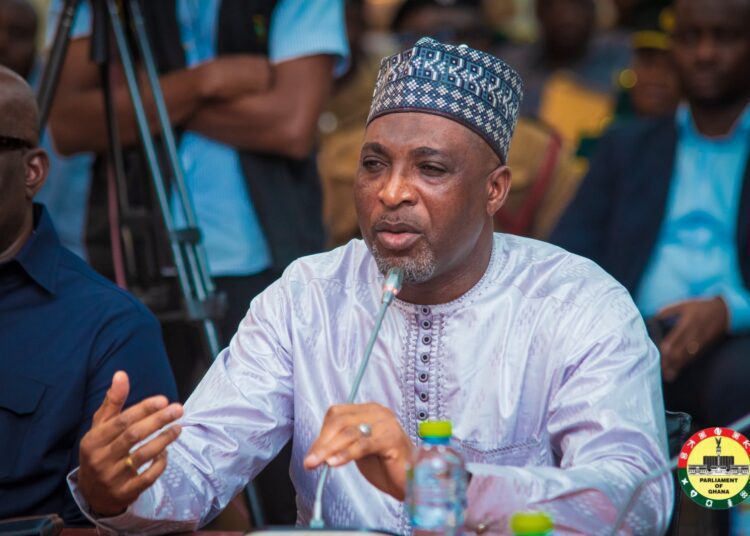
There are moments in public discourse when emotion rises above reflection, especially when the issue at stake touches the hopes of young people seeking opportunities to serve their nation. The recent debate surrounding the internal security recruitment exercise announced by Muntaka Mubarak Mohammed has become one of those moments.
Many young Ghanaians have expressed frustration that more than half a million applicants are competing for only five thousand available positions in the country’s security services. Their anger is understandable. Yet it risks being directed at the wrong target.
Within the governing National Democratic Congress, some voices have suggested that the Interior Minister should be blamed for the limited recruitment numbers. That would be a serious mistake.
Sacrificing a minister on the altar of the “Reset” narrative that the party sold to Ghanaians would neither solve the problem nor strengthen the credibility of the government. In truth, the Minister is simply managing the reality that the Ghanaian economy currently faces.
A basic principle in law captures this reality perfectly. The Latin maxim Nemo dat quod non habet reminds us that no one can give what they do not have. In property law the rule means a seller cannot transfer ownership of something they do not possess. The same logic applies to economic governance.
Spending with Caution
A country cannot spend resources that it does not have, and it cannot sustainably recruit workers that its fiscal structure cannot support. Ghana remains under an economic recovery programme with the International Monetary Fund, a reminder that the country is still healing from severe economic shocks in recent years.
The painful crisis that culminated in the Ghana Economic Crisis of 2022 exposed structural weaknesses in the nation’s fiscal management and public spending. Those scars have not fully healed.
To pretend that the country suddenly has unlimited fiscal space would be reckless. While the recovery that has taken place offers hope and some measure of stability, the global environment remains unpredictable.
Economic turbulence, geopolitical tensions, and shifting trade dynamics continue to shape the world economy. In such a climate, responsible governance demands caution rather than exuberance.
This is precisely why the Interior Minister’s explanation deserves careful consideration rather than political scapegoating. The government can only recruit what the national budget can sustain.
Expanding recruitment without regard to the wage bill would risk repeating mistakes that previously pushed the economy to the brink. A reset agenda must be about more than slogans. If the government’s broader vision of resetting the nation is to succeed, it must combine fiscal discipline with institutional integrity.
As someone rightly put it, a meaningful reset must achieve two goals simultaneously. It must uphold standards in public service while delivering on the promises of probity and accountability made to the Ghanaian people.
At the same time, it must ensure that those who believed in the project of national renewal do not feel invisible within the government they helped bring to power. Balancing those two expectations is not easy. Governments must manage limited resources while responding to enormous public demand.
High-Stake of Joblessness
The security recruitment exercise has revealed just how intense that demand has become. More than five hundred thousand young Ghanaians applying for five thousand jobs tells a deeper story about the state of the labour market.
It highlights the scale of unemployment and underemployment confronting the nation’s youth. This is the real crisis that deserves national attention. The discussion should therefore move beyond criticism of individuals and focus on structural solutions. One area that deserves reform is the recruitment process itself.
It is difficult to ignore the concerns raised by policy analysts such as Franklin Cudjoe, who has argued that the sale of application forms during recruitment exercises should be reconsidered.
His point is both practical and ethical. Instead of requiring large numbers of applicants to purchase forms at the beginning of the process, it may be more reasonable to screen candidates first and then charge a modest fee only when they advance to later stages such as medical examinations.
Such reforms would not eliminate the challenge of limited vacancies, but they could make the process more equitable and transparent for applicants who already face difficult economic circumstances.
Still, the most important lesson from this episode lies elsewhere. A society in which hundreds of thousands of energetic young people compete for a few thousand public sector jobs should reflect seriously on its economic structure. Public employment alone cannot absorb the aspirations of an entire generation.
The deeper solution lies in expanding opportunities in the private sector, supporting entrepreneurship, and strengthening productive industries that can create sustainable employment at scale. When the majority of young graduates see the security services as their safest path to stability, it signals a broader weakness in the economy.
As Mr Franklin Cudjoe aptly noted, it is not healthy for a country when many young people rush toward public sector employment primarily because those jobs appear secure rather than because they are the most productive opportunities available.
That observation should provoke serious reflection across the political spectrum. Ghana’s future depends not only on managing public employment but also on building an economy that generates diverse and dynamic opportunities.
Returning to Fairness and Perspective
For now, however, the debate must return to fairness and perspective. The Interior Minister did not create the fiscal constraints confronting the country, nor did he manufacture the unemployment crisis that has pushed so many young people toward a small number of government jobs.
Blaming him will not expand the fiscal space. Sacrificing him for political symbolism will not employ the thousands who seek opportunities to serve their nation.
If the reset promised to Ghanaians is to mean anything, it must begin with honesty about the country’s economic limits and determination to fix the structural challenges that have produced them. Only then can the hopes of Ghana’s young people be matched with opportunities worthy of their ambition.
READ ALSO: Government to Crackdown on Unlicensed Courier Operators Starting April 1