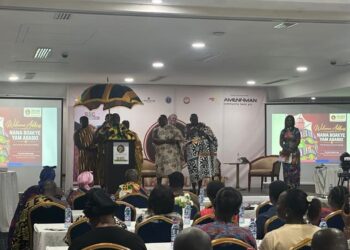

The Ghana Enterprises Agency (GEA) has intensified its efforts to bridge the gap between local production and international retail through a high-level strategic mission to the United States. During the 2026 Business Forum in Cincinnati, Ohio, GEA Chief Executive Officer, Margaret Ansei, led a technical delegation to the Office of the Mayor of Columbus.
This visit, conducted in partnership with Manny Addo, the CEO of African American Business Promotion, marked a pivotal shift in how the Agency intends to leverage the Ghanaian diaspora and municipal-level diplomacy to unlock the multi-billion-dollar American consumer market for Micro, Small, and Medium Enterprises (MSMEs).
“Our engagement focused on exploring practical avenues of collaboration to expand access to international markets for Ghana’s Micro, Small and Medium Enterprises. We discussed opportunities to connect Ghanaian businesses to new markets, strategic partnerships and investment opportunities that will enable them to scale and compete globally”
Margaret Ansei, GEA CEO
According to madam Ansei, the mission to Columbus was specifically designed to move beyond general trade discussions and into the realm of “practical avenues of collaboration.”
The delegation met with Mike Schadek, Director of International Affairs and Regional Partnerships, and Alfred A. Akainyah, Assistant Director of Community Relations, to discuss the creation of formalized trade corridors between Ghana and the Ohio region.
For the GEA, the focus was on “Access to Markets” – ensuring that a soap maker in Tamale or a cocoa processor in Kumasi has a clear, regulatory-compliant pathway to the shelves of major American retailers. A key aspect of this diplomatic push was the involvement of Manny Addo, a Ghanaian-born entrepreneur who has successfully navigated the complexities of the US retail landscape.

As the founder of True Shea, Mr. Addo transitioned from a small-scale Ghanaian operation to securing placement in over 1,500 Kroger stores across the United States.
His success serves as the “Proof of Concept” for the GEA’s current strategy. By partnering with Addo’s African American Business Promotion firm, the GEA is utilizing a “mentor-led” approach to export promotion, where established diaspora businesses act as the anchor for incoming MSMEs.
The discussions in Columbus touched on the technical requirements for Ghanaian products to enter the US market, including FDA compliance, packaging standards, and supply chain reliability. Margaret Ansei emphasized that the GEA’s role is to provide the institutional guidance necessary to prepare local firms for these rigorous standards.
Aligning with the Office of the Mayor of Columbus – a city with a vibrant and economically active Ghanaian community – the GEA is tapping into a pre-existing logistics and cultural network that can facilitate smoother market entry.
“At GEA, we are committed to building strong international partnerships that empower our entrepreneurs, strengthen trade linkages, and position Ghanaian MSMEs to thrive beyond our borders”
Margaret Ansei, GEA CEO
Scaling the Industrial Agenda
The US mission was deeply intertwined with the government’s broader goals for Agriculture and Industrialization, as many of the MSMEs under the GEA’s umbrella are agribusinesses focused on value-added products like shea butter, spices, processed cocoa, and tropical fruit preserves.
The GEA boss noted that the Agency is creating the demand-side pull needed to sustain the “Feed Ghana” programme through securing international market access. When a small processor in Ghana knows there is a dedicated “Ohio-Ghana Trade Corridor,” they are more likely to invest in the technology and labor required to increase production.

The GEA delegation included key technical heads to ensure that the discussions resulted in actionable policy. Hajia Habiba Sumani, the Director for MSME Development, and Abena Nursaa Yiadom, the Access to Market Coordinator, were tasked with identifying specific product categories that match the Ohio region’s demand profiles.
According to Madam Ansei, this data-driven approach allows the GEA to provide targeted support to businesses that are “export-ready,” ensuring that the partnership with Columbus yields immediate commercial results rather than just diplomatic goodwill.
The choice of Columbus as a partner city is a strategic masterstroke, being one of the fastest-growing cities in the American Midwest, and offering a centralized logistics hub and a diverse economic base. The engagement further explored how the GEA could facilitate “Business-to-Business” (B2B) match-making sessions, where Ghanaian entrepreneurs can meet directly with Columbus-based distributors and investors.
This level of municipal-to-national partnership bypasses some of the traditional barriers found in larger federal trade negotiations, allowing for more agile and responsive trade linkages.
This initiative also aligned with the 24-Hour Economy progress back in Ghana. By opening up the US market – which operates in a different time zone – Ghanaian MSMEs can effectively extend their operational cycle. A business that processes orders at night in Ghana to meet the morning demand in Ohio is a prime example of how global market integration drives continuous productivity.
The GEA’s commitment to building “strong international partnerships” is essentially an effort to decentralize the economy, ensuring that small-scale entrepreneurs across all 16 regions can participate in and benefit from the global trade ecosystem.
As Margaret Ansei and her team conclude their engagements in the US, the focus will return to the GEA’s “Business Resource Centres,” (BRCs) in Ghana. These centres will serve as the localized implementation points for the lessons learned in Ohio.

The GEA plans to roll out a specialized training module for “The US Market Entry,” which will guide MSMEs through the specific logistics and partnership models discussed with the Columbus officials.
This includes understanding the “African American Business Promotion” model, which emphasizes cultural branding and community-based marketing to build brand loyalty in the US.
READ ALSO: NDC Comrades, Don’t Sacrifice Muntaka on a Reset Altar