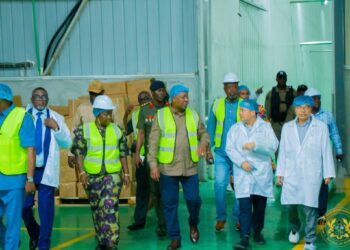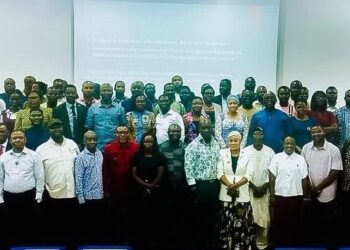

In a coordinated effort to advance regional industrialization and evaluate local manufacturing capacity, the Minister for Trade, Agribusiness and Industry, Hon. Elizabeth Ofosu-Adjare, has led a high-level delegation of Ministers and representatives from the Economic Community of West African States (ECOWAS) on an industrial tour of Kasapreko PLC.
The diplomatic visit to the prominent indigenous beverage manufacturer, on the sidelines of the Fifth Joint Meeting of ECOWAS Ministers of Trade and Industry (ECOMOTI-5), served as a step in the sub-region’s ongoing efforts to strengthen intra-African trade and highlight successful manufacturing operations within West Africa, bringing together trade policy managers and regional representatives.
According to the Ministry of Trade, Agribusiness and Industry (MoTAI), the delegation’s convergence at Kasapreko’s state-of-the-art production facilities in Accra for a first-hand assessment of the enterprise’s inner operations underscored the critical nature of state-backed industrial oversight in driving sustainable economic development across member states.
“Welcoming the delegation, the Managing Director of Kasapreko PLC Mr. Richard Adjei, highlighted the company’s growth from a local beverage producer into a recognized brand with products distributed across numerous African and international markets”
Ministry of Trade, Agribusiness and Industry
Company executives emphasized that the firm’s long-term corporate model remains strictly focused on continuous innovation, internal value addition, domestic job creation, and absolute adherence to international production standards.
The processing tour allowed international policymakers to directly inspect the company’s manufacturing processes, integrated quality assurance systems, and cross-border export operations, providing a functional baseline of how domestic manufacturing entities manage large-scale production while attempting to align with international regulatory frameworks.

A major operational highlight presented during the briefing was the company’s active participation in regional trade, with data confirming that the enterprise currently exports exactly 20 percent of its products into the sub-region.
This established commercial footprint demonstrates that indigenous West African companies possess the technical capacity to scale beyond their primary domestic boundaries when operations are engineered around continuous processing and standardized quality baselines.
The observation of these automated production lines allowed the visiting ECOWAS Commissioner representatives to evaluate the practical intersection of industrial technology and local labor deployment, as they expressed admiration for the sheer scale of operations and the level of technological advancement maintained throughout the factory floor.
The commission formally designated the indigenous beverage manufacturer as an operational model for industrial development in the region, noting that such enterprises provide a clear roadmap for other manufacturing growth initiatives across West Africa.
Confronting Non-Tariff Barriers
Despite the clear processing efficiencies displayed at the facility, the engagement served as a serious policy forum to address the severe systemic constraints that continue to hinder fluid trade across ECOWAS borders.
Addressing the media immediately following the facility inspection, Hon. Ofosu-Adjare commended Kasapreko for its contributions to Ghana’s national industrial transformation agenda and its sustained role in promoting locally manufactured commodities beyond domestic borders.

However, the Minister quickly shifted the policy focus to the severe operational friction points that local exporters face at regional entry ports, highlighting the ongoing persistence of non-tariff barriers as a primary impediment to sub-regional economic expansion.
These constraints restrict the smooth movement of goods and services within the ECOWAS zone, artificially lowering the competitive strength of West African manufacturers.
According to MoTAI, the capacity of African industries to compete effectively in both regional and global markets can only be unlocked when governments actively implement the right policies and establish a thoroughly cleared investment environment.
The industrial tour concluded with intensive policy discussions centered on the strategic opportunities presented by the African Continental Free Trade Area (AfCFTA). Because Ghana hosts the central administrative organs of the continental agreement, the synchronization of local manufacturing outputs with regional trade protocols remains a top priority for state planners.
The Ministerial dialogue focused on the creation of robust regional value chains that allow manufacturing inputs to move across borders without administrative delay, thereby reducing the sub-region’s vulnerability to external trade disruptions.
The participating ministers, delegates, and corporate executives reached a firm consensus that the long-term success of West African economic integration requires a fundamental shift in how governments interact with commercial operators.
Stronger, continuous collaboration between state ministries and private-sector leaders was recognized as a non-negotiable requirement for achieving sustainable industrial development.

Through the direct involvement of top-tier manufacturers in the policy-making process, ECOWAS member states can systematically design and execute practical strategies aimed at reducing artificial barriers to trade, ensuring that West African processed goods are manufactured and distributed freely across the entire continent.
READ ALSO: Dr Amoakohene Says Ashanti’s New Health Facilities Near Completion