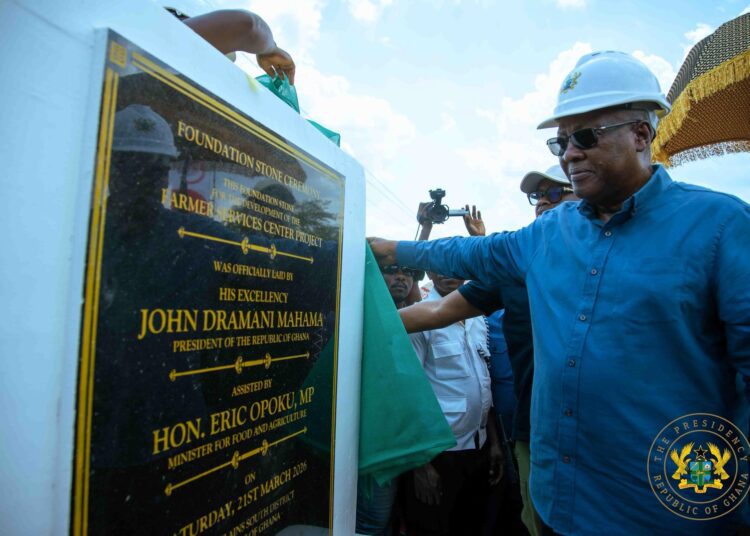
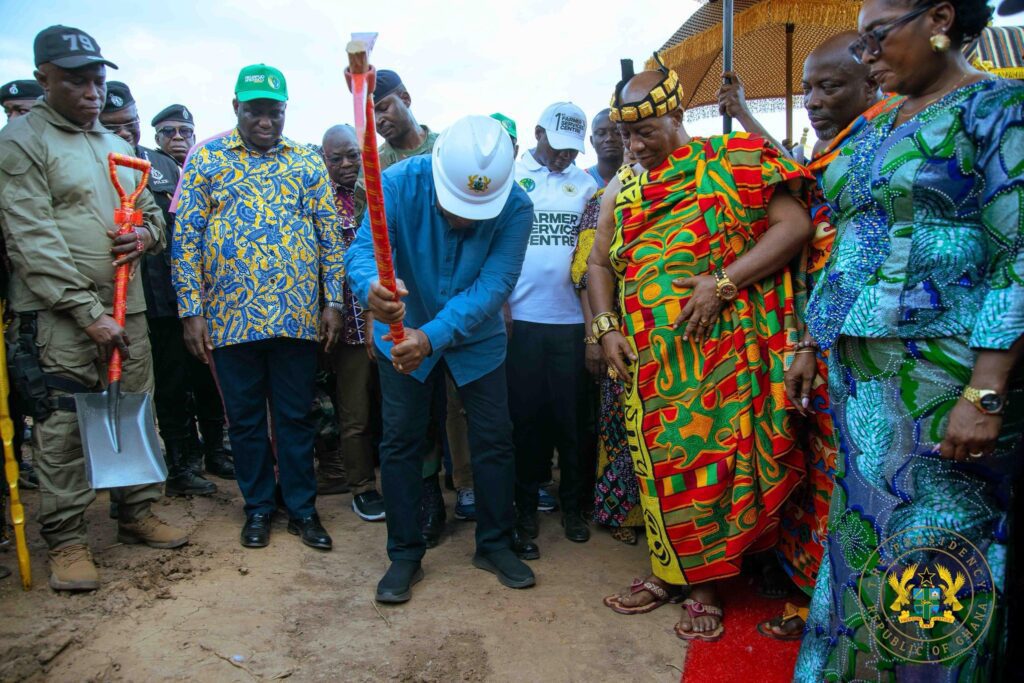
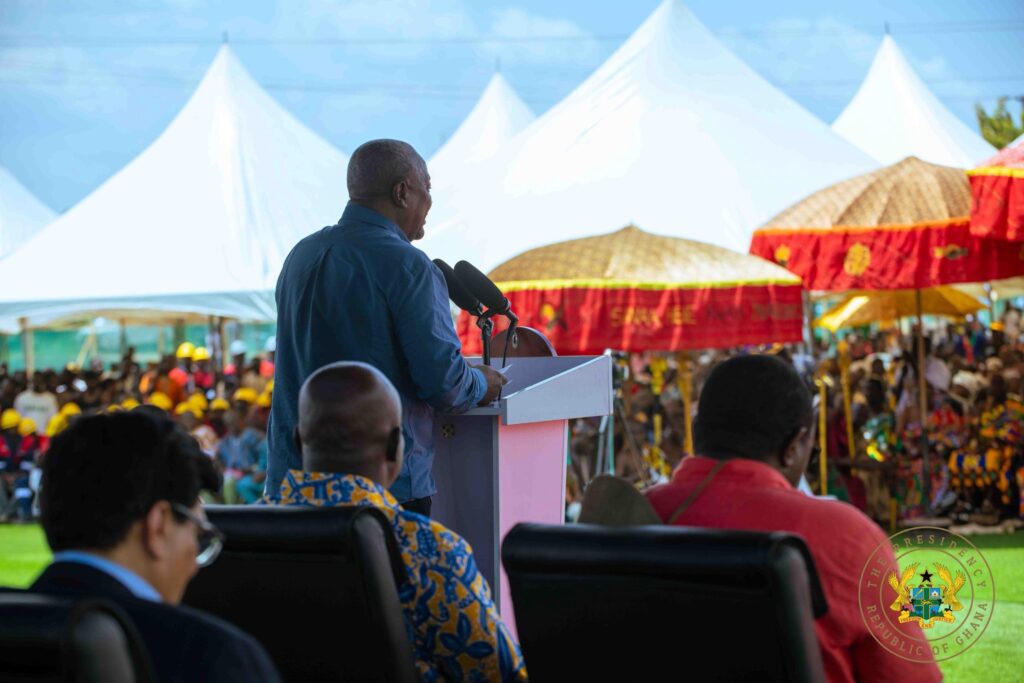
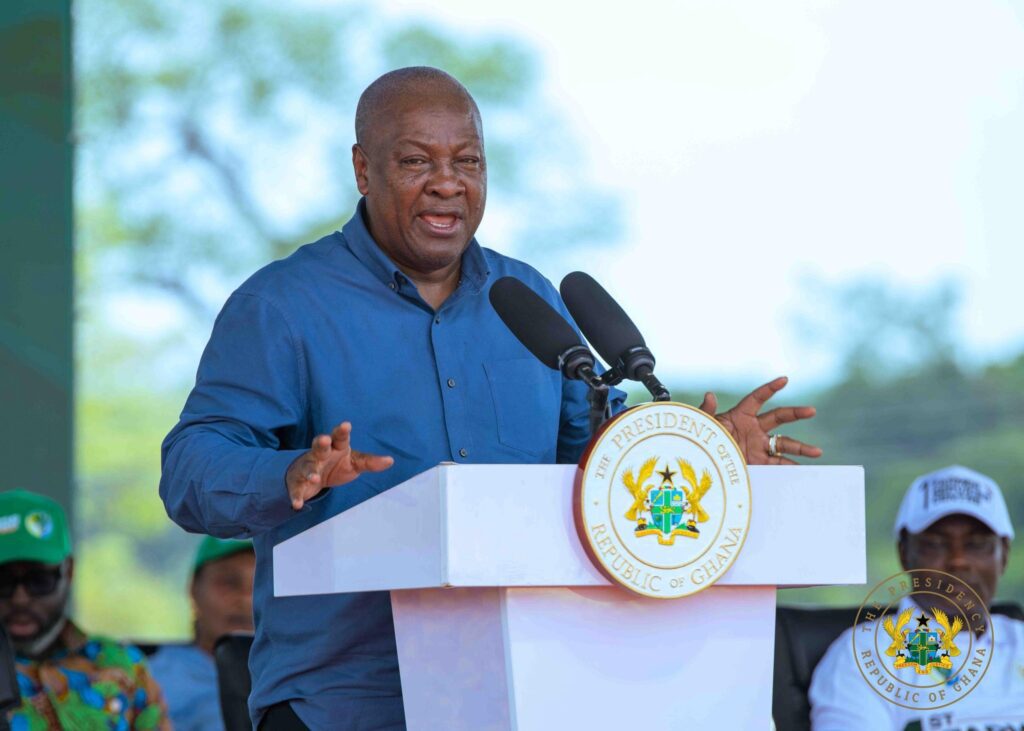
The President of Ghana, HE John Dramani Mahama, has officially broken ground for the construction of Ghana’s first farmers’ service centre at Takoratwene in the Kwahu Afram Plains South District, marking what he described as a major milestone in the country’s agricultural transformation agenda.
Speaking at the ceremony, the President emphasized that the project represents more than the start of a physical structure. He described it as a strategic national investment aimed at modernising agriculture and strengthening the livelihoods of farmers across the country.
“It marks the beginning of a strategic national investment in Ghanaian agriculture. It is a practical step towards building a more modern, productive, and resilient agricultural economy.”
President of Ghana, HE John Dramani Mahama
The President highlighted the persistent challenges that have constrained agricultural productivity in Ghana for decades. According to him, many farmers continue to operate under difficult conditions, including limited access to mechanisation, weak extension services, poor storage facilities, and inadequate market linkages.

He noted that these structural challenges have suppressed productivity levels and reduced incomes for farmers, despite agriculture remaining a key pillar of the national economy.
“Agriculture remains the backbone of livelihoods for millions; it supports local economies, it supplies raw materials to industry, and it underpins our national food security.
“However, for far too long, many of our farmers have worked under very challenging conditions. Limited access to mechanisation services, inadequate storage, weak extension services, and poor market linkages”.
President of Ghana, HE John Dramani Mahama
These issues, according to President Mahama, have hindered productivity and low-end incomes, stressing that if Ghana is committed to transforming its economy, then it must be equally serious about transforming agriculture.
The farmers’ service centre initiative, he explained, is designed to directly tackle these issues by bringing critical services closer to farming communities.
Integrated Services to Boost Productivity
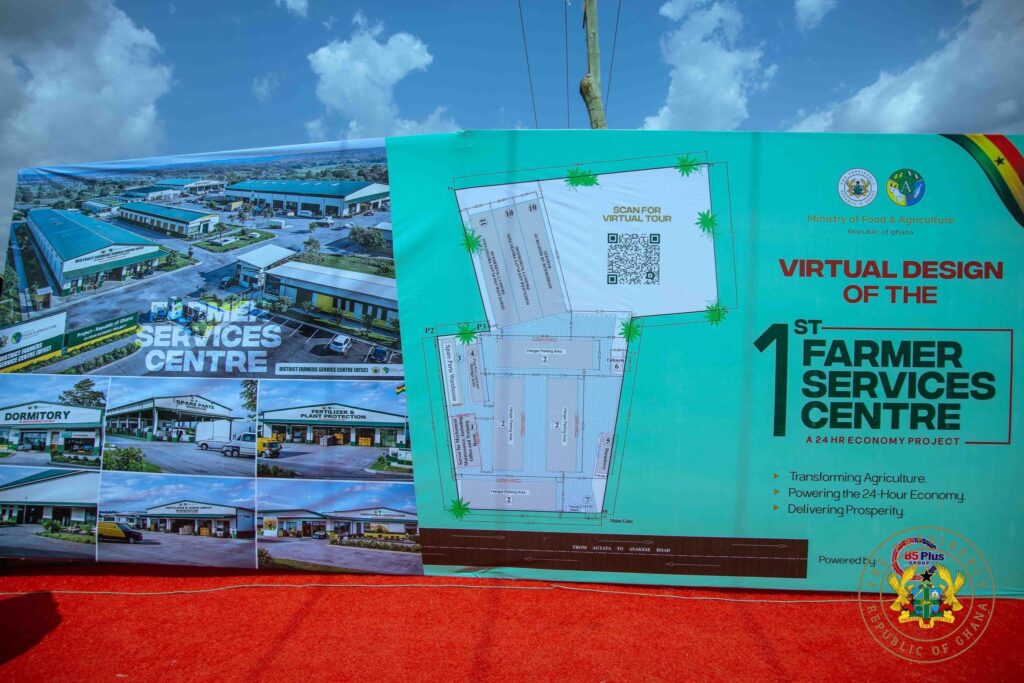
At the core of the programme is the establishment of integrated service hubs that provide a wide range of agricultural support under one system. The Takoratwene facility will offer mechanisation services, access to farm inputs, extension and advisory services, storage infrastructure, and post harvest handling support.
In addition, the centre will facilitate market access and include training facilities to improve farmers’ skills and productivity. The President described it as a one stop service point that will transform how farmers access support.
“This initiative is designed to bring essential agricultural services closer to farmers by creating integrated service hubs in key farming regions”.
President of Ghana, HE John Dramani Mahama
The government plans to establish up to 50 such centres across strategic agricultural zones, forming a network aimed at strengthening food production and value chains nationwide.
The choice of Takoratwene in the Afram Plains area was described as deliberate and strategic. The President pointed to the region’s vast arable land, favourable conditions for crop production, and strong potential for irrigation.
The area is known for producing key staples such as maize, rice, and soybean, as well as supporting livestock farming. With year round water availability and a large farming population, the region is considered a critical agricultural growth corridor.
“The district is endowed with vast arable lands and strong potential for food production. For these reasons, the government sees Afram Plains as a vital agricultural growth corridor”.
President of Ghana, HE John Dramani Mahama
The project, according to the President will occupy approximately 12 acres of land and is expected to significantly improve efficiency within the local agricultural value chain.
Economic Impact and Job Creation
Beyond improving farm productivity, the initiative is expected to generate broader economic benefits. The President stated that the centre will help reduce post harvest losses, enhance market access, and increase incomes for farmers.
He also highlighted the potential for job creation, particularly among young people, as the facility will require skilled and semi-skilled labour for its operations. “When completed, it will increase productivity, reduce losses, and create jobs, especially for our young people,” he said.
The project forms part of a broader effort to shift Ghana’s agriculture from subsistence farming to commercial production, with a focus on value addition and competitiveness.
The President commended B5 Plus Group Limited for its role in supporting the initiative, describing the partnership as essential to achieving sustainable transformation in the sector.
He stressed that government alone cannot deliver the scale of change required and called for stronger collaboration between the public and private sectors.
“Agricultural transformation cannot be achieved by the government alone. It requires strong partnerships and long-term investments in the productive sector”
President of Ghana, HE John Dramani Mahama
The involvement of private sector actors, the President explained, is expected to bring additional expertise, financing, and efficiency to the programme.
Broader Agricultural Reform Agenda
The farmers’ service centre programme is part of a wider policy framework aimed at strengthening Ghana’s agricultural sector. The President outlined ongoing efforts to expand irrigation systems, promote climate resilient farming, and introduce improved seed varieties.
Other initiatives include enhancing mechanisation services, supporting agro processing industries, and improving rural infrastructure to facilitate production and distribution.
The government is also focusing on helping smallholder farmers transition into commercial producers, a move expected to increase output and improve livelihoods. “Our goal is clear, a modern, productive, and profitable agricultural sector,” he stated.
Reaffirming his administration’s commitment, the President assured farmers that their challenges are being addressed through targeted interventions. He acknowledged issues such as rising input costs and climate related risks but emphasized that the government is taking practical steps to mitigate them.
He also expressed appreciation to key stakeholders, including the Ministry of Food and Agriculture, traditional authorities, and local communities for their support in making the project possible.
The sod cutting ceremony, he concluded, reflects a broader national commitment to building a resilient and inclusive agricultural system. “Ghana’s agricultural future will be built on innovation, infrastructure, inclusion, and partnership,” he said.
READ ALSO: NPP Support Base Dips to 25%, NDC Rise to 46% – Poll