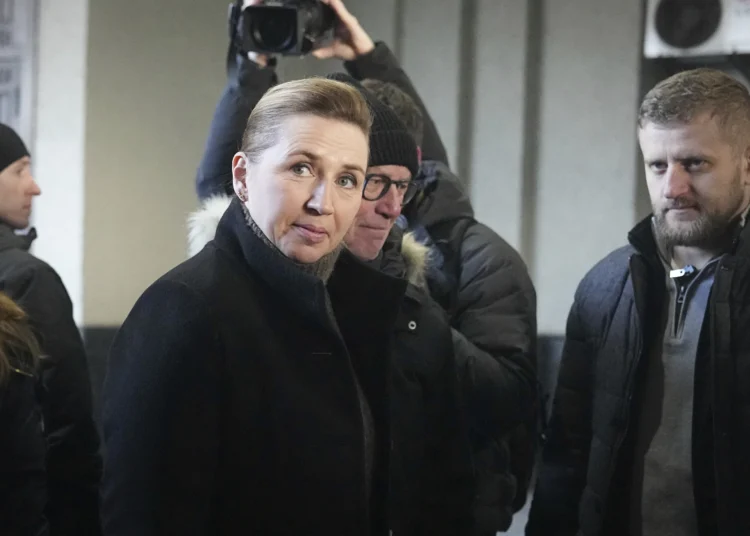
Denmark’s election has ended in an inconclusive result that left the Prime Minister’s future unclear.
Mette Frederiksen’s Social Democrats and Denmark’s other left-leaning parties failed to win enough votes to gain a clear mandate to form a government.
Official results showed that Prime Minister Mette Frederiksen’s center-left Social Democrats lost ground compared with the last election in 2022, as did her two partners in the outgoing government
With 100% of the vote counted in the early hours of Wednesday morning, the Prime Minister’s party won the most votes but performed worse than expected, leaving the Social Democrats and the other left-leaning parties that form the “red bloc” with 84 seats short of a majority in the 179-seat parliament.
The Social Democrats remained the biggest single party by some distance, but with 21.9% of the vote, well below the 27.5% they took in the 2022 election.
However, the right-leaning parties of the “blue bloc” also fell short, with 77 seats, putting the Foreign Minister, Lars Løkke Rasmussen, the leader of the non-aligned centre-right Moderates, in the spotlight as kingmaker with 14 seats.
His centrist Moderate party, with 14 lawmakers in the 179-seat parliament, is in a position to determine whether Frederiksen can serve a third term at the helm of the European Union and NATO country.
Nonetheless, Frederiksen said that she is ready to stay on as Prime Minister.
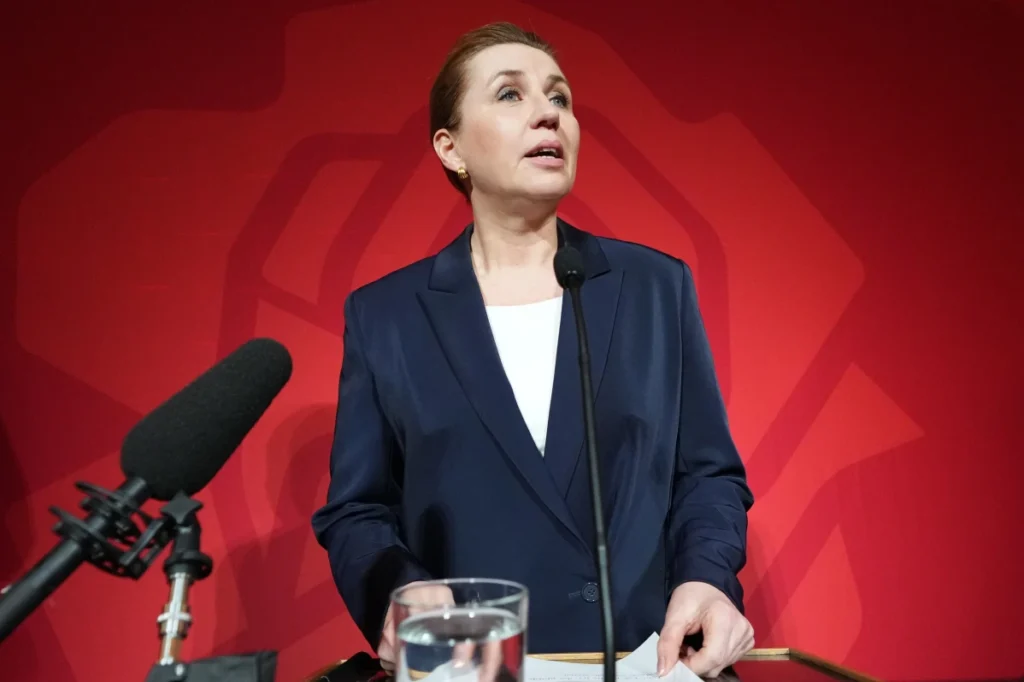
“The world is unsettled. There are strong winds around us. Denmark needs a stable government, a competent government. We are ready to take the lead.”
Mette Frederiksen
Frederiksen herself said she had hoped for a better result, but it was normal for a party seeking a third term to lose ground. She compared the election’s result with the 25.9% of the vote her party took in 2019, when she became Prime Minister.
“I have been in charge of this wonderful country for nearly seven years. We have weathered the pandemic. We have had to deal with war. We have been threatened by the American President, and in those nearly seven years, we have seen a four percent decline.”
Mette Frederiksen
Frederiksen’s prospects for a third term as Prime Minister were not looking good after disastrous municipal elections in November, when her party took a severe hit nationally and lost control of Copenhagen for the first time in more than 100 years.
The 48-year-old called an early election last month hoping to benefit from a “Greenland bounce” in the polls in response to her robust handling of Donald Trump’s threats in January to invade the largely autonomous territory that is part of the Danish kingdom. Discussions between the US, Nuuk and Copenhagen are still taking place but tensions have receded. The crisis appears to have had a lasting effe
Although it grabbed the international headlines, the Greenland issue did not dominate the election, which was largely fought on domestic issues, including a Social Democrat pledge for a “wealth tax” to fund smaller class sizes in primary schools, as well as the cost of living crisis, the tightening of Denmark’s already hardline immigration laws, animal rights and clean drinking water.
The wealth tax, a 0.5% tax on assets held by an individual worth more than 25m kroner (nearly £3m), was welcomed by many on the left but went down badly with Denmark’s super-rich.
Denmark Faces Coalition Talks
Denmark now faces weeks of coalition talks, after which a centre-left coalition appears likely to emerge.
Speaking to jubilant supporters of the Moderates party, Rasmussen urged Frederiksen and Troels Lund Poulsen, the leader of Denmark’s Liberal party, with whom he has been in coalition for more than three years, to “come down from the trees” and join him in the centre ground.
“What is clear – with all conceivable reservations – I think is that there is no red majority to the left of us, and there is no black-blue majority to the right of us.”
Lars Løkke Rasmussen
He said Denmark “is a small country of 6 million people in a world of 8 billion, which is in upheaval — and there is war in Iran, and there is war in Ukraine.” He stressed, “We are one tribe,” adding, “We must come together.” “We must not be divided,” he concluded.
However, Defense Minister Troels Lund Poulsen, the best-placed center-right challenger to Frederiksen, said he was still a candidate for Prime Minister and ruled out forming a coalition with the Social Democrats. He told supporters, “We need a new government.” “And that’s also why I’m happy that Venstre [Denmark’s liberal party] has become the largest blue party,” he added.
In the coming weeks the role of Rasmussen is likely to be critical. On the eve of the election, Rasmussen said he did not want to be Prime Minister, a job he has already held twice, but that he would like the role of “royal investigator,” which entails helping to form a government and is usually held by the person who goes on to become Prime Minister.
READ ALSO: Mohammad Bagher Zolghadr Named Iran’s New Security Chief