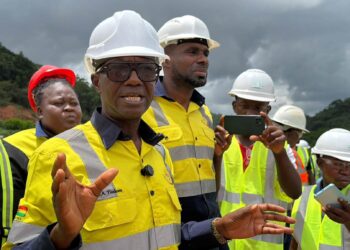
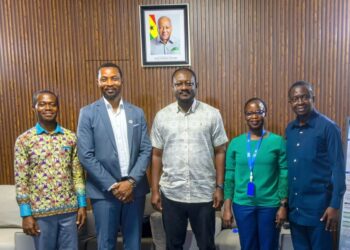
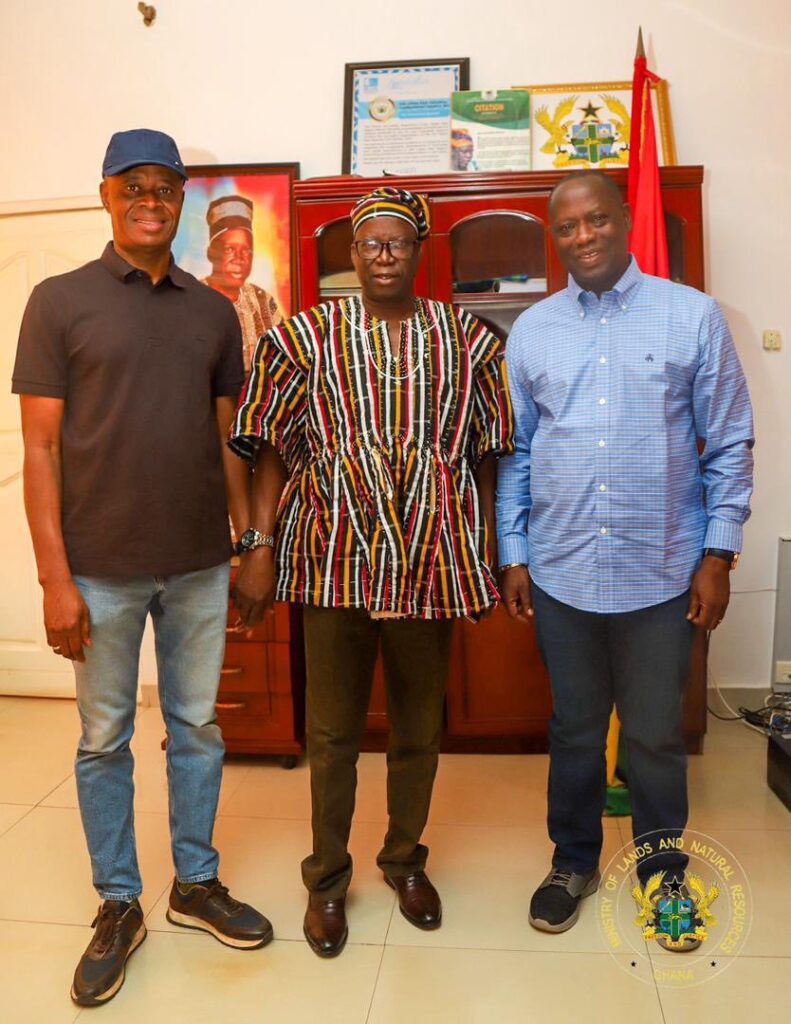
Hon. Emmanuel Armah-Kofi Buah, the Minister responsible for Lands and Natural Resources, has concluded a high-level working tour of mining operations in the Upper East Region as part of a strategic mandate to intensify state oversight of the extractive sector.
The tour, which focused on the Talensi District, serves as a critical pulse-check on the operational integrity of large-scale mining firms in northern Ghana, ensuring that the extraction of gold aligns with national development goals.
By engaging directly with both management and the rank-and-file of these mining entities, the Minister aimed to bridge the gap between policy formulation in Accra and the practical realities of mineral extraction on the ground.
“Our objective was to familiarize ourselves with their operations with a focus on conducting on-the-spot assessments of safety protocols, operational standards, and regulatory compliance.”
Hon. Emmanuel Armah-Kofi Buah

Accompanied by a high-powered technical team from the Ministry and the Minerals Commission, the Minister’s itinerary was a blend of diplomatic courtesy and rigorous field assessment.
“We remain committed to ensuring that mining in Ghana is conducted responsibly, safely, and in a manner that delivers maximum benefit to the Ghanaian people,” the minister assured.
Strengthening Regulatory Frameworks and Safety Standards

The visit to Cardinal Namdini Mining Limited (CNML) comes at a pivotal moment for the project, which is widely recognized as one of the most significant greenfield investments in the region’s history.
For the Ministry, the primary objective is to ensure that the transition from construction to full-scale production adheres to the highest international safety benchmarks. “Safety protocols are non-negotiable,” a member of the delegation noted during the walk-through of the processing facilities.
The Minister’s focus on “operational standards” signals a shift toward proactive regulation, where the Minerals Commission acts not just as a licensor, but as a continuous monitor of technical excellence.
At Earl International Group (GH) Gold Limited, the dialogue shifted toward the integration of large-scale operations within a landscape historically dominated by small-scale mining.
The tour allowed the Minister to witness the scale of the company’s underground and surface infrastructure, emphasizing that “regulatory compliance” extends beyond environmental mitigation to include the fiscal transparency required of major extractive players.
By conducting these “on-the-spot assessments,” the Ministry is effectively signaling to the global investor community that Ghana remains a “predictable legal and political environment” where standards are strictly enforced to protect both capital and lives.
Community Empowerment and the Social License to Operate
A central theme of Hon. Buah’s mission was the concept of the “social license” the idea that mining companies must earn the trust of their host communities to ensure long-term stability.
The Minister emphasized that the “maximum benefit” to the Ghanaian people is achieved when local content is prioritized.
This includes the “empowerment of local communities” through skill development and the integration of local businesses into the mining supply chain.
As the sector evolves in 2026, the Ministry’s oversight now includes monitoring how these companies contribute to local infrastructure, such as health and education, ensuring that the wealth generated from the soil leaves a lasting, positive footprint long after the ores are depleted.
Promoting Sustainable Extraction for National Development

The significance of this tour lies in its alignment with Ghana’s broader “Green Mining” initiatives.
With a national goal to rehabilitate thousands of hectares of mined land, the Minister’s inspection of “operational standards” at CNML and Earl International included a look at environmental reclamation plans.
Responsible mining in the North is being framed as a model for the rest of the country, where high-tech extraction is balanced with rigorous “safety protocols” to prevent the degradation seen in other regions.
Furthermore, this working tour serves as a morale booster for the staff of the Minerals Commission in the region, reinforcing their mandate to enforce the law “without fear or favor.”
As the Minister concluded his tour, the message to the extractive sector was clear: the government is a partner in progress, but that partnership is contingent upon absolute “regulatory compliance.”
Through such direct engagements, the Ministry of Lands and Natural Resources is ensuring that Ghana’s mineral wealth remains a blessing, driving an inclusive economic recovery that values the environment as much as the gold it produces.
READ ALSO: Sarah Mullally Becomes First Female Archbishop of Canterbury