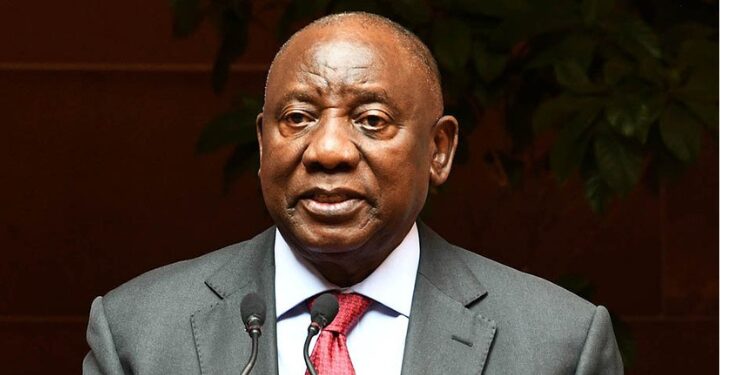
South African President Cyril Ramaphosa has shrugged off reports that his invitation to the forthcoming G7 summit in France has been withdrawn.
According to President Cyril Ramaphosa, South Africa is not a member of the G7 and therefore does not attend as a matter of course. “Many countries around the world are not part of the G7. When we are invited, we go with a clear message to share,” he said.
Ramaphosa added that his country has not participated in every summit, and that missing the June gathering “should not come as a surprise to anyone.”
Earlier reports indicated that the US had put huge pressure on France to rescind Ramaphosa’s invitation to the summit scheduled for June. They claimed US President Donald Trump had threatened to boycott the summit if the South African leader attended.
The Spokesperson for the presidency, indicated that, “they couldn’t risk missing a key member of the G7, hence the withdrawal of their invitation, which President Emmanuel Macron personally extended to President Ramaphosa last year during the G20 summit here in Johannesburg.”
However, French officials have firmly denied that South Africa’s absence from the guest list was due to external pressure. They confirmed that countries such as India, Brazil and Kenya would attend the summit in Évian-les-Bains, explaining that the selection aligns with broader efforts to address global economic imbalances.
French Foreign Minister, Jean-Noël Barrot, reiterated that Paris had “not yielded to any pressure,” but had instead opted for a more “streamlined” guest list. He added that Kenya’s inclusion was partly aimed at strengthening coordination ahead of the France-Africa summit scheduled to take place in Nairobi in May.
A White House official backed France’s account, saying the decision to invite Kenya came after talks among G7 members, without commenting directly on the exclusion of South Africa. G7 leaders often invite multiple countries as guests.
“The French, in their capacity as 2026 G7 host, expressed a desire in January to invite an African nation to the June G7 leaders’ summit in Evian. After discussion among G7 members, it was collectively determined that Kenya should be invited to the summit. The United States welcomes Kenya’s participation.”
A White House Official
Iran Crisis Threatens to Derail G7 Economic Agenda
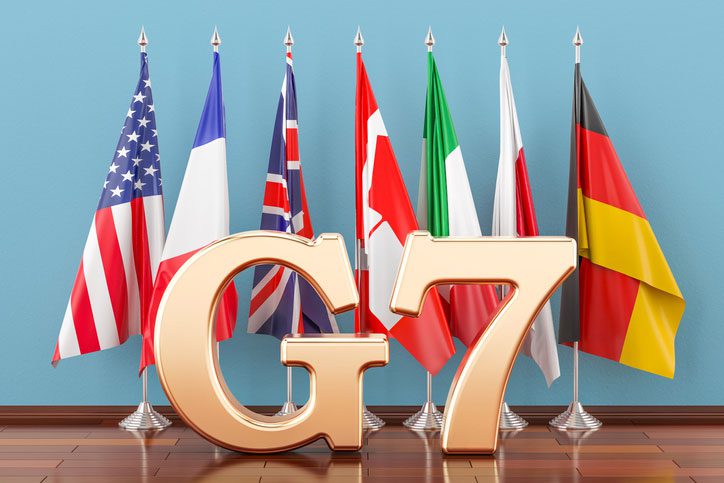
France’s ambition to steer this year’s G7 summit toward long-term economic reforms is increasingly at risk of being overshadowed by escalating geopolitical tensions, as the conflict involving Iran injects fresh uncertainty into global markets and energy supplies.
The summit, scheduled for June 15–17, was initially designed to focus on averting a potential global financial crisis. French officials had hoped to rally major economies around structural adjustments encouraging China to stimulate domestic demand and rein in export imbalances, while pressing the United States to address its growing fiscal deficits and urging European nations to boost production and reduce excessive savings.
However, those priorities now appear likely to take a back seat.
The meeting will take place in the midst of a worsening Middle East crisis, where military activities by the United States and Israel against Iran have caused a severe energy shock, increasing worries about interruptions to the oil supply and wider economic repercussions. The ensuing volatility has already started to affect international markets, making attempts to preserve economic stability more difficult.
An adviser to the French President Emmanuel Macron highlighted that “We don’t know where the Iran crisis will be by June. However it evolves, we will have to address its energy and economic consequences.”
Beyond the immediate energy concerns, the situation is also straining transatlantic relations, with differences emerging over strategy and priorities.
Compounding the challenge is a growing debate over the relevance of the G7 itself. China, the world’s second-largest economy, will not attend the summit and has continued to question the bloc’s legitimacy, dismissing it as a “club of rich countries.”
The absence of Beijing complicates efforts to tackle global imbalances, particularly given its central role in trade and manufacturing.
French officials had reportedly explored the possibility of inviting China but were unsuccessful. Instead, Paris plans to engage Beijing through separate diplomatic channels, emphasizing that cooperation remains in both sides’ interests. “The risk for China is to see global markets, and European markets, closing off to it,” a French official noted, suggesting that economic interdependence could act as a stabilizing force despite political differences.
In place of China, France has extended invitations to a group of countries described as democracies and market economies committed to international cooperation, reflecting a broader effort to reinforce alliances among like-minded nations, even as divisions deepen elsewhere.
READ ALSO : France Revokes Ramaphosa’s G7 Summit Invitation Amid U.S. Pressure