Ghana’s sovereign credit rating has been affirmed at ‘B-/B’ with a stable outlook by S&P Global Ratings, signaling cautious confidence in the country’s ongoing economic recovery and fiscal reform efforts.
The agency also maintained its ‘B-’ transfer and convertibility assessment, reinforcing Ghana’s standing in the international financial system despite recent economic challenges.
The affirmation comes at a critical time as the country continues to rebuild credibility following its 2022 debt default and subsequent restructuring process.
According to S&P, the stable outlook reflects a balance between improving fiscal and external conditions and ongoing structural vulnerabilities.
“The stable outlook balances the potential for stronger balance-of-payments performance and improvements in Ghana’s fiscal outcomes… against still-high debt service costs.”
S&P Global Ratings
While fiscal reforms and stronger export earnings have begun to stabilise the economy, Ghana remains exposed to external shocks, particularly fluctuations in commodity prices such as gold, cocoa, and oil.
This dual reality underscores the fragile nature of the recovery, where gains are evident but risks remain firmly in place.
Debt Restructuring Nears Completion
A major factor supporting the rating affirmation is Ghana’s progress in restructuring its public debt, a process that has significantly reduced immediate fiscal pressures.
S&P noted that the government has completed or reached agreements in principle to restructure approximately 97 percent of eligible debt.
This includes the successful exchange of local currency debt in 2023 and the restructuring of $13.1 billion in Eurobonds in October 2024.
The agency also highlighted recent agreements with key creditors, including the African Export-Import Bank and holders of Saderea commercial notes, as important milestones in concluding the process.
“Ghana is nearing the completion of its comprehensive government debt restructuring process following its default in December 2022.”
S&P Global Ratings
Improved external balances have also played a crucial role in stabilising Ghana’s economic outlook.
Higher global gold prices have significantly boosted export earnings, contributing to a current account surplus of $9.35 billion in 2025, equivalent to 8.1 percent of GDP.
Gross foreign reserves have also risen sharply, reaching a record $14.5 billion, providing a stronger buffer against external shocks.
S&P noted that Ghana has begun diversifying its gold export destinations due to geopolitical tensions in the Middle East, with shipments increasingly directed toward markets such as India.
This shift reflects the country’s efforts to mitigate risks associated with global supply chain disruptions.
Fiscal Reforms Anchor Medium-Term Stability
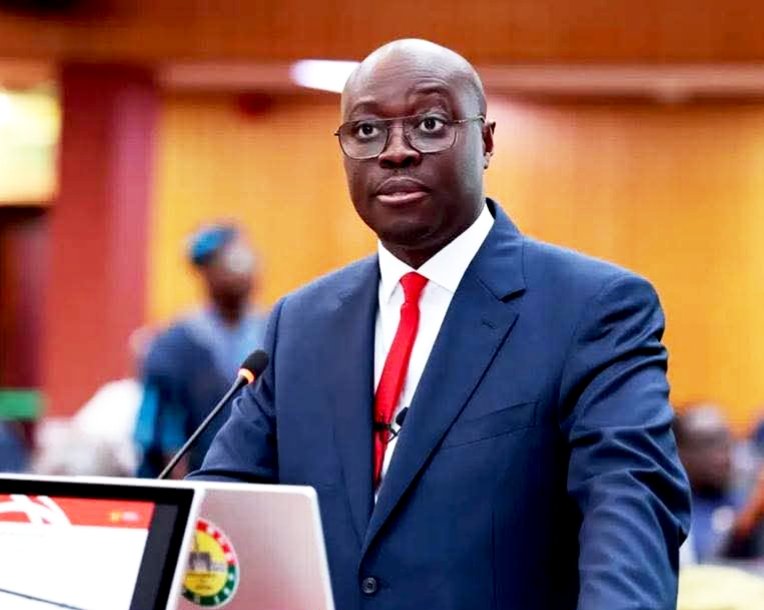
The agency also pointed to ongoing fiscal reforms by the government as a key factor underpinning the stable outlook.
The current administration, which assumed office after the December 2024 elections, has introduced measures aimed at restoring fiscal discipline and preventing future slippages.
These include a mandated primary surplus target of 1.5 percent of GDP annually, with the broader goal of reducing public debt to 45 percent of GDP by 2034.
S&P expects these reforms, combined with revenue-enhancing measures and economic growth averaging 5.5 percent through 2029, to strengthen Ghana’s fiscal position over time.
Despite these improvements, S&P cautioned that Ghana’s credit profile remains constrained by several structural challenges.
High debt servicing costs continue to weigh on public finances, limiting the government’s ability to allocate resources to other priority areas.
The agency also highlighted weaknesses in institutional frameworks and the risk of policy slippages, particularly as reforms are still in their early stages.
“Despite the improvements, our rating on Ghana remains constrained by still-weak… institutional arrangements, and elevated government debt service costs.”
S&P Global Ratings
In addition, Ghana’s economy remains vulnerable to external shocks, including fluctuations in commodity prices and climate-related risks affecting agriculture, which accounts for about 20 percent of GDP.
Downside and Upside Scenarios
S&P outlined several scenarios that could influence Ghana’s credit rating over the next 12 to 18 months.
On the downside, the rating could face pressure if fiscal reforms lose momentum, leading to higher deficits or increased debt servicing costs.
External factors such as a decline in export earnings or deterioration in terms of trade could also weaken Ghana’s position.
The agency also warned that delays in completing the remaining debt restructuring could trigger negative rating action.
“We could raise the rating in the next 12-18 months if Ghana maintained low fiscal deficits, reducing debt service costs and strengthening its access to foreign financing, while its external position continued to strengthen, including via the accumulation of additional foreign currency reserves.”
S&P Global Ratings
The affirmation of Ghana’s sovereign credit rating reflects cautious optimism about the country’s economic trajectory, but it also underscores the importance of sustained policy discipline.
With reforms still in their early stages, their success will depend on consistent implementation and the ability to navigate both domestic and global challenges.
For investors and policymakers alike, the message from S&P is clear: while Ghana has made significant progress, maintaining momentum will be critical to securing long-term economic stability and improving its credit standing on the global stage.
READ ALSO: Ghana, Burkina Faso Engage On Tomato Crisis at WTO MC14