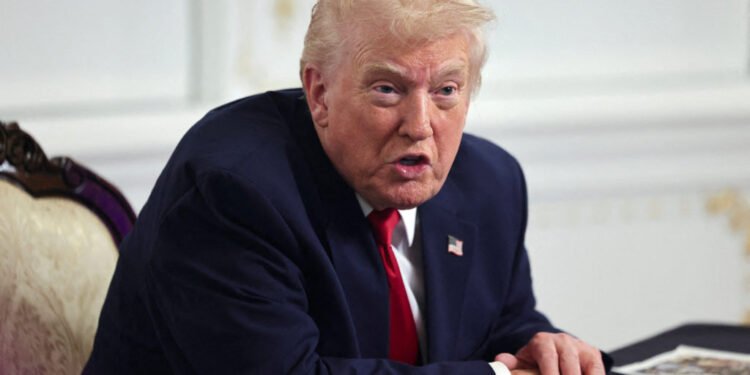
US President Donald Trump has issued a stark warning of destroying a “whole civilization” if Tehran does not meet his latest deadline to agree to a deal that includes reopening the Strait of Hormuz.
Trump issued the stark threat today, about 12 hours ahead of his deadline for Iran to agree to the deal.
Trump said in a post that “a whole civilization will die tonight, never to be brought back again,” if a deal isn’t reached, while keeping open the possibility of an off-ramp, saying that “maybe something revolutionarily wonderful can happen.”
Trump has extended previous deadlines but suggested the one set for 8 p.m. in Washington was final. Trump threatened to destroy all of Iran’s power plants and bridges if Tehran does not allow traffic to fully resume in the strait, through which a fifth of the world’s oil transits in peacetime.
While Iran cannot match the sophistication of US and Israeli weaponry or their dominance in the air, its chokehold on the strait is roiling the world economy and raising the pressure on Trump both at home and abroad to find a way out of the standoff.
Officials involved in diplomatic efforts said talks were ongoing, but Iran has rejected the latest American proposal, and it was unclear if a deal would come in time to head off Trump’s threatened attacks.
Yesterday, Tehran rejected a 45-day ceasefire proposal and said it wants a permanent end to the war. However, as Trump’s deadline neared today, an official said that indirect communications between the United States and Iran remained underway.
The official said that mediators from Pakistan, Egypt and Turkey “are racing against time” to reach a compromise before the deadline. He said that Iran has linked the reopening of the Strait of Hormuz to sanctions relief, and the US was open to easing some sanctions, especially on Iran’s oil sector, in part to stabilize the global oil market.
Meanwhile, Iranian officials urged young people to form human chains to protect power plants.
Iranian official Alireza Rahimi issued a video message calling on “all young people, athletes, artists, students and university students and their professors” to form human chains around power plants.
Iranians have formed human chains in the past around nuclear sites at times of heightened tensions with the West. Some images of people surrounding power plants were posted by local Iranian media Tuesday, though it was unclear how widespread the practice was or if the photos were simply brief shows of government-encouraged defiance.
President Masoud Pezeshkian posted on X that 14 million Iranians had answered campaigns urging people to volunteer to fight and said he would join them while a Revolutionary Guard General urged parents to send their children to man checkpoints.

The Guard warned that Iran would “deprive the US and its allies of the region’s oil and gas for years” and expand its attacks across the Gulf region if Trump carries out his threat.
Also today, airstrikes hit two bridges and a train station in Iran, and the US struck military targets on the Iranian oil hub of Kharg Island. The attack marked the second time the island was hit by American forces.
It was not clear if the latest airstrikes were linked to Trump’s threat to attack bridges. At least two of the targets were connected to Iran’s rail network, and Israeli Prime Minister Benjamin Netanyahu said Israeli warplanes struck bridges and railways in Iran.
Tehran fired on Israel and Saudi Arabia, prompting the temporary closure of a major bridge.
Saudi Arabia said it intercepted seven ballistic missiles and four drones launched by Iran. Saudi Arabia temporarily closed the King Fahd Causeway, the only road connection between Bahrain, home to the U.S. Navy’s 5th Fleet, and the Arabian Peninsula. Iran also fired on Israel.
Warnings Of War Crimes
World leaders and experts warned that strikes as destructive as Trump threatenedw could constitute a war crime.
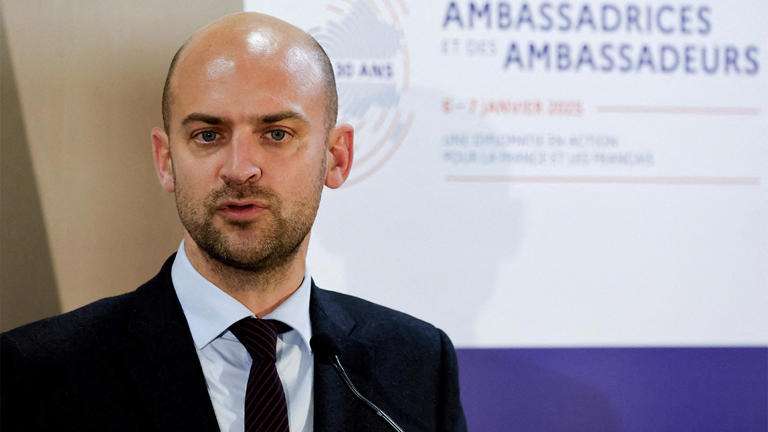
French Foreign Minister Jean-Noël Barrot joined a growing chorus of international voices and calling for restraint, saying attacks targeting civilian and energy infrastructure “are barred by the rules of war, international law.”
“They would without doubt trigger a new phase of escalation, of reprisals, that would drag the region and the world economy into a vicious circle.”
Jean-Noël Barrot
UN Secretary-General António Guterres also warned the US that attacks on civilian infrastructure are banned under international law, according to his spokesperson.
Such cases are notoriously difficult to prosecute, and Trump told reporters that he’s “not at all” concerned about committing war crimes.
READ ALSO: Akyem Swedru MP: Accra-Kumasi Expressway Could Cost GHc28.7bn, Take 6 Years