Artemis II crew have returned to Earth following a successful and closely monitored re-entry and splashdown of NASA’s Orion spacecraft in the Pacific Ocean off the coast of San Diego.
The mission’s conclusion marks a major milestone in NASA’s Artemis program, as the crew safely completed a high-speed atmospheric re-entry, deployed multiple parachute systems, and landed precisely within the designated recovery zone.
Artemis II Commander, Reid Wiseman said, “what a journey” as the crew splashed down, adding, “we are stable one, four green crew members,” describing the capsule’s position and the health of his team.
Speaking on behalf on NASA, Megan Cruz explained that “Green, meaning they are feeling great,” “not the complexion of their skin,” he teases.
The return of Artemis II comes after a complex deep-space mission designed to test the Orion spacecraft’s human-rated systems under real lunar-return conditions. As the spacecraft began its final descent sequence, it executed a carefully timed series of maneuvers, including crew module separation from the service module, followed by a controlled attitude adjustment to correctly position its heat shield for atmospheric entry.
According to reports from NASA, as Orion approached Earth, it encountered the upper atmosphere at around 400,000 feet while traveling at approximately 35 times the speed of sound.
Despite the loss of signal, the spacecraft remained fully stable, guided by onboard navigation systems that maintained its trajectory toward a designated splashdown zone in the Pacific Ocean. Once it passed through the most extreme heating phase, Orion re-established communications and began a carefully sequenced descent involving multiple parachute deployments designed to slow the capsule for ocean landing.
The final phase of descent saw the capsule transition from controlled freefall to a gentle ocean landing, concluding with a successful splashdown in calm Pacific waters.
Engineers confirmed that the spacecraft remained structurally intact and stable after impact, floating as designed while post-landing systems were activated.
Immediately after landing, recovery operations were launched. Teams from NASA and the U.S. Navy moved toward the capsule in inflatable boats to secure the spacecraft and begin preparing for astronaut extraction.
Once secured, the crew was transferred by helicopter to a U.S. Navy vessel, where medical personnel began post-flight evaluations to assess the astronauts’ physical condition after prolonged exposure to microgravity and the stresses of re-entry. The astronauts are expected to be transported back to shore and later flown to NASA’s Johnson Space Center for detailed medical assessments and debriefing.
The Orion capsule itself will be recovered from the ocean and transported aboard a naval ship before being returned to NASA facilities for extensive post-mission inspection.
Meanwhile, US President, Donald Trump has welcomed the crew members back to Earth.
“Congratulations to the Great and Very Talented Crew of Artemis II. The entire trip was spectacular, the landing was perfect and, as President of the United States, I could not be more proud! I look forward to seeing you all at the White House soon. We’ll be doing it again and then, next step, Mars!”
Donald Trump
The Science of Splashdown: Why NASA Still Lands in the Ocean
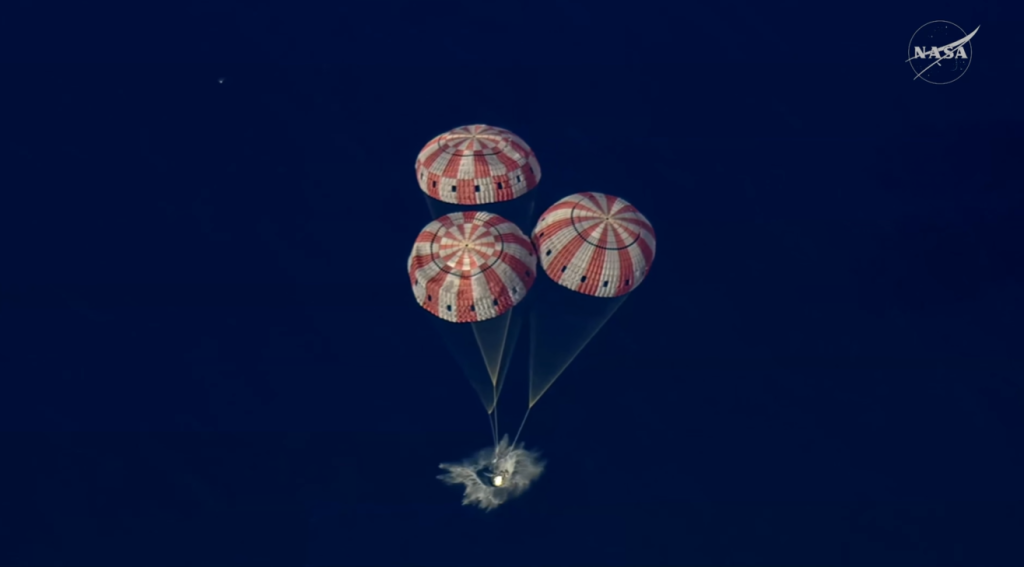
The practice of landing spacecraft in the ocean using parachutes remains central to modern human spaceflight. After decades of evolution, NASA continues to rely on this method as it returns to deep-space missions with the Orion capsule, reaffirming a system first used during earlier crewed programs.
The success of Artemis II’s landing emphasizes the significance of re-entry physics in developing recovery techniques. Spacecraft returning from outer space must slow down from speeds greater than 17,000 miles per hour, a process that begins high in the atmosphere with aerobraking.
According to experts, the capsule generates drag by intentionally interacting with air particles, reducing velocity while enduring intense heating. Only in the latter stages of fall are parachutes deployed, slowing the spaceship even further to guarantee a controlled and survivable splashdown.
Water remains an essential component in this process. Compared to land, the water has a more forgiving surface, which helps absorb leftover impact forces after the capsule touches down. This eliminates the need for heavy structural reinforcement or costly landing mechanisms, allowing spacecraft such as Orion to be more efficient in design.
Beyond cushioning the landing, ocean recovery also offers operational flexibility. Splashdown zones are carefully selected based on trajectory and safety considerations to minimize risks to populated areas while allowing recovery teams to position themselves in advance.
In the case of Artemis II, concerted efforts by NASA and US Navy crews achieved a quick and controlled retrieval after the capsule’s descent.
READ ALSO : New GoG Bond Trades at 12.11% Yield As GFIM Turnover Surges to GH¢3.48bn