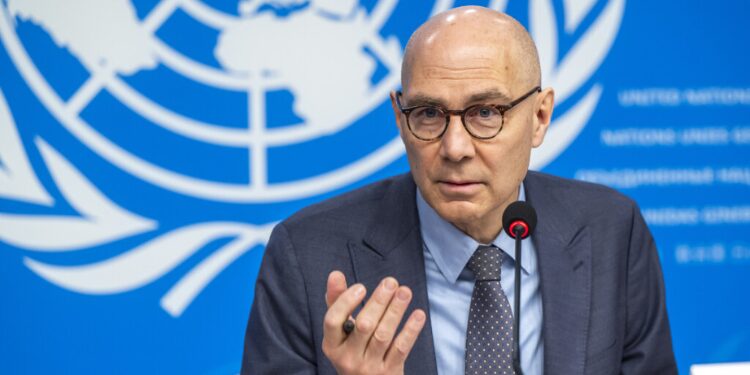
United Nations Human Rights Chief, Volker Türk, has issued a stark warning that Sudan’s devastating civil war is approaching an even more dangerous stage, as escalating violence and the growing use of armed drones push civilian casualties to alarming levels across the country.
His remarks come as fresh data from the Office of the United Nations High Commissioner for Human Rights (OHCHR) show that drone strikes have become the leading cause of civilian deaths in Sudan, dramatically altering the nature of a war that has already shattered communities, destroyed livelihoods and uprooted millions.
“The international community is on notice that, unless action is taken without delay, this conflict is on the cusp of entering yet another new, even deadlier phase.”
Volker Turk
According to OHCHR figures, armed drones accounted for 80 per cent of all conflict-related civilian deaths recorded between January and April this year.
During those four months alone, at least 880 people were killed in attacks involving unmanned aerial vehicles, highlighting the increasingly lethal role that advanced weapons technology is playing in Sudan’s two-year war.
Many of the deaths were reported in Kordofan and Darfur, two regions that have endured some of the conflict’s most relentless and brutal assaults.
Darfur, the vast western region long associated with cycles of violence and displacement, remains one of the most dangerous areas in Sudan. Since fighting erupted in April 2023 between the Sudanese Armed Forces and the paramilitary Rapid Support Forces, the region has witnessed repeated reports of ethnically motivated killings, widespread destruction, and systematic attacks on civilians. Entire communities have been uprooted as families flee air strikes, artillery bombardments and armed raids.
Human rights officials say the threat is no longer confined to Sudan’s traditional conflict zones. Both the Sudanese Armed Forces and the Rapid Support Forces are increasingly deploying drones in Blue Nile, White Nile and Khartoum, expanding the battlefield and exposing previously less affected areas to a new and highly destructive form of warfare.
The spread of drone technology is also allowing combat operations to continue during the rainy season, a period that historically slowed military offensives because flooded roads and harsh weather conditions limited troop movements.
Turk warned that the coming weeks may prove especially perilous as both sides seek to gain or consolidate territory amid shifting battlefield dynamics.
“An intensification of hostilities in the coming weeks, as the parties seek to gain or consolidate control of territory amid shifting conflict dynamics, risks hostilities expanding even further to central and eastern states, with lethal consequences for civilians across enormous areas.”
Volker Turk
He also called for robust international measures to halt the transfer of weapons to both sides, including advanced armed drones that are increasingly being used in the conflict.
Without urgent intervention, the United Nations warns that Sudan could descend into an even broader and more destructive phase of war, with devastating consequences for millions of civilians trapped in one of Africa’s gravest humanitarian emergencies.
Sudan’s Silent Catastrophe Deepens Three Years Into War
Three years after war erupted in Sudan, the country remains trapped in a devastating humanitarian and human rights crisis that survivors and advocates say is unfolding with far too little global attention.
Since fighting broke out in April 2023, an estimated 14 million people have been forced to flee their homes, making Sudan the site of the world’s largest displacement crisis. Millions of civilians continue to endure violence, hunger, trauma and uncertainty as the conflict rages on across large parts of the country.
According to the United Nations human rights office, widespread abuses including torture, rape, trafficking and other forms of sexual violence have become defining features of the war, with women, men and children among the victims.
According to Dr. Nahid Jibrallah, founder and director of the SEEMA Centre for the Protection of Women and Children, “The violations are severe: torture, rape, and other forms of sexual violence affecting women, men, and children.”
She added that, “torture is used as a weapon to control communities, including sexual abuse and also trafficking.”
Moreover, during a recent visit to Sudan, United Nations High Commissioner for Human Rights, Volker Türk mentioned that he was shocked by accounts from survivors who described extraordinary brutality.
“I heard harrowing stories from survivors who witnessed the killing of their loved ones, and from women who had been subjected to gang rape and other forms of torture.”
Volker Turk
UN Human Rights Representative in Sudan, Li Fung, also added that, “what makes Sudan’s crisis even more alarming is its invisibility. The world is not watching closely enough, but we are here, despite insecurity and access restrictions.”
With the conflict now moving into its fourth year, human rights advocates are calling for stronger international action and renewed diplomatic efforts, cautioning that millions of Sudanese civilians remain trapped in a worsening crisis that demands urgent global attention.
READ ALSO: Barcelona is the “Biggest Club” in the World – João Cancelo Declares