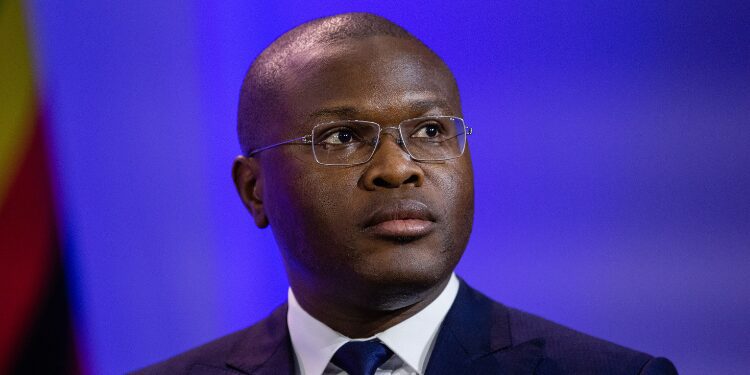
Benin’s Finance Minister, Romuald Wadagni, widely regarded as the frontrunner in this weekend’s presidential election, has vowed to extend and deepen the country’s ongoing economic transformation.
Speaking on the penultimate day of campaigning before Sunday’s elections, Wadagni promised supporters that his administration will “go even further” in building on the economic improvements undertaken over the last decade, which have resulted in some of the region’s greatest growth performance.
The forthcoming election represents a watershed point in Benin’s political transition, as incumbent President, Patrice Talon, prepares to step down after fulfilling the constitutional maximum of two terms.
Ramuald Wadagni, who currently serves as finance minister has emerged as the principal candidate of the ruling coalition, enjoying the backing of the two main parties that form the governing bloc.
His main challenger, Paul Hounkpe, a former culture minister and figure within the FCBE party, has maintained a significantly lower campaign profile.
Campaigning in the commercial hub of Cotonou, Wadagni addressed several thousand supporters and senior ruling-party figures, presenting himself as the custodian of continuity in a country that has experienced sustained economic expansion.
His campaign centred on the argument that maintaining policy stability is essential for preserving investor confidence and sustaining growth momentum. “We are going to move forward, go even further with what began before your very eyes,” he said, referring to a decade of economic transformation in the west African country.
Throughout the campaign, Wadagni has tried to strike a balance between his professional background and a more approachable political persona. He has eschewed traditional appearances in favor of a more relaxed demeanor and brief, spontaneous speeches while interacting with fans across.
Romuald Wadagani’s campaign rhetoric has continuously highlighted Benin’s structural limitations, such as its sparse natural resource base, while contending that economic development should be properly controlled and gradual rather than sudden or disruptive. “You can’t do everything in a single day, particularly in a nation with limited natural resources,” he stated.
His policies include measures to increase access to microcredit, boost assistance for small businesses, and formalize the administration of contemporary marketplaces, which have increasingly supplanted informal trading methods.
He further framed his agenda as one of refinement rather than rupture, stating, “that’s the beauty of continuity: what has begun will grow, and we’ll correct certain mistakes,” highlighting his argument that steady governance, rather than structural change, is the best way for Benin’s progress.
Meanwhile, opposition candidate Paul Hounkpe has focused his campaign on cost-of-living pressures and governance concerns, pledging to reduce the price of essential goods and advocate for the release of political detainees linked to previous opposition activity under the current administration.
Benin Elections and the Democratic Evolution Under Talon

The modern democratic electoral era in Benin began in 1990 following the National Conference, a landmark political moment that ended decades of Marxist-Leninist governance under Mathieu Kérékou.
That transition established a new constitutional framework that prioritised multiparty democracy, civilian oversight of governance, and regular competitive elections.
The first presidential election under this system, held in 1991, resulted in the victory of Nicéphore Soglo and is widely regarded as a foundational moment in Benin’s democratic consolidation.
In the years that followed, Benin developed a reputation as one of West Africa’s more stable electoral democracies. Power was transferred through the ballot box on several occasions, including the return of Mathieu Kérékou through elections in 1996, subsequent political changes in the early 2000s and the election of Thomas Boni Yayi who spearheaded the affairs of the country from 2006 to 2016.
By 2010, however, concerns about fragmentation, institutional inefficiency, and political instability began to shape calls for reform.
It was within this context that Patrice Talon emerged as a central political figure. A businessman with significant economic influence, Talon was elected president in 2016 on a platform centred on economic modernisation, governance reform, and administrative efficiency.
Upon taking office, Patrice Talon introduced series of reforms, overhauling the country’s economic, administrative, and political structures. Reforming the party system and electoral participation became a central priority.
The law governing political parties was altered in 2018 just before the 2019 legislative elections, making it significantly more difficult for parties to obtain legal recognition. A new criterion demanded a broader territorial presence which has resulted in a dramatic decrease in the number of officially recognized parties across the country.
Patrice Talon has now served the maximum two terms allowed under Benin’s constitution and is set to hand over power to a successor, with his finance minister emerging as the front-runner.
READ ALSO : Prince Harry Faces Defamation Lawsuit From Charity He Founded