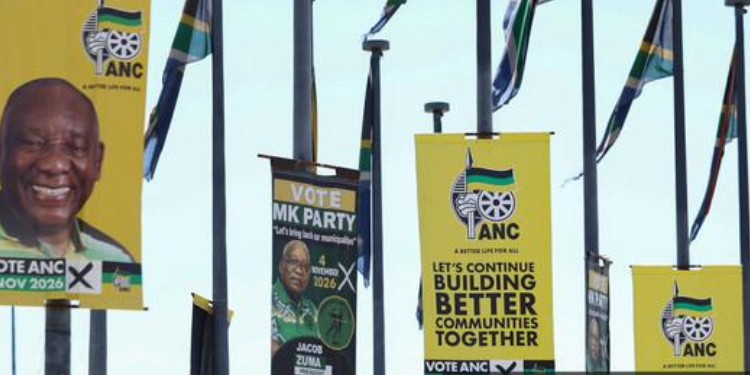
South Africans have begun voting in municipal elections amid mounting frustration over corruption, unemployment, crime and deteriorating public services, placing the African National Congress (ANC) under pressure.
The election comes as the ANC struggles to recover from declining public support, having fallen below 50% for the first time in municipal elections in 2021.
Opinion polls suggest the party could suffer further losses, with some projections placing its support below 40%.
The outcome will also shape South Africa’s political landscape ahead of the 2029 national elections and influence the ANC’s succession contest as President Cyril Ramaphosa approaches the end of his tenure as party leader in December 2027.
More than 29 million South Africans are registered to vote, but participation remains a concern following the 2021 municipal elections, when turnout stood at just 46%.
Unreliable water and electricity supplies, unemployment, crime and limited access to affordable housing have featured prominently in voters’ concerns.
President Ramaphosa has acknowledged shortcomings in municipal governance, stating that “Municipal failures have contributed to declining public trust and confidence in democratic governance.”
However, the growing fragmentation of the political landscape means that even where the ANC loses support, opposition parties may struggle to secure outright majorities, leaving several municipalities dependent on coalition negotiations.
Johannesburg Emerges as Key Opposition Battleground
Johannesburg, South Africa’s commercial hub, has emerged as the biggest prize in the municipal elections, with the Democratic Alliance (DA) mounting a strong challenge to the ANC’s political dominance.
DA mayoral candidate Helen Zille led an energetic campaign, drawing attention through unconventional stunts, including snorkelling in a pothole and kayaking along a flooded street to highlight infrastructure problems.
Opinion polls suggest the DA could emerge as the largest party in Johannesburg but fall short of securing an outright majority, potentially leaving it dependent on smaller parties to form an administration.
The ANC, meanwhile, is considering several potential mayoral candidates amid internal divisions, further complicating its efforts to retain control of the economic hub.
Other closely watched contests include Tshwane and eThekwini, which encompasses the port city of Durban.
The DA is seeking to strengthen its position in Tshwane, while former president Jacob Zuma’s uMkhonto weSizwe (MK) party is mounting a strong challenge in Durban, where it has established significant support.
The MK party made a major electoral breakthrough in 2024, securing 14.5% of the national vote and finishing third after drawing support away from the ANC.
Speaking at a campaign event earlier, Jacob Zuma indicated, “we are going to start by taking back our country here.”
The DA, which has governed Cape Town since 2006, is widely expected to retain control of the city, although the outcome of the other metropolitan contests remains uncertain.
Coalition Politics Could Shape South Africa’s Future
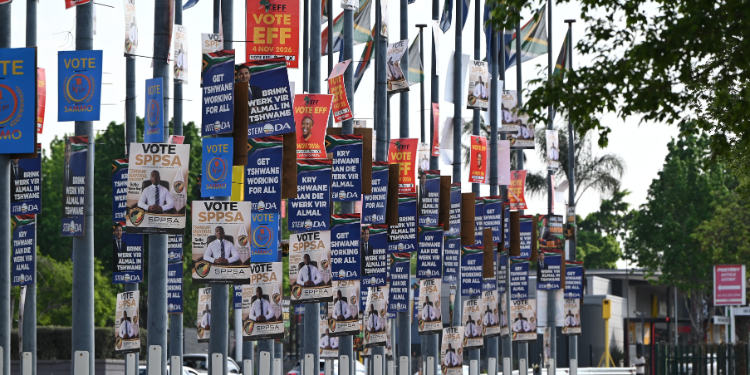
With no single party expected to secure outright majorities in several major metropolitan areas, the elections could produce another round of coalition negotiations, potentially determining which parties control municipal administrations.
South Africa’s local government system requires voters to elect municipal councillors, who subsequently choose mayors and establish the administrations responsible for running their municipalities.
The IEC has urged voters to understand the different ballot papers before casting their votes, as the process involves two or three separate choices depending on the municipality.
In local municipalities, voters receive three ballot papers: a white ballot for electing a ward councillor, a green ballot for choosing a political party through the local proportional representation system, and a yellow ballot for selecting parties to represent them on the district council.
IEC Chief Electoral Officer Sy Mamabolo emphasised that the number of ballot papers issued depends on the type of municipality in which voters are registered.
The prospect of coalition governments has nevertheless generated uncertainty among voters concerned about political compromises and the stability of municipal administrations.
The election results, expected on Sunday, will provide a clearer indication of the country’s changing political alignments and the parties likely to control its major municipalities.
READ ALSO: Carrick Fears Baleba’s Injury Could be Worse Than Imagined