Ghana’s state-owned Volta Aluminium Company (VALCO) has returned to profitability, recording a US$1.4 million operating profit before depreciation and interest in the first nine months of 2026, following a production recovery that generated US$113.85 million in revenue.
The company produced 29,506 metric tonnes of primary aluminium between January and September 2026, marking a significant turnaround for the smelter, which has struggled for decades with unreliable electricity supply, ageing machinery, inadequate investment and restricted production capacity.
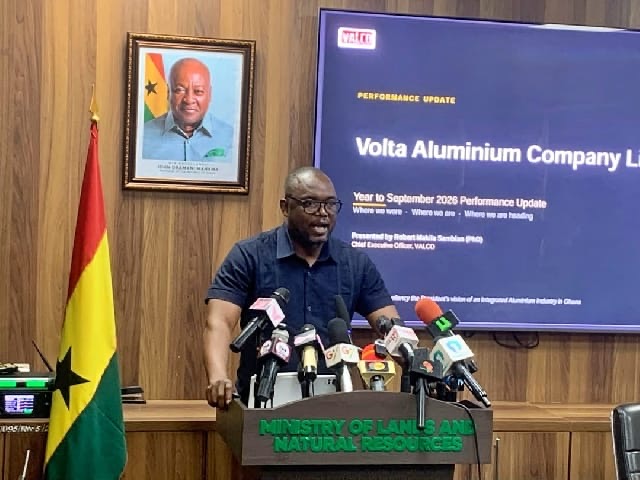
Chief Executive Officer of VALCO, Dr. Robert Makika Sambia, disclosed the financial and operational performance during a media engagement on the company’s recovery programme ahead of its 60th anniversary in March 2027.
“Year to September, we produced 29,506 metric tons. We made revenue of $113.85 million. This is a record in a very long time. The bottom line is positive. We made profit of $1.4 million for the first nine months, before depreciation and interest.”
Chief Executive Officer, VALCO, Dr. Robert Makika Sambia
The results represent an important development for Ghana’s aluminium industry, particularly as the government seeks to strengthen domestic manufacturing, increase local value addition and reduce dependence on imported industrial materials.
VALCO Increasing Production Capacity
Dr. Sambia says VALCO established with five potlines and an installed production capacity of 200,000 tonnes of primary aluminium annually.
The institution operated profitably during its first three decades before declining under the pressure of energy constraints, insufficient capital investment and obsolete production equipment.
When the current management assumed office, the company was operating only 104 of its 200 cells, producing approximately 40,000 tonnes annually against its original installed capacity.
Dr. Makika Sambia said management therefore began its recovery programme by changing the company’s operational culture and introducing a five-year strategic plan aligned with the government’s industrial development agenda.
“We declared that the era of waiting, the era of difficult decisions, the era of accepted decline was over. And we asserted a new mindset, decisive action and ownership of outcomes.”
Chief Executive Officer of VALCO, Dr. Robert Makika Sambia
A major part of the strategy involves reducing operational costs and replacing obsolete equipment that has constrained production efficiency.
Management discovered that the company was spending substantial amounts renting machinery, with some rental costs approaching the purchase price of new equipment.
The company consequently shifted towards a rent-to-own arrangement, acquiring 16 new forklifts, two payloaders, a dump truck, articulators and melting furnaces.
It has also prioritised replacing three critical cranes that have remained in operation since the establishment of the smelter. One of the replacement cranes has been inspected and certified for shipment, with installation expected within six weeks of the announcement.
Production Recovery and Local Value Addition
VALCO’s recovery has, however, faced operational setbacks. Management had initially targeted an increase from 104 to 124 operational cells by June 2026, but a rainstorm-induced national grid disturbance resulted in the loss of approximately 80 cells, reducing the operating number to 90.
The company has since introduced recovery measures and is working towards restoring production capacity to 200 cells by 2027.
Beyond primary aluminium production, management is pursuing downstream processing to retain more economic value within Ghana.
Dr. Makika Sambia disclosed that the company’s long awaited rod and rolling mill project had commenced production within the nine month period and was supplying both domestic and international markets.
The facility is expected to strengthen local manufacturing by providing aluminium inputs for industrial applications, reducing reliance on imported products and supporting export growth.
The development also aligns with Ghana’s broader industrialisation objectives, which emphasise processing locally produced materials into higher value finished and semi finished products.
The rolling mill operates a four-shift arrangement under the government’s 24-hour economy programme to respond to demand from markets in Europe, North Africa and South Africa.
Management also emphasised the local technical capacity behind the operations, stating that the facility operates entirely with Ghanaian personnel without expatriate workers.
$4bn Investment Vision for Aluminium Industry
Looking beyond the immediate recovery programme, VALCO has outlined an ambitious long-term plan to increase production to 1.5 million tonnes annually within a decade.
The expansion is estimated to require between US$2.5 billion and US$4 billion in investment and is projected to generate more than US$3 billion in annual revenue.
The proposed development could create over 5,000 direct jobs, alongside millions of indirect employment opportunities across the integrated aluminium value chain.
Achieving this target, however, will require substantial capital mobilisation, reliable energy supply, modern production infrastructure and stronger partnerships with private-sector investors.
Dr. Makika Sambia acknowledged that the company had not resolved all its operational challenges but said management was engaging potential investors to accelerate its transformation.
VALCO’s return to profitability therefore represents an early milestone rather than the completion of its recovery programme. Its ability to sustain production, expand downstream processing and secure long-term investment will determine whether the smelter can reclaim its position as a major industrial contributor to Ghana’s economy.
READ ALSO:Ghana’s Loan Costs Face Further Pressure as Reference Rate Hits 10.01%