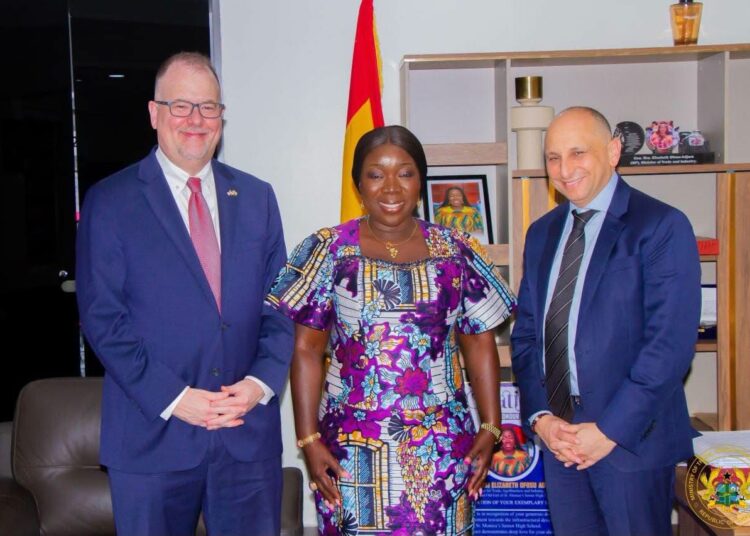
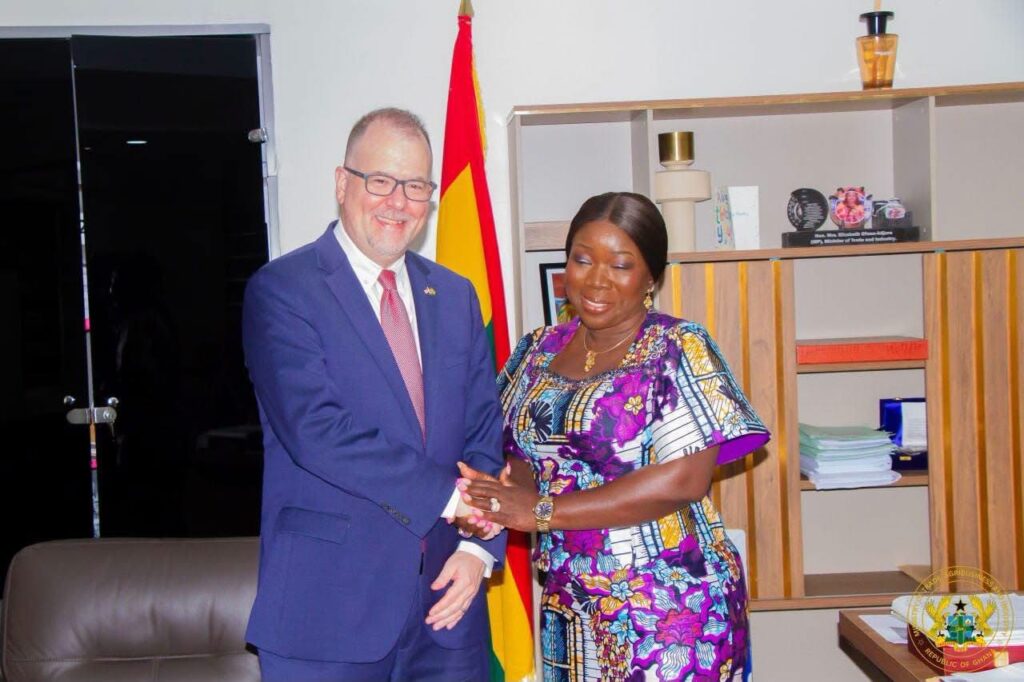
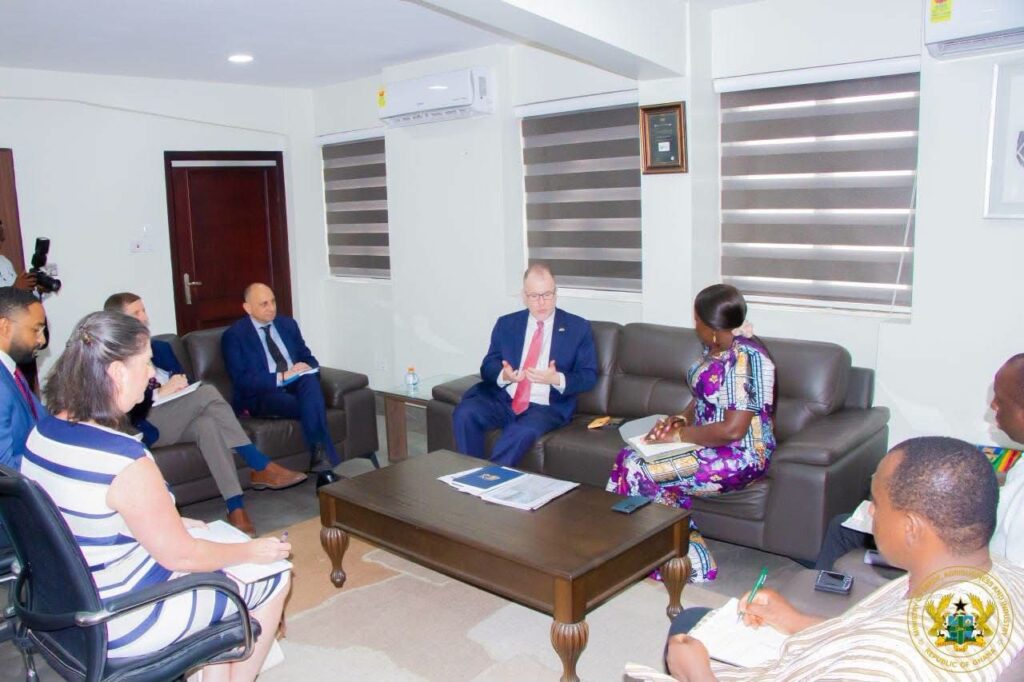
Ghana and the United States are seeking to deepen trade and investment cooperation through improved market access, investment facilitation and industrial partnerships following discussions between the Minister for Trade, Agribusiness and Industry, Elizabeth Ofosu-Adjare, and outgoing US Chargé d’Affaires, Rolf Olson, and his successor, Asad.
The engagement focused on strengthening bilateral commercial relations and identifying opportunities for American businesses to participate in Ghana’s industrial development agenda.
A key proposal from the discussions was the establishment of a working group to address challenges affecting trade and investment between the two countries.
The proposed mechanism is expected to provide a platform for identifying regulatory bottlenecks, improving investment conditions and facilitating greater private-sector participation.
The economic significance of the relationship is reflected in existing trade figures. According to the United States Trade Representative (USTR), bilateral trade in goods and services reached an estimated US$4.6 billion in 2025.
“U.S. goods and services (exports plus imports) trade with Ghana totaled an estimated $4.6 billion in 2025, up 21.3 percent ($806.7 million) from 2024.”
US Chargé d’Affaires, Rolf Olson
The figures demonstrate the scale of commercial engagement and the potential to expand cooperation beyond conventional trade into manufacturing, technology, agribusiness and industrial production.
Expanding Trade and Market Access
Merchandise trade presents further opportunities for Ghana to strengthen its export capacity and improve its competitiveness in the American market.
USTR statistics indicate that goods trade between the two countries reached approximately US$2.5 billion in 2025.
“U.S. goods trade (exports plus imports) with Ghana totaled an estimated $2.5 billion in 2025.”
US Chargé d’Affaires, Rolf Olson
For Ghana, improving access to the American market requires more than preferential trade arrangements.
It also involves strengthening local production, meeting international standards and developing the capacity of domestic businesses to supply international markets.
The African Growth and Opportunity Act (AGOA), which provides eligible African countries with preferential access to the US market for thousands of products, remains an important instrument for achieving this objective.
“Ghana is eligible for AGOA this year. It also qualifies for textile and apparel benefits.”
US Chargé d’Affaires, Rolf Olson
The programme creates opportunities for Ghanaian manufacturers, particularly in the textile and garment industry, to export to the American market under preferential conditions.
However, taking advantage of these opportunities requires increased manufacturing capacity, investment in production facilities and the ability to meet international quality standards.
Industrial Investment and Domestic Production
Ghana’s industrialisation priorities provide another important dimension to the discussions, particularly in sectors where American investment and technical expertise could support domestic production.
The government has identified manufacturing, pharmaceuticals and agribusiness among areas requiring increased investment to reduce import dependence, create employment and strengthen the country’s industrial base.
The garment and apparel industry illustrates the potential for expanding exports through local manufacturing. United Nations Comtrade data published by Trading Economics indicate that Ghana exported approximately US$22.34 million worth of knitted or crocheted apparel to the United States in 2025.
“Ghana Exports of articles of apparel, knit or crocheted to United States was US$22.34 Million during 2025.”
US Chargé d’Affaires, Rolf Olson
The figures point to an existing export relationship that could be expanded through investment in technology, skills development, production facilities and access to international supply chains.
Beyond garments, stronger investment partnerships could support Ghana’s ambitions to develop domestic pharmaceutical manufacturing, agro-processing and other industries capable of adding value to locally available resources.
The proposed working group could therefore help address regulatory bottlenecks while creating opportunities for stronger private-sector participation, particularly in sectors identified by Ghana as investment priorities.
Sustaining Bilateral Economic Cooperation
As Olson concludes his diplomatic assignment in Ghana, he expressed appreciation for the cooperation received during his tenure and reaffirmed the importance of sustained engagement between the two countries.
The introduction of Asad also provides continuity for diplomatic and economic discussions, particularly as Ghana seeks to translate its industrial development priorities into concrete investment partnerships.
Ultimately, the engagement underscores a shared interest in strengthening bilateral commercial relations through improved market access, investment facilitation, industrial cooperation and institutional dialogue.
For Ghana, the priority will be converting preferential trade opportunities and international investment interest into expanded domestic production, competitive exports and employment opportunities.