Democrats have won control of the US Senate and are on the brink of securing the House of Representatives after a series of election victories that dealt a significant setback to President Donald Trump and the Republican Party.
The midterm election results saw Democrats flip six Republican-held Senate seats and more than a dozen House seats, making gains in states that supported Trump in the 2024 presidential election. Texas, Kansas and South Carolina elected Democratic Senators for the first time in decades, while Democrats also retained a key Senate seat in Georgia.
The victories extended beyond Congress, with Democratic candidates Keisha Lance Bottoms in Georgia, Amy Acton in Ohio, Rod Sand in Iowa and Gina Hinojosa in Texas winning gubernatorial races and flipping Republican-held offices.

The results represent a significant challenge for Trump, whose personal involvement in the midterm campaign had made the elections a test of his political influence. He had campaigned extensively for Republican candidates, urging supporters in predominantly conservative states to vote for his preferred nominees.
Several of those candidates nevertheless lost in states Trump carried in 2024, including North Carolina, Ohio, Iowa, Texas, South Carolina and Kansas.
Democratic Senate Victory Reshapes Congress
Democratic control of the Senate will give the party greater authority to scrutinise the Trump administration and influence the legislative process.
With control of the chamber, Democrats will be better positioned to launch investigations into the administration and block or delay presidential nominations to Cabinet positions and lifetime federal judgeships.
The party’s gains also reflect a broader shift in voter sentiment across states that had backed Trump in the previous presidential election.
In 2024, Trump won Texas, South Carolina, North Carolina, Ohio, Georgia, Iowa and Kansas. However, Democratic candidates made significant gains across several of those states, defeating Republican nominees whom the President had personally endorsed or campaigned for.
The results also produced historic milestones. In Georgia, Keisha Lance Bottoms became the first Black woman elected Governor in US history, while Gina Hinojosa’s victory in Texas made her the state’s first Latina Governor.
Trump’s controversial mid-decade redistricting strategy also appeared to have failed to deliver the expected political advantage, as Democratic candidates made gains in several key contests.
Economy, Iran War Feature In Voter Backlash
The election results came amid concerns over rising living costs, with voters expressing dissatisfaction with the economic consequences of Trump’s policies, including his tariffs and the war against Iran.
Democrats capitalised on those concerns during the campaign, presenting the cost of living and the administration’s handling of the conflict as key issues for voters.
Trump had repeatedly urged supporters to treat the midterm elections as a vote on his leadership, telling them to “pretend I’m on the ballot” as he travelled to support Republican candidates.
He also defended his administration’s economic and foreign policy decisions, maintaining that his record would persuade voters to support the Republican Party.
However, the defeats of several Trump-backed candidates in states he had won comfortably in 2024 raised questions about the effectiveness of his personal campaigning and the appeal of his political agenda.
Trump Congratulates Democrats, Rejects Personal Setback
Despite the Republican losses, Trump congratulated Democrats on their performance, acknowledging that the party had campaigned effectively. “The Democrats did a good job. They fought hard,” he said in a phone interview with a news agency.
However, the US President rejected the suggestion that the results represented a judgment on his presidency, instead blaming the defeated Republican candidates for failing to secure enough support.
“I don’t view it as a hit on me. We’ve had the greatest two years in the history of the presidency.”
Donald Trump
Trump had earlier campaigned aggressively to preserve Republican control of Congress, warning voters about the consequences of a Democratic majority in Washington. His efforts reflected the political risks his administration could face if Democrats gained control of both chambers.
A Democratic-led House, alongside the party’s Senate majority, would give the opposition greater opportunities to investigate the administration, challenge its policy agenda and obstruct some of its legislative priorities.
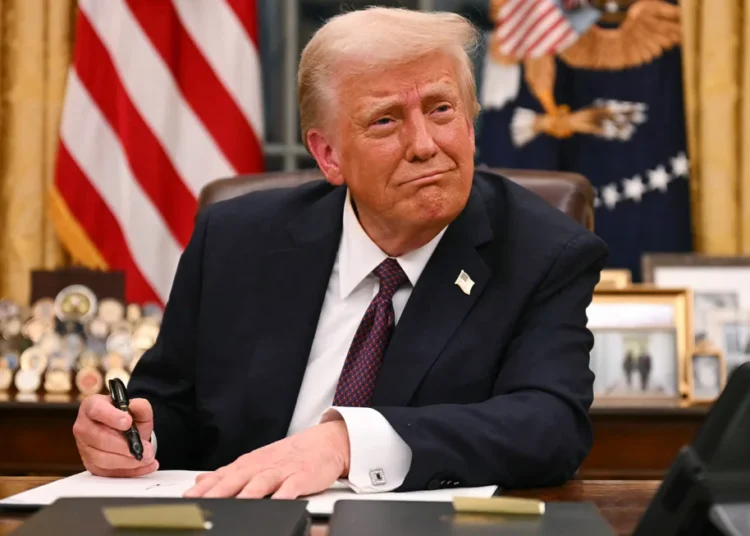
Trump watched the election results come in from the White House East Room, where the atmosphere was described as tense as Democratic victories continued to emerge.
He remained silent on his Truth Social platform for approximately three hours as the results came in before posting shortly after 10:30 p.m. local time.
“I wasn’t on the Ballot and if I was, we would have won IN A LANDSLIDE! Thank you for your attention to this matter. President DONALD J. TRUMP.”
Donald Trump
Trump’s response underscored his continued rejection of the elections as a personal rebuke, even as Democratic victories across Republican-leaning states raised questions about his party’s standing with voters.
With Democrats now controlling the Senate and the House outcome still unfolding, the results point to a potentially difficult period for the Trump administration as it faces a more assertive opposition in Congress.
READ ALSO: Bulgaria Votes As Russia-Ukraine War Dominates Presidential Race