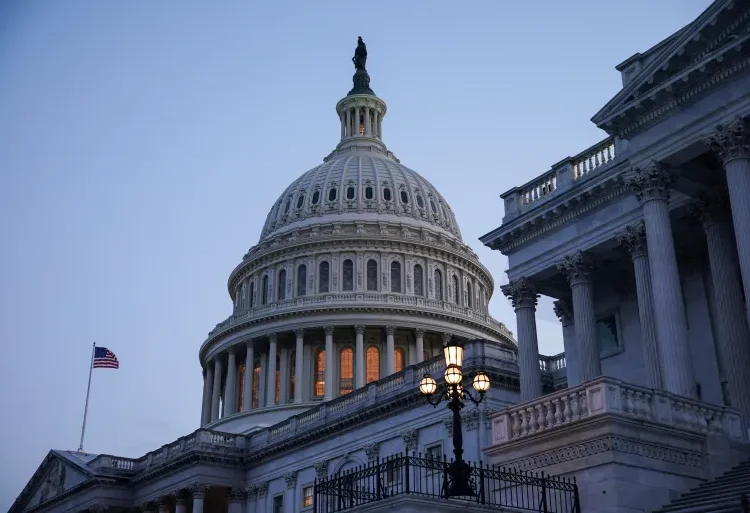
Democrats have secured control of the US House of Representatives, completing a sweeping takeover of Congress after winning the Senate and delivering a decisive electoral setback to President Donald Trump and the Republican Party.
As at the moment, the party has clinched 228 seats in the House, exceeding the 218 required for a majority, after flipping more than two dozen Republican-held districts. Several of the victories came in constituencies that supported Trump by double-digit margins in the 2024 presidential election.
The results mark a significant shift in the balance of power in Washington, giving Democrats control of both chambers of Congress and creating a new political challenge for Trump during the final two years of his presidency.
Democratic candidates made gains across several traditionally Republican states, including Iowa, Texas, Florida and Pennsylvania. The party also secured new seats in Kentucky, Missouri, Nebraska, Ohio and Utah, extending its victories into areas where Republicans had previously enjoyed strong support.
The outcome has been widely described as a blue wave, reflecting the scale of Democratic gains and the defeat of several candidates backed by Trump.
The congressional results also produced several historic victories in the Senate.
James Talarico became the first Democrat in 38 years to win a US Senate seat in Texas, while Adam Hamilton secured a Democratic victory in Kansas, marking the party’s first Senate win in the state since 1932.
In Maine, progressive candidate Troy Jackson defeated Republican incumbent Susan Collins, ending her three-decade hold on the state’s Senate seat.
Michigan also recorded a historic result, with Egyptian-American doctor Abdul El-Sayed defeating Republican Mike Rogers in one of the election cycle’s closely watched contests. His victory made him the first Muslim elected to the US Senate.
The victories represent a significant expansion of Democratic representation in states that have traditionally favoured Republican candidates, further weakening the party’s position in Congress.
Jeffries Poised To Make History As Speaker
Democratic control of the House is also expected to pave the way for House Minority Leader Hakeem Jeffries to become the first Black Speaker of the House.

Jeffries will need to secure the support of his Democratic colleagues when the new Congress convenes on January 3, 2027. If nominated and elected, he would make history by becoming the first Black lawmaker to hold the powerful position.
The speakership is one of the most influential offices in American government. The Speaker presides over the House, helps determine its legislative agenda and stands second in the presidential line of succession.
Jeffries’ expected rise carries particular historical significance given that enslaved African Americans helped build the US Capitol, where he could become the first Black politician to wield the Speaker’s gavel.
His potential election would also mark a milestone more than 150 years after the first Black American was elected to the House during the Reconstruction era following the Civil War.
At the Democrats’ election watch party in Washington, supporters welcomed Jeffries with chants of “Speaker! Speaker!” “This is not a partisan moment. This is a patriotic one,” he said.
Jeffries described the outcome as a demand for change from voters, saying Democrats understood the significance of the election results.
“The American people are crying out for transformational change. We hear you. We’re going to work hard to deliver on the dramatic change that you deserve.”
Hakeem Jeffries
If elected, Jeffries would replace Republican Mike Johnson, who currently holds the speakership.
Democratic Majority Signals Scrutiny Of Trump Administration
The Democratic takeover of the House and Senate is expected to reshape Trump’s remaining two years in office, giving the opposition greater influence over congressional investigations, legislation and oversight of the executive branch.
Party leaders have indicated that they intend to use their new majority to investigate senior members of the Trump administration and intensify scrutiny of the President’s business interests and whether his family has benefited from his position.
Potential targets include Defence Secretary Pete Hegseth and Elon Musk, the technology entrepreneur and former senior Trump adviser.

Democrats have also indicated that impeachment proceedings against Trump and members of his Cabinet have not been ruled out, although any such move would depend on decisions by party leaders and the outcome of congressional investigations.
Control of both chambers will give Democrats greater capacity to hold hearings, issue subpoenas and challenge the administration’s actions. It could also make it more difficult for Trump to advance his legislative priorities and secure approval for his nominees.
The election outcome therefore represents more than a change in congressional leadership. It creates a new political environment in which the Trump administration will face a Democratic-controlled Congress with the authority to intensify oversight and resist parts of its agenda.
With Jeffries expected to be the Speaker and Democrats preparing to assume control of both chambers, the party now faces the task of translating its electoral gains into legislative action.
READ ALSO: China Warns Philippines Against Escalating South China Sea Dispute