
South Africa’s Democratic Alliance (DA), the second-largest party in the country’s governing coalition, has taken its fight against the controversial Expropriation Act to court.
The legal challenge targets legislation that allows the state to expropriate land in the public interest and, under specific circumstances, without paying compensation to landowners.
The law was introduced as part of South Africa’s broader effort to address the enduring inequalities created by apartheid, during which the Black majority was systematically dispossessed of land while ownership became concentrated among the white minority.
The judicial lawsuit occurs at a politically sensitive time for Africa’s biggest industrialised economy. Although the Democratic Alliance and the African National Congress (ANC) agreed to form a coalition government following the 2024 general election, their alliance has frequently been tested by deep ideological differences on issues ranging from economic policy to governance and land redistribution.
Land reform has remained one of the most contentious subjects in South African politics for decades. More than 30 years after the end of apartheid, the ownership of agricultural land remains highly unequal, with many Black South Africans arguing that democratic governments have been too slow in correcting historical injustices. Successive administrations have maintained that accelerating land reform is necessary to promote social justice, economic inclusion and national reconciliation.
The Expropriation Act was enacted to provide government with a legal framework for acquiring land needed for public purposes or in the public interest. While compensation remains the general principle, the legislation permits expropriation without compensation in limited circumstances that are set out in law.
The South African government have continuously defended the legislation, claiming that it does not constitute arbitrary land seizure and that it includes safeguards designed to protect property rights while furthering constitutional goals. They have also denied charges that the law is unusual or severe, pointing out that similar expropriation processes exist in numerous countries across the world.
The legislation attracted significant international attention after United States President Donald Trump cited it when his administration suspended aid to South Africa last year. Trump argued that South Africa was unfairly targeting white landowners, particularly Afrikaners, descendants of mostly Dutch settlers, and later offered refuge to those he claimed faced discrimination.
South African government on the other hand have repeatedly dismissed those allegations, maintaining that there is no evidence of systematic persecution of Afrikaners and insisting that the country’s land reform programme is intended to address historical inequality through constitutional and legal processes.
The Democratic Alliance’s decision to challenge the law nevertheless places it on a collision course with its coalition partner. While the DA supports land reform, it argues that the Expropriation Act is inconsistent with constitutional protections for private property and risks undermining investor confidence in an economy already grappling with sluggish growth, high unemployment and persistent inequality.
Court Challenge Adds Pressure to Coalition Ahead of Municipal Elections
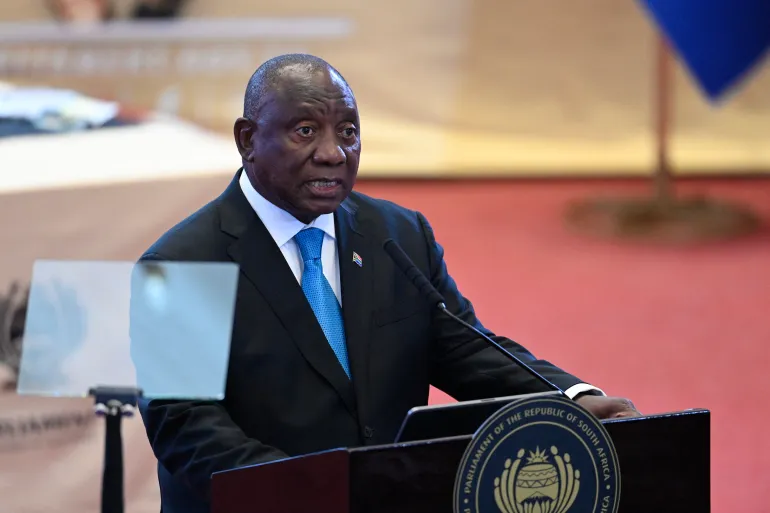
The Democratic Alliance’s application will be heard alongside two other legal challenges brought by organisations representing the interests of Afrikaners, further increasing the national significance of the case.
Although the DA has sought to distinguish its constitutional arguments from broader political campaigns surrounding Afrikaner identity, the simultaneous hearing means the courts will be asked to examine multiple perspectives on one of South Africa’s most politically charged pieces of legislation.
The outcome could have far-reaching implications not only for land reform policy but also for the future of South Africa’s coalition politics.
The ANC has long argued that meaningful land redistribution remains essential to addressing one of apartheid’s most enduring legacies. During decades of white minority rule, millions of Black South Africans were forcibly removed from their land under discriminatory laws that concentrated ownership in the hands of a relatively small white population.
Since the country’s democratic transition in 1994, successive governments have introduced programmes aimed at restoring land rights and expanding ownership. However, progress has often been criticised as slow, with many communities still waiting for restitution or redistribution.
The Democratic Alliance, on the other hand, believes that reform should be accomplished while upholding constitutional rights and legal certainty. The party has continuously maintained that open, market-friendly procedures that uphold the trust of both domestic and foreign investors should be used to advance land reform.
Therefore, the legal challenge is a reflection of the coalition partners’ wider ideological disagreements on how South Africa should achieve economic reform.
Since the ANC and the DA decided to form a joint government after the 2024 general election, these divisions have grown more apparent. The ANC had to find allies to stay in power after losing its legislative majority for the first time since apartheid ended. This led to the formation of the alliance.
Defending the Expropriation Act is a political and constitutional priority for President Cyril Ramaphosa’s administration because it tries to dispel allegations that property rights are in danger while assuring the public that land reform would take place within the bounds of the law.
READ ALSO: Mahama Orders GH¢2 Diesel Relief as Fuel Pressures Intensify