The International Energy Agency (IEA) has announced that global oil supply and demand growth are expected to fall from last year’s levels as the United States-Israel war on Iran disrupts oil flows and weighs on the global economy, sharply cutting its forecasts for both.
According to its report, the IEA sees global oil demand falling by 80,000 barrels per day (bpd) this year, compared with a projected year-on-year rise of 640,000 bpd in its previous monthly report. “Demand destruction will spread as scarcity and higher prices persist,” the IEA report said, adding that the deepest cuts in oil consumption have come from the Middle East and Asia Pacific so far, for naphtha, LPG and jet fuel in particular.
The Paris-based watchdog said that a projected 1.5 million bpd drop in demand in the second quarter of this year would mark the deepest contraction since the COVID-19 pandemic.
It asserted that where oil inventories could not bridge the gap, demand has taken a hit. Most notably, Asian petrochemical producers have curtailed operating rates as feedstock supply dried up. Households and businesses using LPG have also been impacted, while flight cancellations across the Middle East, parts of Asia and Europe have led to a sharp drop in jet fuel consumption.
It noted that a growing number of countries have implemented policies to reduce demand, while others have put in place measures to shield consumers from the full impact of rising fuel prices.
According to the IEA, attacks on energy infrastructure in the Middle East and Iran’s closure of the Strait of Hormuz have led to the largest oil supply disruption in history, with 10.1 million bpd lost in March.
Iran brought traffic through the strait; a key route for global energy shipments, to a near-total halt in response to US-Israel attacks on its territory since February 28.

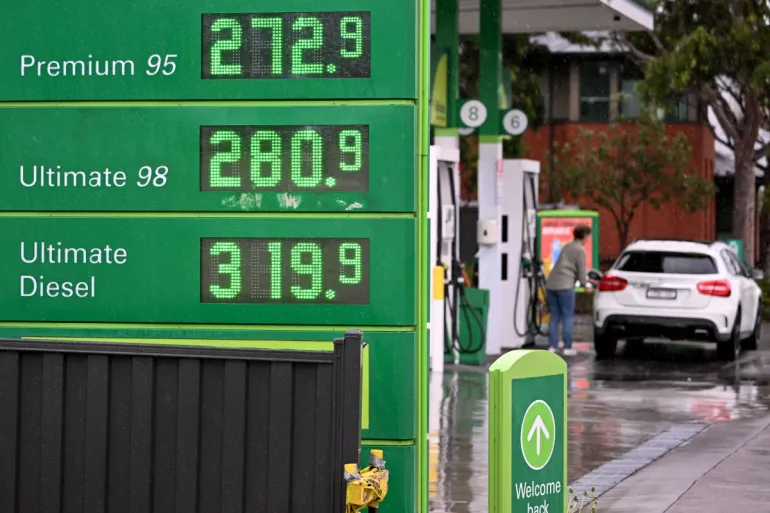
The Iranian de facto control over the chokepoint sent gas and petrol prices skyrocketing around the world. Now, Washington aims to take control of the strait from Tehran by making it impossible for Iranian tankers, which have continued to pass each day, to transit. For this, US President Donald Trump announced a blockade on the strait on Sunday, after weekend peace talks in Pakistan’s capital, Islamabad, between the US and Iran failed to reach a deal.
The IEA also noted that a chief beneficiary of the disruptions has been Russia. Thanks to the surge in prices, Moscow’s revenues from crude oil and refined products rose in March, rebounding from February when they fell to their lowest level since the start of the all-out war on Ukraine in 2022. Russia’s commodity revenues are a vital part of the state budget and are needed to support rising military spending.
The IEA said that Russia’s crude oil exports rose by 270,000 bpd last month from February to 4.6 million bpd, mostly driven by higher seaborne shipments as the Druzhba pipeline remained offline. Flows via the Druzhba pipeline to Hungary and Slovakia across Ukrainian territory have remained shut following the attacks on the pipeline infrastructure at the end of January.
The forecast was released after the International Monetary Fund, World Bank and IEA urged countries on Monday to avoid hoarding energy supplies and imposing export controls that could worsen the shock.
IEA chief Fatih Birol on Monday told reporters that several countries were holding onto stocks and imposing export restrictions, and appealed to all countries to let energy stocks flow to the markets. He did not name the countries.
Also on Monday, the Organization of the Petroleum Exporting Countries (OPEC) lowered its prediction for world oil demand in the second quarter, but kept its full-year outlook unchanged.
US Blockade To Further Worsen Situation

The IEA report said the US blockade has further clouded the outlook for global energy security and the supply of a vast array of goods that rely on petroleum.
It added that oil demand could plunge even further if the strait remains closed, warning, “In this case, energy markets and economies around the world need to brace for significant disruptions in the months to come.”
Moreover, the IEA asserted that resuming flows through the Strait of Hormuz remains the “single most important variable in easing the pressure on energy supplies, prices and the global economy.”
READ ALSO: Ghana Exports 100% of Its Crude Oil While Spending Nearly $5 Billion to Import Fuel — Here Is Why