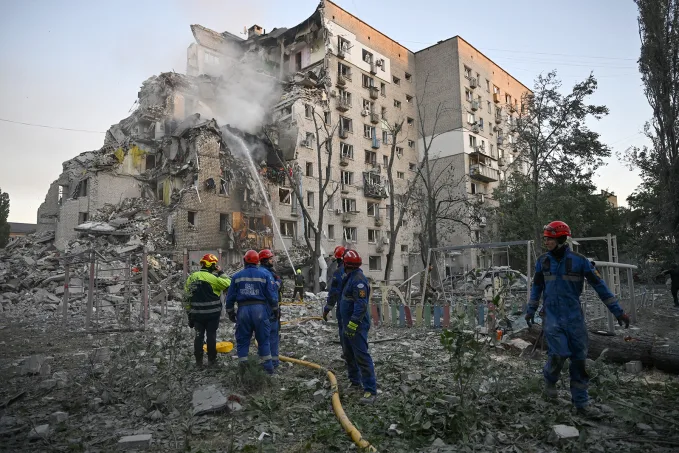
United Nations has condemned Russia’s latest large-scale aerial assault on Kyiv after one of the deadliest attacks on the Ukrainian capital in recent months left at least 18 people dead and nearly 90 others injured.
The overnight attack, described by Kyiv’s Mayor as the city’s “most massive attack,” inflicted widespread destruction across the Ukrainian capital.
According to United Nations officials, the attack affected nearly every district of Kyiv, highlighting the growing intensity of aerial strikes on civilian areas more than four years after Russia launched its full-scale invasion of Ukraine.
Among those still feared trapped beneath the debris is a 15-year-old girl and members of her family, with search and rescue operations continuing as emergency crews race against time to locate survivors.
According to Matthias Schmale, the UN Humanitarian Coordinator in Ukraine, “search and rescue operations are ongoing to save people trapped beneath the rubble of collapsed residential buildings, including a 15-year-old girl and her family.”
The attack also struck emergency medical infrastructure, injuring several healthcare workers and ambulance drivers after an ambulance station was hit and multiple emergency vehicles sustained damage, further complicating rescue efforts at a time when hospitals were already treating scores of wounded civilians.
The latest bombardment has intensified concerns over the growing humanitarian impact of the conflict, with aid agencies warning that attacks on densely populated urban areas continue to place civilians at extraordinary risk despite the protections afforded under international humanitarian law.
In a strongly worded statement condemning the strikes, Schmale described the ordeal endured by residents of the Ukrainian capital, many of whom spent almost half a day seeking refuge from the bombardment.
He said many of Kyiv’s three million residents had spent up to 11 hours in bomb shelters or sheltering inside their homes “to the terrifying sounds of war.”
United Nations noted that the latest strikes are part of a broader deterioration in civilian safety across Ukraine.
According to the UN Human Rights Monitoring Mission in Ukraine, civilian casualties increased by 40 percent between December 2025 and May 2026 compared with the same period a year earlier, reflecting a worsening security environment despite ongoing diplomatic efforts to end the conflict.
Humanitarian agencies stated that the rising casualty figures underscore the increasing danger facing communities across the country as attacks continue to strike homes, schools, hospitals and other civilian infrastructure.
For residents of Kyiv, the latest bombardment represents another painful reminder that even the country’s capital remains exposed to large-scale attacks capable of causing mass casualties and extensive destruction within a matter of hours.
Escalating Attacks Worsen Ukraine’s Humanitarian Crisis
Moreover, United Nations issued a warning, stating that the most recent attack on Kyiv is part of an ongoing pattern of attacks that are causing millions of civilians to suffer severe and long-lasting psychological suffering in addition to physical destruction.
Matthias Schmale condemned the strikes and emphasised that civilians should never be targeted in times of armed conflict.
“Civilians in Kyiv and across the country should not be bracing for yet another attack; they are protected under international humanitarian law.”
Matthias Schmal
Schmale described the latest bombardment as part of a “continuing deadly pattern” affecting communities throughout Ukraine, where repeated attacks on civilian areas continue to generate humanitarian needs on a massive scale.
While Ukraine has been the target of persistent drone and missile attacks, Russia has also been increasingly disrupted by swarm drone attacks, which media reports have linked to Ukrainian forces.
According to reports, these attacks have impacted oil infrastructure and momentarily caused Moscow’s airports and facilities in Russian-occupied Crimea to close.
Despite the growing intensity of military operations on both sides, humanitarian organisations continue to emphasise that civilians must remain protected under international law.
Across Ukraine, aid agencies are currently providing emergency assistance to nearly one million people affected by Russian strikes. Relief operations include emergency first aid, temporary shelter, cash assistance, protection services and mental health support for survivors coping with repeated displacement and trauma.
Humanitarian workers indicated that while physical reconstruction remains an urgent priority, the emotional consequences of prolonged conflict are becoming increasingly severe.
“The loss and fear caused by this and every other attack intensify the psychological trauma countless people have to bear. The longer the war goes on, the deeper these invisible scars become.”
Matthias Schmal
Aid agencies warn that repeated exposure to bombardment, displacement and bereavement is creating long-term mental health challenges affecting children, parents, older people and emergency responders alike.
READ ALSO: Supreme Court Delivers Second Blow in a Week against Torkornoo