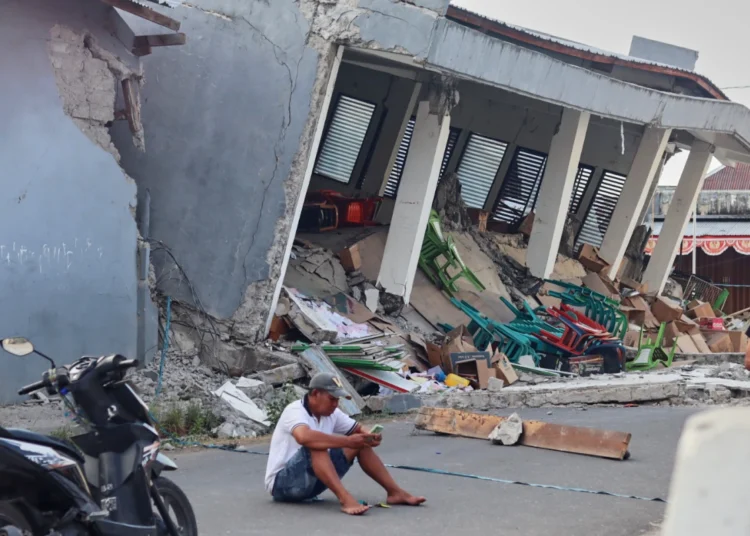
The death toll from a powerful magnitude 7.7 earthquake in eastern Indonesia has risen to 53 as rescue teams continue searching for victims and assessing damage across the island of Flores.
Six additional bodies were recovered today, a day after the earthquake struck near Flores in East Nusa Tenggara province, according to local authorities. Search teams are continuing to clear landslides and inspect damaged areas as thousands of residents remain displaced and many people spend nights outdoors because of fears of further tremors.
The earthquake struck shortly before 6 a.m. local time on Saturday at a depth of about 10 kilometres (6 miles), according to the U.S. Geological Survey. The shallow quake caused widespread shaking across Flores, triggering landslides, damaging homes and cutting off roads to several communities.
Rescue operations have focused on six regencies affected by the earthquake, with particular attention on Manggarai, East Manggarai and Nagekeo, where access has remained difficult. Fathur Rahman, Head of the search-and-rescue office in Maumere, the capital of Sikka regency, said that emergency crews had made progress in reopening roads but were still facing difficulties caused by damaged infrastructure. “We have cleared most landslides and reopened roads to previously isolated villages, although communication disruptions and power outages continue to hamper search efforts,” Rahman said.
The earthquake was followed by a large number of aftershocks, adding to concerns among residents and emergency workers. Authorities have recorded at least 995 aftershocks since the main earthquake, although only 46 were strong enough to be felt by residents, according to Abdul Muhari, the National Disaster Management Agency’s chief for disaster prevention.
Authorities said that at least 135 people have been injured. The continuing tremors have prompted many residents to avoid returning to their homes, particularly where buildings have been damaged or weakened. In Labuan Bajo, a major tourist destination and gateway to Komodo National Park, residents spent the night outside as a precaution.
The earthquake also caused significant damage to homes and other infrastructure. More than 900 houses were destroyed and another 450 damaged across East Nusa Tenggara province, forcing about 5,000 people into temporary shelters, according to disaster officials. At least 241 homes were damaged in the Flores region alone.
Emergency shelters have been established to accommodate people whose homes were destroyed or deemed unsafe. Relief workers have been distributing essential supplies, including rice, ready-to-eat meals, drinking water, blankets and medicine.
Landslides Complicate Rescue Operations
Landslides triggered by the earthquake have become one of the main obstacles to the emergency response. Several sections of the Trans-Flores Highway, a roughly 700-kilometre (435-mile) road linking communities across the mountainous island, were blocked by debris.
The road is an important transportation route for communities on Flores, meaning closures have complicated the movement of rescue teams and delivery of emergency supplies. Authorities have managed to reopen some previously isolated roads, but several communities remain difficult to reach.
Restoring electricity and communications is another major challenge. Power outages and disrupted communication networks have limited authorities’ ability to gather information about damage and casualties and have made coordination of relief operations more difficult.
Emergency crews are therefore prioritising communities that remain isolated while continuing to assess the scale of destruction. The earthquake initially prompted authorities to issue a tsunami warning for several areas of eastern Indonesia.
Residents were urged to move away from coastal areas as officials monitored the possibility of dangerous waves.The warning was later lifted after authorities determined that there was no continuing tsunami threat.The quake’s shallow depth nevertheless heightened concerns about damage, particularly in communities close to the epicentre.
Indonesia is particularly vulnerable to earthquakes because it lies along the Pacific “Ring of Fire”, an area characterised by intense tectonic activity and numerous active volcanoes and fault lines.Flores has experienced devastating earthquakes and tsunamis in the past. A powerful earthquake in 1992 triggered a tsunami that killed about 2,500 people on the island.
The latest disaster has once again highlighted the challenges faced by communities across Indonesia’s vast and geographically dispersed archipelago, where mountainous terrain and limited infrastructure can make emergency response difficult. For now, rescue teams remain focused on finding anyone who may still be trapped beneath collapsed structures or landslides, while authorities work to restore roads, electricity and communications and provide shelter and basic supplies to displaced residents.
With aftershocks continuing, officials have urged affected communities to remain cautious as the search and recovery operation enters its next phase.