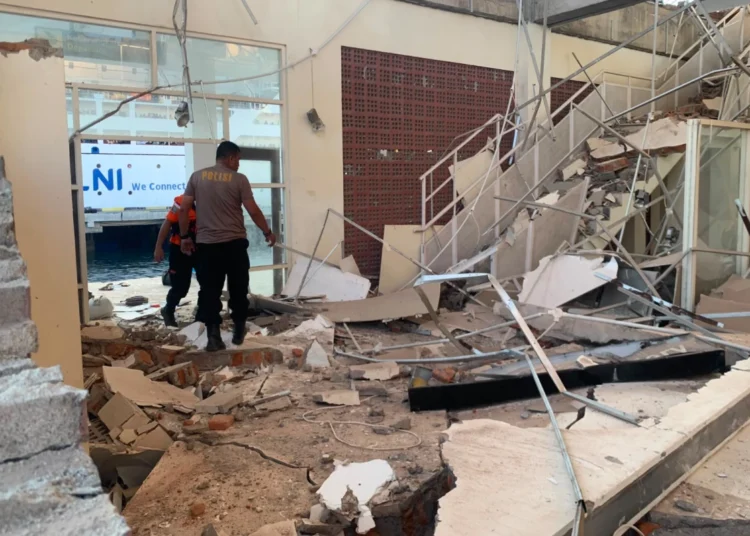
A powerful magnitude 7.7 earthquake struck off Indonesia’s Flores region early Saturday, killing at least 38 people, injuring more than a dozen others and causing widespread damage across parts of East Nusa Tenggara province.
The earthquake struck at 5:58 a.m. local time, according to the United States Geological Survey, with its epicentre about 68 kilometres north-northwest of Ende. The quake occurred at a depth of approximately 10 kilometres, increasing the potential for severe shaking near the epicentre.
The National Disaster Management Agency said most of the deaths were recorded in the regencies of Sikka, Manggarai and East Manggarai. Sixteen people were among those killed in a landslide in the village of Reok in Manggarai, highlighting the dangers posed by the mountainous terrain of Flores.
At least 13 people were taken to hospitals for treatment, including two who suffered serious injuries. Authorities said the number of casualties could change as emergency teams reach areas that remain difficult to access.
The earthquake also affected medical facilities in several communities. Patients were evacuated from some hospital buildings as a precaution, while medical workers moved beds, oxygen cylinders, intravenous equipment and other supplies outdoors. Temporary treatment areas were established outside some facilities to allow medical teams to continue caring for patients while buildings were assessed for structural safety.
The earthquake was felt across large parts of Flores, with reports of damage extending beyond the immediate area surrounding the epicentre. Tremors also caused panic in Labuan Bajo, a major tourist gateway to Komodo National Park. Damage was reported in Bima, in neighbouring West Nusa Tenggara province, as well as in parts of southern Sulawesi, although authorities were still assessing the full impact.
The earthquake initially prompted Indonesian authorities to issue a tsunami warning for several provinces, including East Nusa Tenggara, West Nusa Tenggara, South Sulawesi and Southeast Sulawesi. Residents in affected coastal areas were urged to move away from beaches and riverbanks and seek higher ground.
The warning was later lifted after Indonesia’s Meteorology, Climatology and Geophysics Agency reported that monitoring had detected no significant changes in sea levels that posed a threat to coastal communities. Several aftershocks followed the initial earthquake, keeping residents and emergency workers on alert.
The authorities’ decision to issue the warning reflected the risks associated with a shallow undersea earthquake in a region with a history of destructive tsunamis
Rescue Efforts Face Difficult Terrain
Indonesia’s National Disaster Management Agency deployed three helicopters and a rescue vessel to support emergency operations and transport supplies. The equipment is also being prepared for possible evacuations if further emergencies arise.
East Nusa Tenggara consists of numerous islands, making transportation and emergency access particularly challenging. In Nagekeo regency, around 2,000 residents reportedly left their homes and moved to temporary shelters following the earthquake. Power outages and communication disruptions have further complicated the response.
East Nusa Tenggara Police Chief Rudi Darmoko said authorities were still gathering information about casualties and structural damage. “We are continuing to collect reports of damage and casualties, but there are communication disruptions,” Darmoko said.
Landslides triggered by the earthquake also blocked sections of the Trans-Flores highway in Ende regency. The approximately 700-kilometre road is a major route across Flores Island, connecting Labuan Bajo in the west with Larantuka in the east. The disruption could hinder the movement of emergency personnel and supplies as authorities continue assessing the extent of the damage.
Indonesia is particularly vulnerable to earthquakes and volcanic eruptions because it lies along the Pacific “Ring of Fire”, a zone characterised by intense seismic and volcanic activity. Flores itself has experienced devastating earthquakes and tsunamis in the past.
In 1992, a powerful earthquake generated a tsunami that killed about 2,500 people on the island. The country also suffered one of its worst modern disasters in 2018, when a magnitude 7.5 earthquake struck near Palu on Sulawesi. The earthquake triggered a tsunami and widespread soil liquefaction, killing more than 4,400 people and destroying large sections of the city.
In 2010, an offshore earthquake near the Mentawai Islands generated a tsunami that killed more than 400 people.Indonesia was also at the centre of the catastrophic Indian Ocean tsunami in December 2004. A magnitude 9.1 earthquake off Sumatra triggered waves that killed about 230,000 people across a dozen countries.
Saturday’s earthquake has not produced a tsunami on that scale, and the warning was lifted after authorities found no significant threat. However, the deaths and destruction across Flores have prompted a major emergency response as rescuers continue searching affected communities and assessing damaged infrastructure.
Authorities are expected to continue monitoring aftershocks and vulnerable areas while efforts to restore communications, reopen transport routes and provide assistance to displaced residents continue.
READ ALSO: Trump Seeks Supreme Court Approval to Restart Ballroom Work