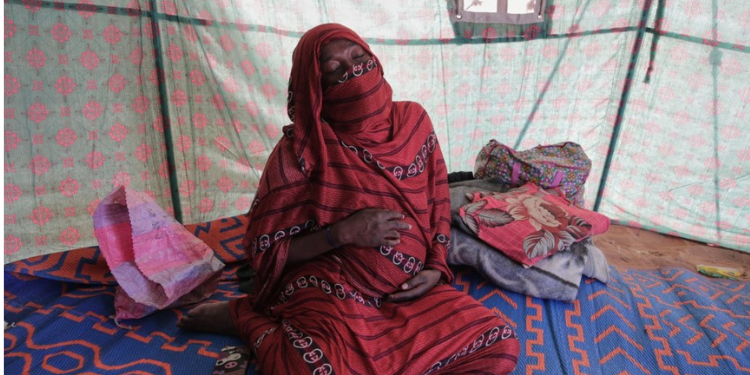
The UN sexual and reproductive health agency, UNFPA, has warned that pregnant women in Sudan’s war-ravaged Darfur region are facing life-threatening journeys to access basic maternity care, with many arriving at hospitals only after it is too late to save their lives or those of their babies.
In Golo, a mountain town in western Sudan’s Central Darfur region, one hospital serves as the only facility capable of performing caesarean sections for communities spread across vast and difficult terrain.
According to UNFPA Sudan Country Representative, Fabrizia Falcione, “most women reach it from mountain villages on foot, often walking for hours or being transported on crude wooden stretchers through the mountains, when they’re already in labour or bleeding.”
She added that, “those who can afford it hire a donkey, but many women cannot. Many arrive when it is already too late for them and also for their babies.”
Since attacks erupted between Sudan’s paramilitary Rapid Support Forces and the Sudanese Armed Forces in April 2023, healthcare facilities have been damaged or rendered inaccessible, while millions of people have been forced from their homes.
For women in labour, the collapse of healthcare access can quickly turn a manageable medical complication into a fatal emergency.
Golo Hospital, despite the efforts of its doctors, midwives and other healthcare workers, is struggling to maintain essential services.
According to UNFPA, the facility frequently runs short of critical medical supplies, including anaesthetic required for surgical procedures.
Even after undergoing a caesarean section, women face another difficult journey home.
The urgency extends beyond Golo to Tawila, a sprawling displacement camp located roughly 100 kilometres away across mountainous terrain. The journey, which can take several hours even in an all-terrain vehicle, is virtually impossible for women travelling during labour or experiencing severe complications.
Tawila has become a major refuge for people displaced by Sudan’s conflict, with more than 700,000 people now sheltering across the vast camp, according to UNFPA. New families continue to arrive, adding to pressure on already overstretched humanitarian and medical services.
“Women come even from Golo to Tawila to get a C-section when they know that their situation is desperate. Now, if it took us by four by four, nine hours by car, you can imagine how long it will take a woman on a donkey.
“And that is exactly why the medical health providers told us when the women reach here, it’s often too late and they cannot do anything and they lose their lives and those of their babies.”
Fabrizia Falcione
The crisis is further aggravated by shortages of medicines used during childbirth. Health facilities in Tawila and other parts of Central and Northern Darfur are reportedly running out of oxytocin, a critical drug used to control severe bleeding after delivery.
For women already weakened by pregnancy, displacement, malnutrition or prolonged journeys, the absence of such medicines can have devastating consequences.
UNFPA Calls for Mobile Healthcare as Sudan’s Humanitarian Crisis Deepens
According to UNFPA, expanding hospital capacity alone will not be enough to address the maternal-health crisis in Darfur. The agency indicated that healthcare must be decentralised so that women living in remote communities can receive treatment without undertaking dangerous journeys across mountains and desert.
“We can’t give pregnant women no other option than going across this vast and difficult terrain to reach a hospital to give birth safely. We need to decentralize healthcare, expand mobile services to reach those most difficult to reach.”
Fabrizia Falcione
Community midwives are also being seen as an important component of the solution. Falcione stated that skilled midwives are commonly available in communities but require substantially more assistance and resources to deliver safe mother care.
Many, she noted, are paid in basic commodities such as soap or sugar rather than receiving adequate financial support.
She added that “a well-trained and properly equipped midwife can meet 90 per cent of medical needs before, during and after delivery.”
Strengthening community-based services could thus provide a lifeline for women who are unable to reach hospitals swiftly, particularly in remote locations where transportation is restricted and insecurity continues to impede movement.
The maternal-health emergency is unfolding alongside a broader deterioration in Sudan’s humanitarian situation. Conflict between the RSF and SAF has displaced millions and destroyed essential infrastructure, with Darfur among the regions most severely affected.
UNFPA’s warning therefore points to a crisis that extends beyond the immediate battlefield. As Sudan’s war continues, the collapse of accessible maternal healthcare is placing women and newborns at extraordinary risk, making the expansion of mobile clinics, support for community midwives and reliable supplies of essential medicines increasingly urgent.
READ ALSO: Shatta Wale Confirms Second Edition Of Shatta Fest This October