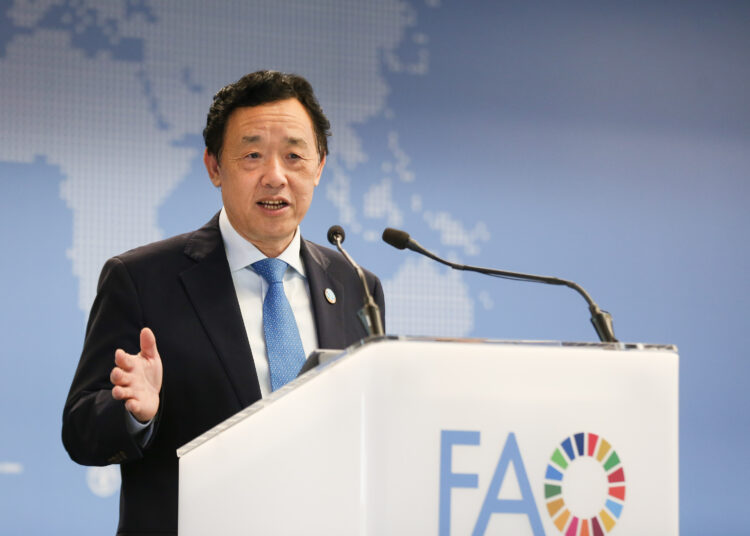
The Director-General of the Food and Agriculture Organization of the United Nations (FAO), QU Dongyu, has called for more efficient water use, fairer resource allocation and a shift towards circular and regenerative agricultural practices to strengthen global water and food security amid growing climate pressures.
Speaking at a high-level session of the Rome Water Dialogue 2026 during the World Food Forum, the FAO Chief stressed that the increasing frequency of droughts and floods is intensifying competition for scarce water resources among agricultural producers, communities, industries and ecosystems.
He noted that recent El Niño events had demonstrated how rapidly changing rainfall patterns could lead to devastating consequences, including loss of human life, livestock and crops, placing additional pressure on already constrained water supplies.
“Water security is food security. Water is food. Water is life. We cannot achieve one without the other. And we cannot secure water without changing how agriculture uses and manages it.”
QU Dongyu
FAO Chief Calls for Wider Adoption of 4R Water Management Approach
Moreover, the Director-General of the Food and Agriculture Organization of the United Nations urged countries to expand the application of the 4R approach reduce, reuse, recycle, and replenish to improve agricultural water productivity while limiting pressure on freshwater resources.
The approach is intended to help countries produce more and better food with less water, while reducing the environmental impact of agricultural activities.
The FAO Director-General outlined four interconnected priorities for achieving these objectives. They include improving water-use efficiency through innovation, reliable data and transparent water accounting; ensuring fair and dependable access to water, particularly for small-scale producers, women, Indigenous Peoples and vulnerable communities; strengthening preparedness for droughts and floods through early warning systems and proactive risk management; and protecting forests, rivers, lakes, soils and other ecosystems that regulate water cycles and sustain agricultural production.
He stressed that the priorities must be pursued collectively to ensure that improvements in efficiency do not deepen existing inequalities or undermine the livelihoods of vulnerable populations.
“These four objectives must be advanced together. Efficiency without inclusion deepens inequality. And resilience cannot last without healthy ecosystems or viable livelihoods.”
QU Dongyu
Through its Framework for Integrated Land and Water Resources Management, FAO supports member countries in improving water productivity and strengthening the resilience of agrifood systems.
Water Governance and Allocation Central to Sustainability
The Rome Water Dialogue also examined how water is priced, allocated and governed, with discussions highlighting the importance of appropriate pricing mechanisms and incentives in encouraging more efficient use.
The FAO Chief emphasised that such measures must be supported by sound public policies that protect basic water needs and prevent vulnerable communities from being disadvantaged by allocation decisions.
“Water has cultural, social, economic and environmental value. Responsible governance must recognize all four,” he stated.
The discussions highlighted water tenure as an important element of effective water governance, particularly in determining how individuals, communities and other stakeholders access and use water resources.
FAO explained that it would continue supporting countries through water tenure assessments, water accounting and National Water Roadmaps, while strengthening collaboration among governments, farmers, researchers, civil society organisations, financial institutions and private-sector actors.
The high-level session brought together representatives from governments, international organisations and development institutions, including King Letsie III of Lesotho; LI Junhua, United Nations Under-Secretary-General for Economic and Social Affairs; Yasmine Fouad, Executive Secretary of the United Nations Convention to Combat Desertification; and Retno L. P. Marsudi, the UN Secretary-General’s Special Envoy on Water.
Other participants included agriculture and water officials from Tajikistan, Türkiye, Kazakhstan, Syria, Saudi Arabia, Thailand, Morocco and China, alongside representatives of Germany, Sri Lanka and the Asian Development Bank.
New FAO Platform to Guide Sustainable Irrigation Investment
FAO also launched a digital platform designed to help countries identify where irrigation development is feasible, most needed and likely to deliver sustainable benefits.
The Mapping of Irrigation Potential and Needs Initiative (IRMA) provides a decision-support framework that combines information on existing irrigation infrastructure, biophysical suitability, sustainable development needs and anticipated benefits.
The platform enables agricultural areas to be assessed, compared and prioritised, helping policymakers identify where irrigation investments could have the greatest impact.
According to FAO, IRMA is intended to replace fragmented assessments with structured, evidence-based planning, allowing countries to align irrigation development with national priorities and strengthen coordination between water management and agricultural institutions.
The initiative also seeks to help reduce the financial and environmental risks associated with irrigation investments by enabling governments to assess suitability and expected benefits before committing resources.
READ ALSO: BoG Retains Forex Intervention Powers Despite GoldBod Selling Fx to Banks- Dr Asiama