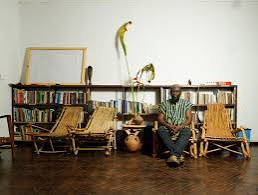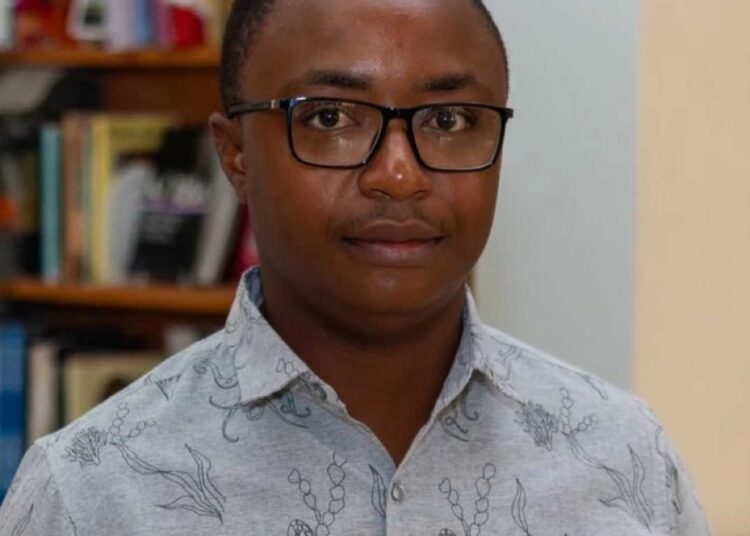
Zimbabwean writer Simbarashe Steyn Kundizeza, winner of the 2026 Caine Prize for African Writing, has issued a detailed public statement firmly denying allegations that his prize-winning short story “The Blue Fighter” was generated by artificial intelligence. The response comes days after a controversial article in The Atlantic raised questions about the authorship of the work.
Kundizeza was awarded the £10,000 prize on October 6, 2026, at a ceremony in London for “The Blue Fighter,” a deeply personal story exploring a boy’s experiences amid his family’s economic hardships in Zimbabwe.
The narrative draws on themes of familial struggle after the father abandons his accounting career to pursue a passion for building fish tanks. Judges praised the piece for its emotional depth and storytelling craft.
On October 11, The Atlantic published an article by journalist Vauhini Vara titled “Yet Another Literary Prizewinner Seems to Be AI.” Vara reported that the AI-detection tool Pangram had flagged nearly the entire story as machine-generated, with the sole exception of an epigraph drawn from an unpublished poem by South African writer Vangile Gantsho.
She also pointed to stylistic features she associated with chatbot writing, including certain sentence constructions, frequent metaphors, and what she described as “maudlin” tropes. Vara noted that Pangram classified all 25 previous Caine Prize-winning stories, as well as Kundizeza’s earlier 2021 story “The Whistleblower,” as human-written.
Statement by the Author
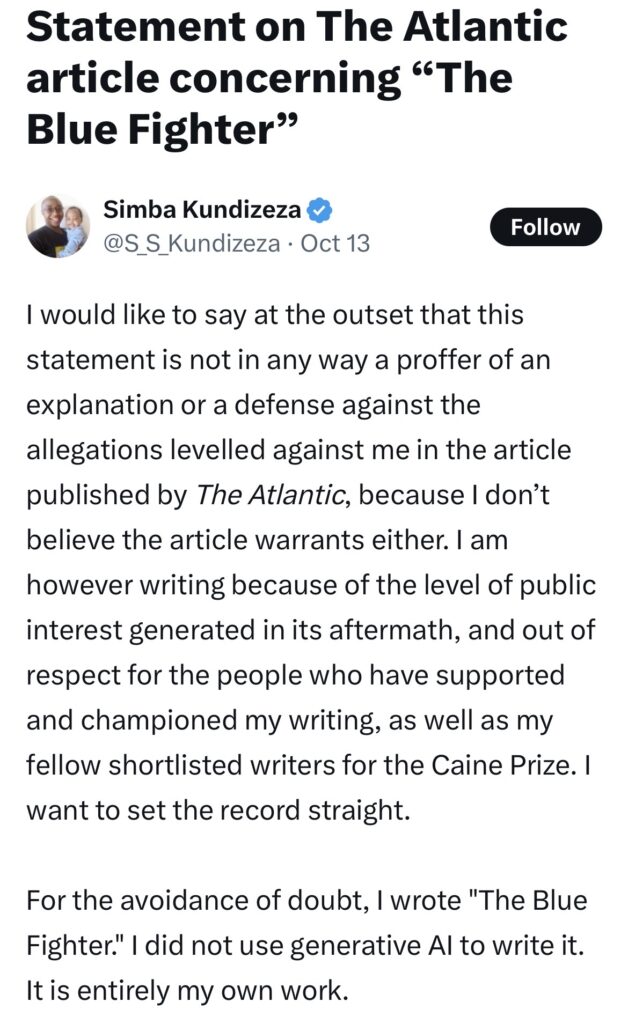
In his statement, released on X and republished by literary platform Brittle Paper, Kundizeza rejected the claims outright. “For the avoidance of doubt, I wrote ‘The Blue Fighter.’ I did not use generative AI to write it. It is entirely my own work,” he wrote.
He emphasized that the statement was not a defense, as he did not believe the article warranted one, but rather an effort to set the record straight amid public interest and out of respect for supporters and fellow shortlisted writers.
Kundizeza provided a detailed chronology of the story’s development. He explained that the idea originated during his LOATAD Black Atlantic Residency in Ghana, where he encountered Gantsho’s poem “my father’s hands.” Inspired by it, he crafted a narrative incorporating elements from his own family’s experiences in Zimbabwe, including his father’s career change and the resulting hardships.
He sent a completed first draft to Gantsho for feedback on May 15, 2025, and submitted the story to The Shallow Tales Review on May 27, 2025. Fiction editor Nzube Nlebedim accepted it on June 10. Feedback from both Gantsho and the editor arrived on June 25, and Kundizeza submitted the final draft on June 27, requesting that the epigraph’s formatting be preserved as a courtesy. The story was published on June 30, 2025.
Addressing comparisons to his earlier work, Kundizeza noted that “The Whistleblower” and his debut novel Freelance are political thrillers, while “The Blue Fighter” is a personal exploration of economic collapse and family bonds. “The voice shifts because the subject matter demands it,” he stated. “To suggest that a writer cannot write in different styles or genres, or improve his writing substantially after five or more years fundamentally misunderstands the craft of writing.”
He also dismissed any suggestion of motive, pointing out that he was neither commissioned nor paid for the story’s initial publication. The decision to submit it for the Caine Prize was made by the journal’s editor months later, with no guarantee of success.
The Caine Prize has initiated a review of the allegations. Board chair Ellah Wakatama expressed concern that The Atlantic published its claims before a fuller investigation, stating that the organization takes such matters seriously and is examining documentation, including drafts, while consulting judges and the original publishers. The prize has not been withdrawn.
Public Reaction
The controversy has sparked debate within African literary circles about the reliability of AI-detection tools and potential biases against writers from the continent telling their own stories. Kundizeza has suggested that such technology can create unfair barriers and called for its responsible use.
In closing his statement, Kundizeza reaffirmed ownership of the work: “‘The Blue Fighter’ is my work, and I stand by it completely.” He expressed gratitude to Gantsho, The Shallow Tales Review, the Caine Prize judges, supporters, and his literary agents, and confirmed he would continue writing.
The episode highlights ongoing tensions in the literary world as AI tools become more sophisticated, raising complex questions about authorship, detection methods, and the evaluation of creative work particularly for writers from underrepresented regions.
As the Caine Prize review proceeds, attention remains focused on both the integrity of the process and the broader implications for African literature.
READ ALSO:Gomoa Special Economic Zone Roads Assigned to 48 Engineers Regiment