United Kingdom has disclosed details of a prolonged Russian submarine operation in the North Atlantic, warning that any threat to critical undersea infrastructure will be met with a firm and coordinated response from Britain and its allies.
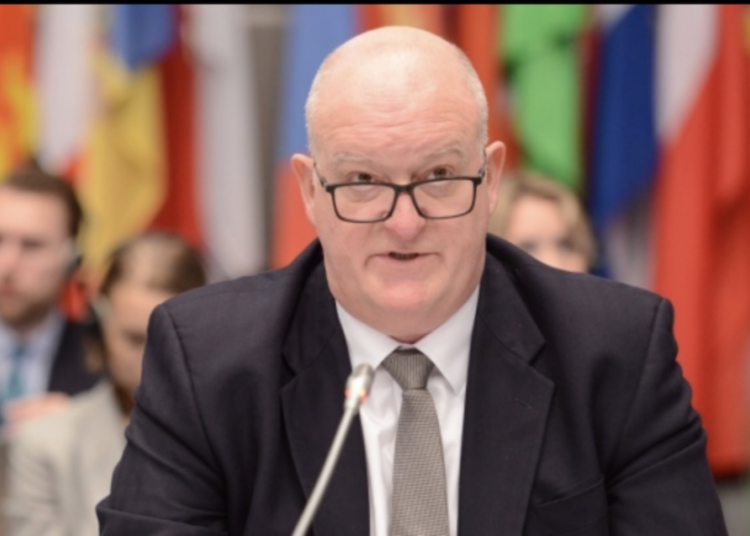
Addressing the Council, Head of the United Kingdom’s Delegation to the Organization for Security and Co-operation in Europe (OSCE), Neil Holland said the update was being formally placed on record following a statement by the Defence Secretary on 9 April 2026, which highlighted increased Russian naval activity in waters north of the UK.
The disclosure, made “in the spirit of transparency and risk reduction,” is intended to inform all states while signalling the UK’s readiness to respond to activities that could threaten its national security.
According to the statement, the operation involved a Russian Akula-class submarine operating alongside two specialised submarines from GUGI, Russia’s Main Directorate for Deep-Sea Research. These units, which included the vessel Yantar, are described as being tasked with conducting hybrid warfare operations, particularly targeting critical undersea infrastructure across the UK and allied regions.
Ambassador Holland indicated that such vessels are designed to map and survey subsea infrastructure during peacetime, with the capability to sabotage these systems during periods of conflict. The deployment reportedly spanned the North Atlantic, including areas within the Exclusive Economic Zones of the UK and its allies.
In response, UK, working in close coordination with Norway and other allied nations, deployed military assets to track and deter the Russian submarines. A Royal Navy warship, supported by Royal Air Force P-8 maritime patrol aircraft, conducted continuous monitoring operations to ensure the movements of the vessels were fully observed.
He stated that the Russian Akula submarine was tracked throughout its deployment before eventually returning home. Monitoring of the GUGI submarines continued until they too withdrew, bringing the operation lasting more than a month to a close.
“Our Armed Forces left them with no doubt that they were being monitored, that their movements were not covert as had been planned, and that their operations had been exposed,”
Neil Holland
Ambassador Holland acknowledged the role of its allies in the operation, thanking Norway and other partners for their close cooperation throughout the mission. He further emphasised that the joint response demonstrated the strength of allied coordination in addressing emerging security threats in the region.
By making the operation public, UK aims to send a clear message that such activities are being closely watched. The statement stressed that attempts to conduct covert operations near critical infrastructure will not go unnoticed.
In a direct warning to Russia, the Ambassador highlighted UK’s readiness to counter any threat to undersea systems, which are increasingly viewed as vital to national security and economic stability. “You cannot operate in secret,” the representative said, adding that any attempt to damage critical undersea infrastructure would have “serious consequences.”
Russia Intensifies Ukraine Offensive Amid Ceasefire Tensions

Meanwhile, Russia has stepped up its military campaign against Ukraine, with a sharp rise in drone attacks and continued frontline activity raising fresh doubts over Moscow’s commitment to peace efforts.
According to Ambassador Holland, Russian forces launched an average of more than 200 drones per day in March the highest level recorded since the start of the war. Early indicators suggest that April could match this pace, pointing to a sustained escalation in aerial assaults even as calls for de-escalation continue.
The escalation comes despite repeated appeals from Ukraine for a comprehensive ceasefire. On 31 March, President Volodymyr Zelenskyy proposed a temporary truce over the Easter period, describing it as a good-faith initiative aimed at reducing civilian harm and creating space for dialogue.
He added that, during the proposed truce, thousands of violations were reported, including shelling and short-range drone strikes, undermining confidence in the ceasefire.
Although there was a brief pause in long-range attacks, the reduction in hostilities proved temporary. Within hours of the truce ending, Russia launched nearly 100 drones, signalling a rapid return to intensified operations.
Ukraine on the other hand, has continued to position itself as open to dialogue, emphasising that a ceasefire would serve as a stepping stone toward a broader settlement grounded in international law and respect for its sovereignty.
However, Russia’s actions on the ground have complicated those prospects. According to the Ambassadors report, Russia has continued to escalate attacks, creating a disconnect between its rhetoric and military conduct. This contradiction has fuelled scepticism among Western officials about Moscow’s credibility as a negotiating partner.
READ ALSO : Technical Fault at Ghana Gas Plant Forces Emergency Power Disruptions