
In a decisive nationwide working tour, Dr. Peter Boamah Otokunor, the Director of the Presidential Initiative on Agriculture and Agribusiness (PIAA), has positioned modern infrastructure and commercial livestock farming as the dual engines of Ghana’s economic transformation.
Highlighting a series of strategic visits to the Bono Region and the Afram Plains, Dr. Otokunor detailed a sovereign vision that shifts the agricultural narrative from subsistence to a robust, digitally-led supply chain, emphasizing that farm-level efficiency is the heartbeat of the “Feed the Industry” program.
For Dr. Otokunor, the tour was not merely an inspection but a validation of the Mahama administration’s blueprint to fix supply chain uncertainties and catalyze agro-industrialization, as it showcased the integration of private-sector expertise and state-led initiatives. He provided a technical report card on the nation’s readiness to pivot toward commercial agriculture.
A central highlight of the tour was Dr. Otokunor’s visit to Bouna Farms at Degedege, owned by Hon. Johnson Asiedu Nketiah, in the Tain District.
“This farm was constructed, fitted, and stocked by a team from Heamp Agro Ltd. Chairman General, in his usual resilient and innovative self, has done a super marvelous job in the management of the farm and its facilities. Clearly, commitment, dedication, and consistency are the heart of farm-level efficiency.
“Pig farming is one of the most profitable agribusinesses one can engage in, provided the passion and consistency exist”
Dr. Peter Boamah Otokunor, Director of the Presidential Initiative on Agriculture and Agribusiness
Dr. Otokunor noted that the presence of a 3rd-Generation Duroc Boar, bred at Heamp Farms, underscores the push for genetic modernization to improve yields and industrial standards. He also highlighted how the farm serves as a model for private agribusiness success facilitated by technical teams.

For Dr. Otokunor, the success of Bouna Farms is rooted in the “resilient and innovative” leadership of its management, which he cited as a benchmark for national agribusiness. The Presidential Initiative demonstrated that with the right commitment and consistency, the private sector can lead the charge in diversifying animal protein production.
The Buffer Strategy
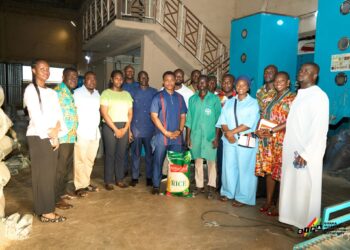
The mission also addressed the critical failure point in Ghana’s food security: post-harvest logistics. During a visit to the Badu Grain Storage site and the NAFCO grain warehouse, Dr. Otokunor noted that facilities built in the 1980s are currently providing cleaning and drying services but require urgent maintenance to meet modern industrial needs.
He identified limited processing and storage as the primary barrier preventing smallholder farmers from accessing expanded markets, as it forces them into distress sales during harvest peaks. To solve this, Dr. Otokunor detailed President John Dramani Mahama’s vision to introduce digitally controlled storage facilities nationwide.
“It is the vision of President John Dramani Mahama to improve the nation’s food buffer systems by introducing modern digitally controlled storage facilities across the country, as a means of organizing the grains supply chain system and providing expanded markets for our farmers”
Dr. Peter Boamah Otokunor, Director of the Presidential Initiative on Agriculture and Agribusiness
Beyond organising the supply chain, this digital transformation of the food buffer system is intended to reduce moisture-related losses and protect farmers from market volatility. According to the PIAA boss, the administration aims to create a reliable bridge between rural production and industrial demand, ensuring that the nation’s grain supply remains secure year-round.
The industrial scope of the tour extended to the Afram Plains, where Dr. Otokunor inspected the Ekyi Amanfrom irrigation site. This project, under construction by the Ghana Irrigation Development Authority (GIDA), is currently 75% complete and features electric-powered Centre-pivot irrigation equipment.

Once operational, the scheme will allow for all-year-round farming across 250 hectares, specifically targeting the upscaling of tomato production to reduce the nation’s heavy reliance on imported paste.
This site is a physical manifestation of the move toward commercial agriculture. The government is attempting to stabilize the raw material supply for local processing plants, and the site is providing the infrastructure for consistent, non-seasonal production.
Dr. Otokunor argued that without this level of irrigation infrastructure, agro-industrialization remains vulnerable to the erratic nature of rainfall patterns, which has historically hindered large-scale investment in the processing sector.
Agro-Industrialization Vision
Dr. Otokunor’s nationwide tour is underpinned by a clear mandate: the integration of modern technology and sovereign infrastructure to drive industrial growth.
Whether through the production of 3rd Generation Boars or the construction of digitally-led grain warehouses, the Presidential Initiative is focused on creating a “bankable” agricultural sector to move beyond simple production and toward a system where every link in the value chain – from genetics to storage to irrigation – is optimized for commercial output.
Through connecting the personal success of veteran farmers like Hon. Asiedu Nketiah with broader state projects like the Ekyi Amanfrom scheme, Dr. Otokunor presented a unified agricultural front, reaffirming that the current administration is an active participant in the vision for a prosperous, self-sufficient Ghana backed by tangible, high-tech progress on the ground.
From the advanced piggery operations at Bouna Farms to the 75% complete Ekyi Amanfrom irrigation site, Dr. Otokunor’s mission signaled a consolidation of the state’s role in organizing the grain supply chain and expanding markets for both large-scale and smallholder farmers.

The working tour serves as a report card for the state of Ghanaian agribusiness in 2026, identifying the maintenance gaps in 80s-era infrastructure while launching ultra-modern irrigation projects.
The Presidential Initiative is effectively bridging the gap between historical potential and future industrialization, with a focus on digitally controlled systems and “3rd Generation” livestock, proving that the administration’s strategy is no longer just about feeding the nation, but about powering the industry.
READ ALSO: African Finance Chiefs Seek Lifelines as Growth Slips