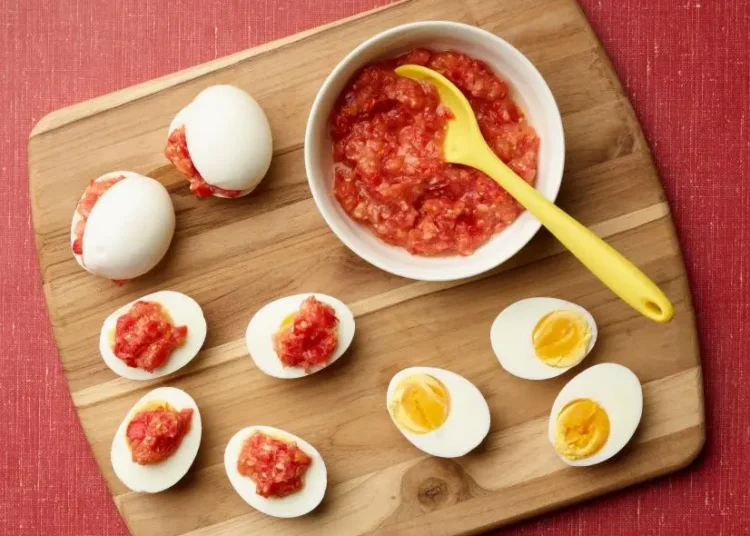
The familiar call of “Kosua ne meko!” still rings out across busy markets, trotro stations, and traffic lights in Ghana. For generations, this simple street snack hard-boiled eggs split open and filled with a fiery, chunky tomato-pepper relish has been a quick, affordable favourite for students, traders, office workers, and late-night travellers.
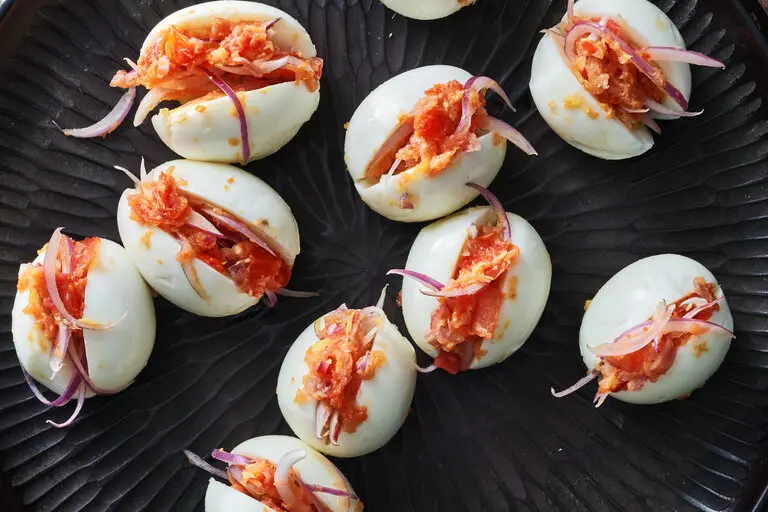
Literally meaning “egg and pepper” in Twi, kosua ne meko represents everyday Ghanaian ingenuity at its best: maximum flavour from minimal ingredients. Vendors often cure the eggs a day ahead by rolling them, shell and all, in damp salt for subtle seasoning. They then peel them, make a gentle slit down the middle, and generously stuff the gap with fresh “raw pepper” a vibrant mix of crushed tomatoes, red onions, Scotch bonnet or habanero chillies, and sometimes ginger or garlic. The result is creamy, spicy, messy joy in one handheld bite.
Recognition on the Global Stage
In August 2023, this humble invention stepped onto the international stage when The New York Times Cooking section featured it in an article titled “An Even Better Way to Eat Hard-Boiled Eggs.” Written by Yewande Komolafe, the piece described kosua ne meko as an easy-to-make, shareable snack perfect for potlucks, beach days, or quick meals. It highlighted how the relish varies slightly by vendor but always delivers bold, addictive flavour. One Ghanaian home cook quoted in the story captured the essence perfectly: “You never, ever have just one.”
The feature sparked quite a pride among Ghanaians. Social media lit up with comments celebrating the recognition of a dish long sold at roadside stalls for just a few cedis. For many, it marked a gradual but meaningful validation proof that Ghana’s street food culture, born from necessity and creativity, deserves global appreciation alongside jollof rice and waakye.
On the streets, the snack remains deeply practical. Street prices typically range from GH¢3 to GH¢10 per egg depending on location and size, though some modern eateries have introduced premium versions costing as much as GH¢50. Its popularity endures because it is cheap, protein-rich, portable, and endlessly satisfying the perfect fix during morning rushes, afternoon breaks, or evening traffic jams.
Consumer’s Opinions
Consumers across Ghana have their own cherished memories of the dish. Many recall buying it as schoolchildren or during long trotro rides, where the spicy kick provided both energy and comfort. Others note its social side: sharing one egg often leads to buying two, then three, turning a simple purchase into a small moment of connection.
One regular eater shared her honest thoughts on the snack, “Kosua ne meko, it’s nice but sometimes it is dependent on the pepper, how the vendors do it. When the pepper is not nice, I personally become nauseous after eating it. But when the pepper is very nice, I enjoy it.”
A young professional in Accra reacted enthusiastically to the international spotlight, “For kosua ne meko to be featured in the New York Times, it means our snack has gone international. Take for instance the egg vendor at China Mall, the one who sells hers with corned beef and sardines -that’s a big step and a win for us Ghanaians.”
Another consumer expressed some grievances about preparation standards, “People don’t really take their time to prepare it, especially the pepper. Some of the sellers’ pepper tastes bitter and others too doesn’t taste good. I think it happens this way because it has become a favourite for everyone and the consumers too have become a lot.”
A health practitioner also weighed in on its nutritional value, “Eggs are a good source of protein, so if you eat it, it is good. Some people even get as much as five, unless you have any health restriction or health condition that restricts you. Apart from that, health-wise it is good.”
Several voices emphasised that while home versions or restaurant plates can come close, nothing quite matches the fresh, vibrant taste straight from the vendor’s tray.
Though similar egg-and-pepper combinations appear elsewhere in West Africa, Ghana’s version with its signature raw relish and convenient street presentation feels uniquely ours. It embodies the resourcefulness that defines much of Ghanaian cuisine: turning ordinary ingredients into something unforgettable.
As Ghanaian food continues gaining fans worldwide, kosua ne meko stands as a quiet success story. What began as a practical roadside solution has slowly earned broader recognition, reminding us that some of the country’s best inventions are the simplest ones.
Next time you hear a vendor’s call, stop for one or two. Because this small snack carries big flavours, big memories, and now, a growing place on the global table.
READ ALSO: Kremlin Urges Continued US–Iran Talks to Avert Escalation