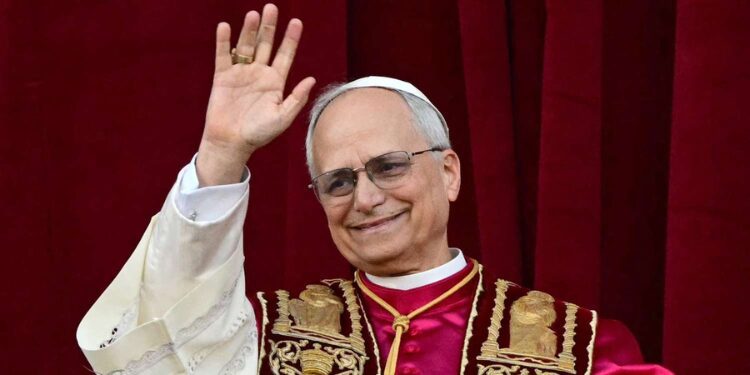
Pope Leo XIV has returned to Rome after completing an 11-day Apostolic Journey across four African nations, concluding a high-profile tour marked by strong messages on global leadership, peace, and social justice.
The pontiff wrapped up his visit with a final Mass held at Malabo Stadium in Equatorial Guinea, where tens of thousands of faithful gathered from early morning despite heavy rain to witness the closing ceremony of the tour.
The apostolic journey, which included stops in Algeria, Cameroon, Angola, and Equatorial Guinea, saw Pope Leo XIV cover nearly 18,000 kilometres as part of his first major international mission since assuming the papacy. It also marked the first major overseas tour by a U.S.-born pope.
During the final Mass, Pope Leo XIV delivered his 25th address of the trip, urging the faithful to live their religion with joy and emphasising that the Christian message is rooted in liberation from what he described as the “slavery of evil.”
His remarks reflected recurring themes throughout the visit, particularly the importance of faith, resilience, and moral responsibility.
Across the tour, the Pontiff adopted a notably direct tone on global affairs, warning that international instability is being driven by concentrated wealth and power.

Pope Leo XIV criticised what he described as neo-colonial influences in global systems and warned that parts of the world were being “ravaged by a handful of tyrants.”
His comments attracted international political attention, including criticism from U.S. President Donald Trump, who described the Pope as “terrible” ahead of the visit in response to earlier remarks interpreted as criticism of Western policy.
Despite the controversy, Pope Leo XIV signaled he would continue addressing global issues affecting peace and justice, reinforcing his commitment to speaking on conflict, inequality, and international governance.
The final Mass in Equatorial Guinea served as a symbolic conclusion to a journey that combined pastoral outreach with broader reflections on the Church’s role in a rapidly changing world.
Throughout the tour, the Pontiff repeatedly highlighted Africa’s importance to the Catholic Church, describing the continent as a source of spiritual vitality and missionary strength and encouraged communities to remain central to shaping the Church’s future and strengthening its social mission.
As he departed for Rome, Pope Leo XIV expressed gratitude for the encounters and experiences of the journey, describing them as deeply formative for his ministry.
Pope Leo XIV’s Final Message of Apostolic Journey to Africa

Pope Leo XIV delivered the final message of his Apostolic Journey to Africa during a concluding Mass at Malabo Stadium in Equatorial Guinea, marking the end of an 11-day visit across four African nations.
The Mass, was the Pope’s final public engagement before the farewell ceremony at Malabo International Airport, from where he departed for Rome.
During his homily, Pope Leo XIV underlined that interpreting Scripture is “both serious and providential,” as it “prepares us to read together the book of history, that is, the pages of our own lives, which God continues to inspire with His wisdom.”
The Pontiff referenced the Acts of the Apostles, in which the deacon Philip explains the Scripture and proclaims Jesus to the eunuch of the Queen of Ethiopia.
Pope Leo XIV noted that the eunuch is intelligent and cultured but not fully free, and all he has is his labour, which benefits others. Even his body, the Pontiff explained, shows this, as being a eunuch, he cannot give life, and thus “all his vitality is placed at the service of a power that controls and rules over him.”

“Yet, as he returns to his homeland of Africa, which for him has become a place of servitude, the proclamation of the Gospel sets him free. The Word of God that he holds in his hands bears unexpected fruit in his life.”
Pope Leo XIV
According to the Holy Father, through Philip, the eunuch is transformed from a spectator of the sacred texts “into a protagonist in the very story that captivates him, because it now concerns him personally.”
“This African man thus enters into Scripture, which welcomes every reader who seeks to understand God’s word. He steps into salvation history, which embraces every man and woman, especially the oppressed, the marginalized, and the least among us.”
Pope Leo XIV
Pope Leo XIV pointed out that this word becomes a lived reality, explaining that the story of human lives also finds its deepest meaning, fulfilment, and transformation through the Gospel.
READ ALSO : Pentagon Announces Sudden Departure Of Navy Chief John Phelan