
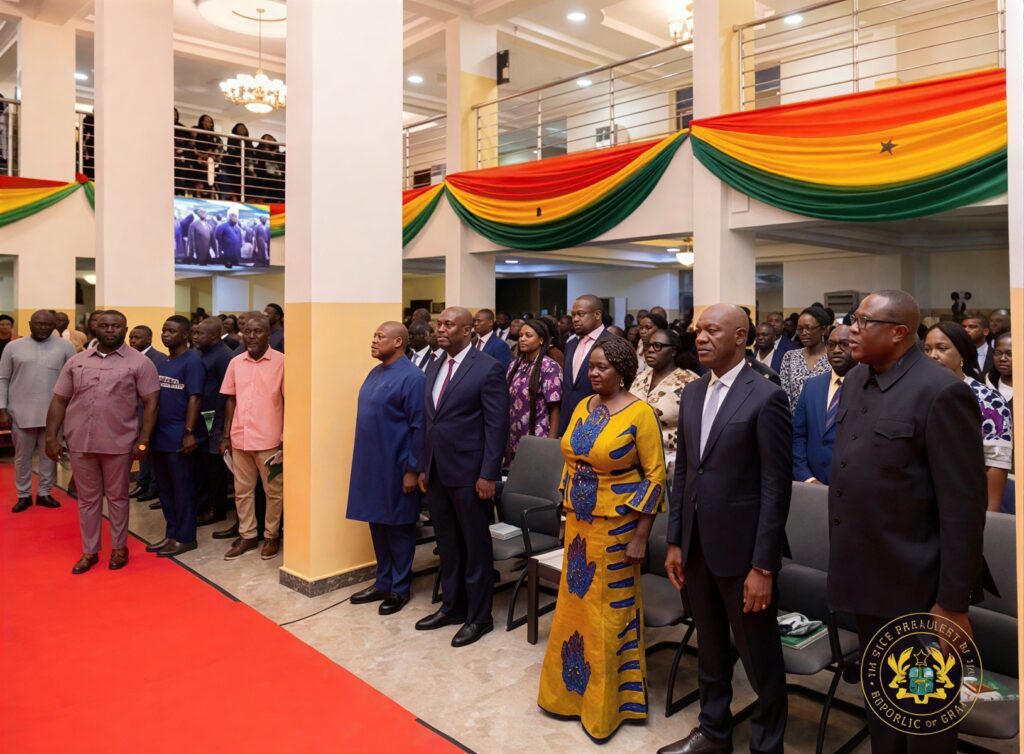
Speaking at the Controller and Accountant-General’s Department (CAGD) conference, the Vice President emphasised the need for sustainable fiscal governance and deeper integration of technology across Ghana’s public sector. The address focused on strengthening transparency measures and reinforcing the importance of professional excellence in managing national resources.
According to Her Excellency, sound accounting systems continue to underpin effective governance, enabling government to plan and allocate resources efficiently. She pointed out that sustained fiscal discipline and deliberate reforms are yielding measurable results, including a marked decline in inflation and increased currency stability.
Recent economic data show inflation falling sharply from 23.8 percent in December 2024 to 3.2 percent by March this year. The Ghana cedi has also stabilised, supported by improved reserves and a primary fiscal surplus of 1.6 percent, reversing earlier deficits.
“Over the past year, government has aimed to show that disciplined management delivers results. Inflation declined from 23.8% in December 2024 to 3.2% as of March this year. The cedi has stabilised significantly, supported by improved reserves. More importantly, Ghana has achieved a primary fiscal surplus of 1.6%, thereby reversing previous deficits.”
Her excellency, Professor Jane Naana Opoku Agyemang
These gains, she explained, stem from targeted reforms and stronger public financial management systems driven by state institutions. Looking ahead, she stressed that the future of fiscal governance will depend on responsible digital transformation and innovation to boost efficiency and minimise financial leakages.
Efforts to strengthen payroll systems and eliminate irregularities, including ghost names, were highlighted as critical steps in protecting public funds through verifiable processes. She reaffirmed government’s commitment to ensuring that every cedi delivers tangible value through transparent expenditure.
The Controller and Accountant-General’s Department was recognised for its central role in translating policy into impact and ensuring resources reach their intended beneficiaries. The Vice President commended the department’s work and called for sustained professionalism and accountability.
She further noted that transparency in public finance management is essential for effective governance and maintaining public trust. Under the 2026 budget policy, strict compliance and oversight mechanisms have been introduced to ensure that public funds are used efficiently.
Government has begun enforcing the amended Public Financial Management Act 2025, which introduces sanctions for non-compliance alongside real-time audit monitoring. In addition, a newly established Value-for-Money office now evaluates and certifies projects before approval, while also tracking implementation to ensure measurable economic impact.
“We are enforcing the following: the amended Public Financial Management Act 2025, sanctions for non-compliance, and real-time audit monitoring systems. The government is also establishing a Value-for-Money Office to certify projects before approval, monitor implementation, and ensure that our resources deliver measurable impact.”
Her excellency, Professor Jane Naana Opoku Agyemang
The Vice President tasked the department with leading the digital transformation of accounting systems, particularly in enforcing commitment controls and preventing the accumulation of arrears. She reiterated that accounting remains fundamental to prudent resource management and effective national planning.
Biometric Verification Introduced To Strengthen Payroll Integrity
The Controller and Accountant-General, Kwasi Adjei, announced the rollout of mandatory periodic live biometric verification for all public sector workers. The measure is aimed at safeguarding payroll integrity and aligns with the push for digital transformation.
Under the new directive, Government employees are required to verify their identities using facial or fingerprint recognition on an official platform. This system is designed to ensure continuous alignment between payroll records and verified personnel throughout each employee’s tenure.
Reflecting on past challenges, the Vice President observed that weaknesses in accounting systems have historically carried significant consequences. She described the role of accountants as central to national development and critical to sustaining progress.
The 2026 policy direction places strong emphasis on technology and accountability as pillars of sustainable governance. Authorities believe that disciplined financial management, backed by evidence and verifiable systems, will continue to deliver results across sectors.
Officials have also reiterated the importance of strict institutional compliance, particularly in eliminating unauthorised expenditure and strengthening monitoring frameworks. The Vice President called on the Controller and Accountant-General’s Department to lead efforts in real-time financial reporting to enhance transparency in public spending.
Reinforcing the administration’s fiscal stance, she quoted the 2026 budget statement, emphasising that “every cedi must work for the Ghanaian people,” a principle guiding current reforms.
The Value-for-Money office is expected to play a gatekeeping role by ensuring that only projects with clear public benefit receive approval, while closely monitoring implementation to prevent waste and guarantee measurable returns.
READ ALSO: Ghana’s Broad Money Supply Climbs Sharply to GHS314 Billion