International Maritime Organization has urged its 176 Member States and the global shipping industry to step up efforts to protect the marine environment, warning that stronger implementation of existing rules rather than the creation of new ones alone is now critical to safeguarding the world’s oceans from mounting environmental pressures linked to global maritime activity.
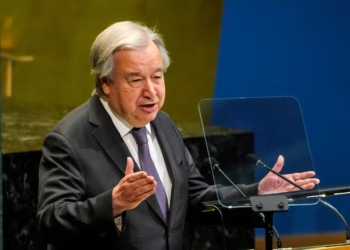
According to IMO Secretary-General Arsenio Dominguez, IMO take responsibility to protect the ocean.
“With shipping being one of the main users of the ocean space, it is the reason why we focus on enhancing our regulatory framework to reduce pollution and address new challenges, such as underwater radiated noise and transboundary species.”
Arsenio Dominguez
He emphasised that although international agreements and regulations are still important, the true test will be how well they are applied throughout the world’s maritime industry. He claims that if significant environmental protection is to be attained, legislative frameworks must now be translated into practical reforms at sea and in ports around the world.
IMO Secretary-General further noted that, “beyond setting the rules, we must put policy into practice.”
This comes at a time when the shipping industry which transports the majority of global trade is under increased scrutiny for its environmental impact, which includes pollution, biodiversity loss, and greenhouse gas emissions that contribute to climate change.
Over several decades, the IMO has developed an extensive array of international treaties aimed at minimising shipping’s environmental impact and increasing maritime safety. These accords are the foundation of global maritime governance and are regarded as critical to efforts to preserve the oceans from industrial and operational damage.
Among the most important is the MARPOL Convention, which establishes restrictions to avoid marine pollution from ships, such as oil spills, sewage discharge, rubbish disposal, and air pollution. It is still one of the most widely accepted environmental treaties in the maritime sector.
Moreover, the Ballast Water Management Convention and the Anti-Fouling Systems Convention are also important tools for mitigating the spread of invasive aquatic organisms, which can severely disturb marine ecosystems when transported across oceans in ship ballast tanks or attached to hulls.
Other important frameworks include the Hong Kong Convention on Ship Recycling, which aims to ensure that ships are dismantled in an environmentally sound and safe manner, as well as the London Convention and Protocol, which regulate waste dumping at sea and seek to limit harmful ocean disposal practices.
Together, these instruments constitute a global effort to strike a compromise between the needs of international shipping and the preservation of endangered marine ecosystems.
Tackling Pollution, Climate Impact and Biodiversity Loss
This year’s World Oceans Day highlights recent progress in tackling some of the most urgent environmental issues confronting the maritime sector, such as greenhouse gas emissions, invasive species, undersea noise, and marine plastic pollution.
A major development is the adoption of the 2026 Strategy and Action Plan to Address Marine Plastic Litter from Ships. The initiative reinforces IMO’s long-standing objective of achieving zero plastic waste discharges from ships into the ocean by 2030, a target that reflects growing global concern over the scale and persistence of plastic pollution in marine environments.
Another focus area is underwater radiated noise (URN), which has been shown to interfere with marine species that depend on sound for communication, navigation, and survival.
To address this issue, the IMO has extended the trial phase of its revised guidelines on reducing underwater noise until 2028. The organisation also plans to commission further studies to better understand its impacts and inform future regulatory measures.
Furthermore, biofouling, the accumulation of microorganisms, plants, algae, or small animals on ship hulls, is also being targeted due to its role in spreading invasive species across ecosystems. Member States have agreed to develop a standalone legally binding instrument to manage and control ships’ biofouling, with the aim of minimising ecological disruption and protecting marine biodiversity.
In addition to these initiatives, ongoing discussions continue around the shipping sector’s contribution to global climate change. Negotiations are focused on strengthening regulations to reduce greenhouse gas emissions from ships, an issue that has become increasingly urgent as the world seeks to meet international climate targets.
On World Oceans Day, the International Maritime Organization’s (IMO) message is clear: protecting marine ecosystems is no longer merely a policy goal but an operational imperative for the survival of international shipping, given the oceans’ crucial role in global trade, climate regulation, and biodiversity.
READ ALSO: Accra Floods Again as $350 Million Drainage Project Stalls, Analyst Warns