• About
  • Advertise
  • Privacy Policy
  • Contact
Friday, May 15, 2026
  • Login
The Vaultz News
  • Top Stories
  • News
    • General News
    • Education
    • Health
    • Opinions
  • Economics
    • Economy
    • Finance
      • Banking
      • Insurance
      • Pension
    • Securities/Markets
  • Business
    • Agribusiness
    • Vaultz Business
    • Extractives/Energy
    • Real Estate
  • World
    • Africa
    • America
    • Europe
    • UK
    • USA
    • Asia
    • Around the Globe
  • Innovation
    • Technology
    • Wheels
  • Entertainment
  • 20MOBPL2DNew
  • Jobs & Scholarships
    • Job Vacancies
    • Scholarships
No Result
View All Result
The Vaultz News
  • Top Stories
  • News
    • General News
    • Education
    • Health
    • Opinions
  • Economics
    • Economy
    • Finance
      • Banking
      • Insurance
      • Pension
    • Securities/Markets
  • Business
    • Agribusiness
    • Vaultz Business
    • Extractives/Energy
    • Real Estate
  • World
    • Africa
    • America
    • Europe
    • UK
    • USA
    • Asia
    • Around the Globe
  • Innovation
    • Technology
    • Wheels
  • Entertainment
  • 20MOBPL2DNew
  • Jobs & Scholarships
    • Job Vacancies
    • Scholarships
No Result
View All Result
The Vaultz News
No Result
View All Result
in Banking, Sub Top Stories1

Ghana’s Broad Money Supply Climbs Sharply to GHS314 Billion

M.Cby M.C
April 23, 2026
Reading Time: 5 mins read
Ghana’s Broad Money Supply Climbs Sharply to GHS314 Billion

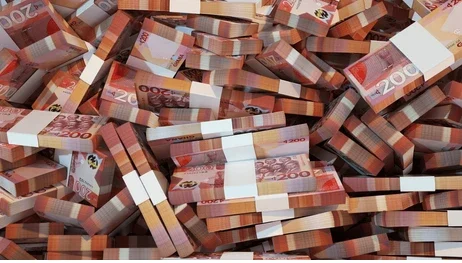
Ghana’s monetary sector recorded significant expansion in 2025, with Broad Money Supply (M2) rising steadily to close the year at GHS314.42 billion in December, up from GHS247.80 billion in December 2024. 

The Bank of Ghana’s latest monetary survey data highlights a year marked by liquidity growth, rising deposits, and sustained financial system resilience despite fluctuations in key components.

The growth trajectory of M2 reflects consistent increases throughout the year. From GHS245.14 billion in January, money supply rose to GHS249.47 billion in February, GHS255.76 billion in March, and GHS259.87 billion in April. It continued upward to GHS267.72 billion in May, before moderating slightly to GHS265.19 billion in June. 

The second half of the year saw stronger gains, with GHS276.93 billion in July, GHS275.48 billion in August, GHS277.59 billion in September, GHS282.47 billion in October, GHS289.44 billion in November, and finally GHS314.42 billion in December.

ADVERTISEMENT

Net Foreign Assets Show Volatility but End Strong

Net Foreign Assets (NFA) displayed notable fluctuations during the year but ended on a strong note. From GHS85.02 billion in December 2024, NFA increased to GHS90.39 billion in January and GHS97.49 billion in February, peaking at GHS134.54 billion in April. 

However, a sharp decline followed, with figures dropping to GHS75.20 billion in May, GHS75.77 billion in June, and GHS67.63 billion in July.

A recovery phase began in August at GHS79.70 billion, strengthening further to GHS101.77 billion in September, before easing to GHS89.64 billion in October and rising again to GHS99.94 billion in November. By December 2025, NFA had surged to GHS120.25 billion, reflecting improved external sector conditions.

The Bank of Ghana’s contribution to NFA rose from GHS45.25 billion in December 2024 to GHS98.30 billion in December 2025, while Deposit Money Banks recorded GHS21.96 billion at year-end, up from GHS39.77 billion the previous year but with fluctuations during the year.

Liquidity Crunch Looms After BoG's GHS15bn Withdrawal from the Economy
Ghana’s Broad Money Supply Climbs Sharply to GHS314 Billion 3

Domestic Assets Drive Monetary Growth

Net Domestic Assets (NDA) remained a key driver of monetary expansion. Starting at GHS244.76 billion in December 2024, NDA declined to GHS207.12 billion in April 2025 before rebounding strongly to GHS264.04 billion by December 2025.

Net Claims on Government formed a substantial component, rising from GHS113.29 billion in December 2024 to GHS132.65 billion in December 2025. Claims on Government stood at GHS166.51 billion in December 2025, compared to GHS160.49 billion a year earlier. Government deposits, however, remained significant, closing at GHS33.86 billion, though lower than the GHS47.20 billion recorded in December 2024.

Credit to the private sector also showed resilience. Claims on the private sector and public enterprises increased from GHS101.05 billion in December 2024 to GHS115.19 billion in December 2025, reflecting gradual recovery in lending activity.

Total Assets and Liabilities Expand

Total Assets in the banking system rose from GHS329.78 billion in December 2024 to GHS384.29 billion in December 2025, mirroring growth in Total Liabilities, which reached the same level. 

Monthly asset figures showed steady progression, including GHS333.08 billion in January, GHS337.58 billion in February, GHS343.93 billion in March, and peaking toward year-end.

ADVERTISEMENT

This expansion underscores the strengthening of Ghana’s financial system, supported by both domestic and external asset growth.

Deposit Growth Anchors Liquidity Expansion

Deposit mobilization played a crucial role in driving money supply growth. Demand deposits increased significantly from GHS104.14 billion in December 2024 to GHS137.70 billion in December 2025. Savings and time deposits also grew from GHS79.49 billion to GHS102.82 billion over the same period.

Foreign currency deposits fluctuated but remained elevated, closing at GHS69.88 billion in December 2025, compared to GHS81.98 billion in December 2024. Meanwhile, currency outside banks rose from GHS64.17 billion to GHS73.90 billion, indicating increased cash circulation within the economy.

Reserve Money and Liquidity Conditions

Reserve Money (RM) increased from GHS130.52 billion in December 2024 to GHS146.83 billion in December 2025, reflecting expansionary liquidity conditions. RM peaked at GHS144.94 billion in April before declining mid-year and rising again toward the end of the year.

Total Liquidity (M2+) followed a similar trend, rising from GHS329.78 billion to GHS384.29 billion, consistent with overall monetary growth.

Narrow Money (M1), which includes currency in circulation and demand deposits, increased from GHS168.31 billion in December 2024 to GHS211.59 billion in December 2025, reinforcing the strong upward trend in liquidity.

Stability in Key Ratios

Despite the expansion, key financial ratios remained relatively stable. The currency to deposit ratio hovered between 0.20 and 0.24, ending the year at 0.24, while the currency to M2 ratio remained steady at around 0.17 to 0.19, closing at 0.19.

These stable ratios indicate balanced growth between cash and deposit components, suggesting effective liquidity management within the banking system.

The sharp rise in Broad Money Supply to GHS314.42 billion highlights increased economic activity and financial deepening in Ghana. Growth in deposits, steady credit expansion, and improved foreign asset positions all point to a strengthening macroeconomic environment.

However, the fluctuations observed in Net Foreign Assets and government-related balances suggest that external shocks and fiscal dynamics remain key factors to watch. Going forward, sustaining this growth will depend on continued policy coordination, inflation management, and strengthening of the external sector.

READ ALSO: Ghana Kills the Waste with New Cocoa Industrial Blueprint 

Sign Up to Our Newsletter

Fresh updates, Straight to your inbox

Tags: Bank of Ghana monetary surveyBroad Money M2 Ghanadeposits growth Ghanadomestic assets Ghanafinancial sector Ghana 2025Ghana banking sector growthGhana money supply 2025liquidity trends Ghananet foreign assets GhanaReserve Money Ghana
Share2Tweet2ShareSendSend
Please login to join discussion
Previous Post

Court Adjourns OSP Suit against Ken Ofori-Atta to May 26

Next Post

Turkish Lawmakers Pass Bill To Restrict Social Media Use For Under 15s

Related Posts

IMF Chief Hails Ghana’s Remarkable Turnaround After 2022 Crisis Following Successful Exit from ECF Programme
Economy

IMF Chief Hails Ghana’s Remarkable Turnaround After 2022 Crisis Following Successful Exit from ECF Programme

May 15, 2026
Fidelity Demands Africa Own Its Digital Future At a time when Africa’s digital economy is accelerating at an unprecedented pace, Fidelity Bank Ghana has delivered one of the strongest messages yet on the continent’s technological future. The bank made a bold and urgent case for Africa to stop depending on foreign controlled digital systems and begin building its own infrastructure capable of retaining value, strengthening currencies, and driving long term economic sovereignty. As one of the key sponsors of the 3i Africa summit, Fidelity Bank did not just show up to participate. It arrived with a message that resonated deeply across conference halls and policy discussions. Fidelity Bank emerged as one of the loudest voices championing a future where African nations control the very digital rails that power their economies. Digital Infrastructure Is The New Economic Power One of the defining moments of the summit came during a high level panel discussion on digital public infrastructure, where Adeline Aryee delivered a statement that immediately captured the attention of participants. She declared that if Africa builds its own digital rails, it naturally retains the value created by those systems. Her message was clear and uncompromising. In previous decades, national infrastructure was measured by roads, bridges, ports, and airports. Today, the true engines of economic power are payment platforms, identity systems, financial technology ecosystems, and digital marketplaces. According to Aryee, digital public infrastructure is no longer a luxury. It is now a strategic national asset. Her remarks struck at the heart of one of Africa’s most pressing economic concerns. Despite growing digital adoption, many transactions across the continent still pass through foreign payment systems, resulting in value leakage and continued pressure on local currencies. Ghana’s Success Story Becomes A Continental Blueprint Aryee highlighted Ghana’s progress in financial inclusion, mobile payments, and digital banking, describing the country as an emerging model for other African economies. Over the years, Ghana has invested heavily in domestic payment systems such as GhIPSS and its flagship platform, Gh-link. These systems have significantly expanded access to financial services while promoting digital transactions across urban and rural communities. Yet Aryee argued that inclusion alone is no longer enough. The next chapter for Africa, she insisted, must focus on ownership. She questioned why local transactions continue to depend on foreign rails when domestic infrastructure already exists. According to her, such dependence creates unnecessary external exposure and limits the continent’s ability to fully capture the economic benefits of its growing digital market. Her comments triggered intense debate among summit participants, many of whom acknowledged the urgent need for policy reforms and infrastructure investments. Market Driven Innovation Takes Center Stage Beyond infrastructure, Fidelity Bank also made a strong case for innovation that begins with real market needs. During the Ecosystem Roundtable on platforms, talent, and digital markets, Prince Osei Hyeaman-Addai shared insights from the bank’s years of digital financial innovation. He stressed that successful digital products are not built in boardrooms or based on assumptions. Instead, they are created by listening carefully to the market and understanding customer pain points. According to him, the market itself reveals the problems that need solving, the type of platform required, and the path toward scalable growth. His comments reflected a growing shift in African fintech circles, where customer centered design is becoming essential for product adoption and long term relevance. Trust And Credibility Remain The Real Currency Prince also emphasized that technology alone does not guarantee success. In his view, trust, credibility, and strong operational structures remain the real foundations of successful innovation. He noted that while investor interest in African fintech continues to rise, startups must prove they can deliver sustainable solutions, maintain transparency, and build products that respond to local realities. This perspective reflects Fidelity Bank’s own journey in digital transformation. Over the years, the bank has built strategic collaborations with leading fintech players, including IT Consortium, helping pioneer wallet to bank integrations and mobile financial solutions in Ghana. These partnerships have helped position Fidelity as one of Ghana’s most innovation driven financial institutions. A Defining Moment For Africa’s Digital Future Fidelity Bank’s participation at the 3i Africa Summit 2026 was more than a corporate appearance. It was a strategic declaration. At a time when Africa is racing to build competitive digital economies, the bank’s message was impossible to ignore. Africa cannot simply consume technology created elsewhere. It must own the infrastructure, shape the platforms, and capture the value generated by its digital future. As conversations from the summit continue to ripple across financial and policy circles, one thing is becoming increasingly clear. Africa’s next economic revolution may not be built on oil, gold, or minerals. It may be built on digital rails designed, owned, and powered by Africans. READ ALSO: IMF Ghana Review Ends in Dramatic Cliffhanger Fidelity Demands Africa Own Its Digital Future At a time when Africa’s digital economy is accelerating at an unprecedented pace, Fidelity Bank Ghana has delivered one of the strongest messages yet on the continent’s technological future. The bank made a bold and urgent case for Africa to stop depending on foreign controlled digital systems and begin building its own infrastructure capable of retaining value, strengthening currencies, and driving long term economic sovereignty. As one of the key sponsors of the 3i Africa summit, Fidelity Bank did not just show up to participate. It arrived with a message that resonated deeply across conference halls and policy discussions. Fidelity Bank emerged as one of the loudest voices championing a future where African nations control the very digital rails that power their economies. Digital Infrastructure Is The New Economic Power One of the defining moments of the summit came during a high level panel discussion on digital public infrastructure, where Adeline Aryee delivered a statement that immediately captured the attention of participants. She declared that if Africa builds its own digital rails, it naturally retains the value created by those systems. Her message was clear and uncompromising. In previous decades, national infrastructure was measured by roads, bridges, ports, and airports. Today, the true engines of economic power are payment platforms, identity systems, financial technology ecosystems, and digital marketplaces. According to Aryee, digital public infrastructure is no longer a luxury. It is now a strategic national asset. Her remarks struck at the heart of one of Africa’s most pressing economic concerns. Despite growing digital adoption, many transactions across the continent still pass through foreign payment systems, resulting in value leakage and continued pressure on local currencies. Ghana’s Success Story Becomes A Continental Blueprint Aryee highlighted Ghana’s progress in financial inclusion, mobile payments, and digital banking, describing the country as an emerging model for other African economies. Over the years, Ghana has invested heavily in domestic payment systems such as GhIPSS and its flagship platform, Gh-link. These systems have significantly expanded access to financial services while promoting digital transactions across urban and rural communities. Yet Aryee argued that inclusion alone is no longer enough. The next chapter for Africa, she insisted, must focus on ownership. She questioned why local transactions continue to depend on foreign rails when domestic infrastructure already exists. According to her, such dependence creates unnecessary external exposure and limits the continent’s ability to fully capture the economic benefits of its growing digital market. Her comments triggered intense debate among summit participants, many of whom acknowledged the urgent need for policy reforms and infrastructure investments. Market Driven Innovation Takes Center Stage Beyond infrastructure, Fidelity Bank also made a strong case for innovation that begins with real market needs. During the Ecosystem Roundtable on platforms, talent, and digital markets, Prince Osei Hyeaman-Addai shared insights from the bank’s years of digital financial innovation. He stressed that successful digital products are not built in boardrooms or based on assumptions. Instead, they are created by listening carefully to the market and understanding customer pain points. According to him, the market itself reveals the problems that need solving, the type of platform required, and the path toward scalable growth. His comments reflected a growing shift in African fintech circles, where customer centered design is becoming essential for product adoption and long term relevance. Trust And Credibility Remain The Real Currency Prince also emphasized that technology alone does not guarantee success. In his view, trust, credibility, and strong operational structures remain the real foundations of successful innovation. He noted that while investor interest in African fintech continues to rise, startups must prove they can deliver sustainable solutions, maintain transparency, and build products that respond to local realities. This perspective reflects Fidelity Bank’s own journey in digital transformation. Over the years, the bank has built strategic collaborations with leading fintech players, including IT Consortium, helping pioneer wallet to bank integrations and mobile financial solutions in Ghana. These partnerships have helped position Fidelity as one of Ghana’s most innovation driven financial institutions. A Defining Moment For Africa’s Digital Future Fidelity Bank’s participation at the 3i Africa Summit 2026 was more than a corporate appearance. It was a strategic declaration. At a time when Africa is racing to build competitive digital economies, the bank’s message was impossible to ignore. Africa cannot simply consume technology created elsewhere. It must own the infrastructure, shape the platforms, and capture the value generated by its digital future. As conversations from the summit continue to ripple across financial and policy circles, one thing is becoming increasingly clear. Africa’s next economic revolution may not be built on oil, gold, or minerals. It may be built on digital rails designed, owned, and powered by Africans. READ ALSO: IMF Ghana Review Ends in Dramatic Cliffhanger Fidelity Demands Africa Own Its Digital Future
Banking

Fidelity Demands Africa Own Its Digital Future

May 15, 2026
IMF Ghana Review Ends in Dramatic Cliffhanger
Economy

IMF Ghana Review Ends in Dramatic Cliffhanger

May 15, 2026
Ing. Kenneth Ashigbey, the Chief Executive Officer of the Ghana Chamber of Mines.
Extractives/Energy

Chamber of Mines Warns Against State Ownership Failures Amidst IEA Policy Dispute

May 14, 2026

Sign Up to Our Newsletter

Fresh updates, Straight to your inbox

Recent News

Ayine aand Dame

When the State’s Former Chief Attorney Becomes the Accused’s Counsel: Ghana Must Shut the Revolving Door

May 15, 2026
President John Dramani Mahama

Government to Finish 35 Agenda 111 Hospitals, President Mahama Confirms

May 15, 2026
President John Dramani Mahama

President Mahama Allocates 1% GDP to Commercial Agriculture Post-ECF

May 15, 2026
President John Dramani Mahama with Northern Regional House of Chief

Mahama Seeks Stronger Partnership With Traditional Authorities

May 15, 2026
Dr. Andy Osei Okrah, TCDA CEO, with Dr. Isaac Danso, CSIR-OPRI Director, and Team at the Institute

CSIR-OPRI Readies Five Million Seedlings For National Oil Palm Policy

May 15, 2026
Next Post
reuters 69c662c1 1774609089

Turkish Lawmakers Pass Bill To Restrict Social Media Use For Under 15s

The Vaultz News

Copyright © 2025 The Vaultz News. All rights reserved.

Navigate Site

  • About
  • Advertise
  • Privacy Policy
  • Contact

Follow Us

Welcome Back!

Login to your account below

Forgotten Password?

Retrieve your password

Please enter your username or email address to reset your password.

Log In
No Result
View All Result
  • Top Stories
  • News
    • General News
    • Education
    • Health
    • Opinions
  • Economics
    • Economy
    • Finance
      • Banking
      • Insurance
      • Pension
    • Securities/Markets
  • Business
    • Agribusiness
    • Vaultz Business
    • Extractives/Energy
    • Real Estate
  • World
    • Africa
    • America
    • Europe
    • UK
    • USA
    • Asia
    • Around the Globe
  • Innovation
    • Technology
    • Wheels
  • Entertainment
  • 20MOBPL2D
  • Jobs & Scholarships
    • Job Vacancies
    • Scholarships

Copyright © 2025 The Vaultz News. All rights reserved.

This website uses cookies. By continuing to use this website you are giving consent to cookies being used. Visit our Privacy and Cookie Policy.

Discover the Details behind the story

Get an in-depth analysis of the news from our top editors

Enter your email address