
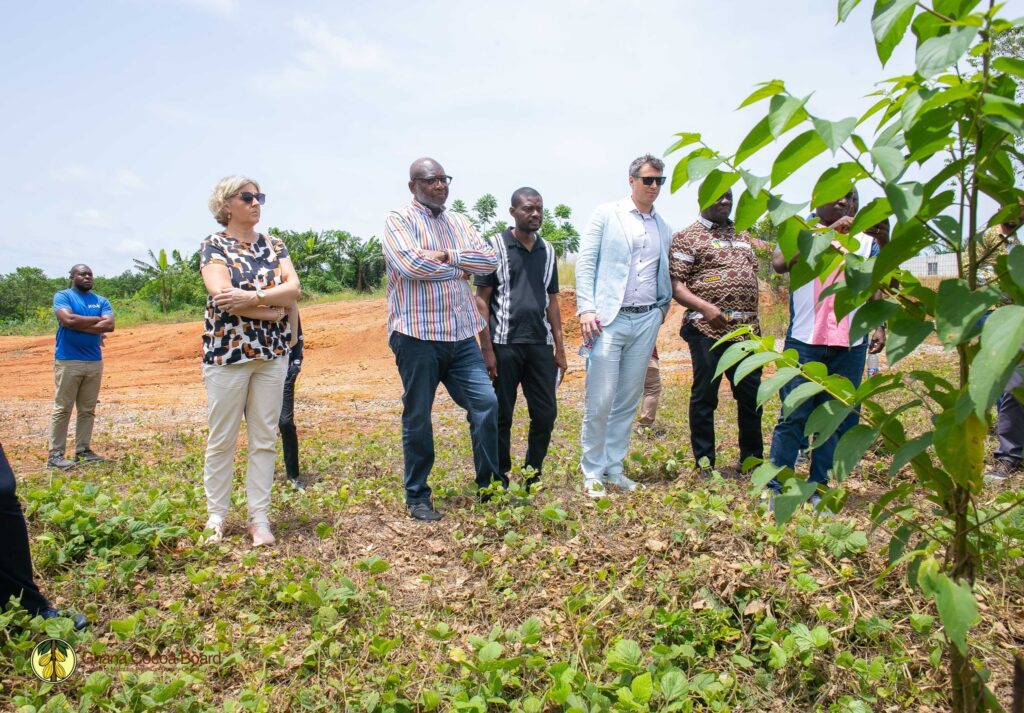
Dr. Ransford (Randy) Abbey, Chief Executive Officer of the Ghana Cocoa Board (COCOBOD), has led a high-powered delegation to the KOA Impact facility in Achiase in the Eastern Region, where the traditional geography of Ghana’s cocoa sector is undergoing a seismic shift, moving away from the binary focus on the fermented bean toward a more sophisticated, whole-fruit industrial model.
Accompanied by the Swiss Ambassador to Ghana, Benin, and Togo, H.E. Simone Giger, Dr. Abbey’s working visit served as an assessment of a technology that effectively monetizes what was previously discarded as biological waste, by validating the extraction of cocoa “sweatings” for the production of cocoa juice.
COCOBOD described this as the end of the raw bean era and the dawn of a diversified, multi-stream agricultural economy.
“The purpose of the visit was to gain firsthand insight into the innovative extraction of cocoa sweatings for the production of cocoa juice, a value-added process that is creating new opportunities within the cocoa sector.
“Discussions focused on strengthening collaboration between COCOBOD and the Swiss company to scale up this initiative across other cocoa-growing regions in Ghana”
Ghana Cocoa Board
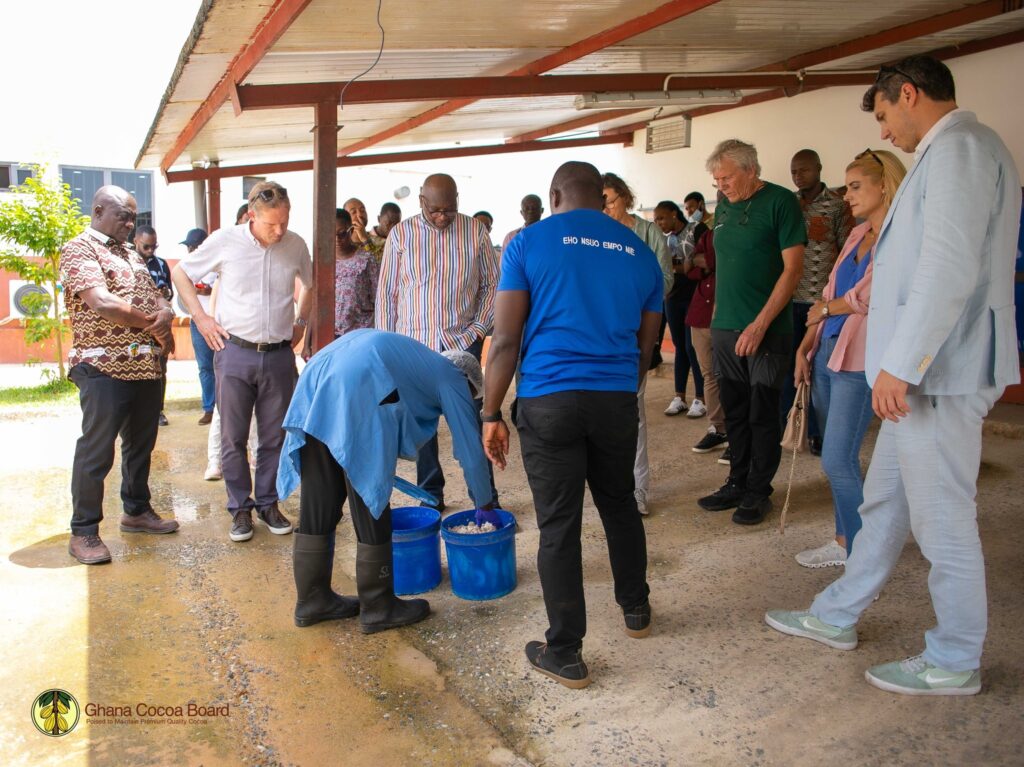
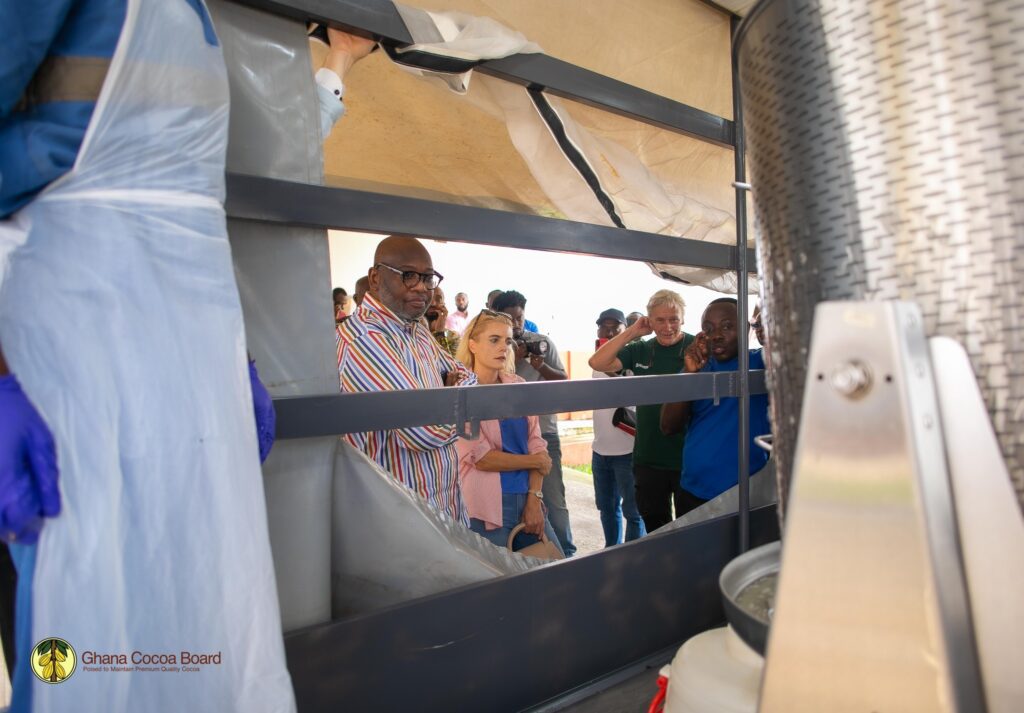
For decades, the pulp surrounding the cocoa bean – technically known as the mucilage or sweatings – was treated as a byproduct of the fermentation process, allowed to seep into the soil as waste. KOA Impact, a Swiss-Ghanaian venture, has disrupted this cycle by engineering a decentralized processing system that captures this high-value liquid before the beans enter fermentation.
For the company, this is the essence of industrial upcycling.
Through turning a waste product into a premium ingredient for the global food and beverage industry, the Achiase facility is proving that Ghana’s industrial future is found in the total utilization of its natural resources. The merit of the innovation lies in its ability to extract this liquid without compromising the quality of the primary export
Income Diversification
According to COCOBOD, the strategic importance of the Achiase visit centers on the living income gap that continues to plague smallholder farmers. Dr. Abbey’s interest in the KOA model is rooted in its potential to function as an immediate income multiplier.
He noted that, according to industry benchmarks, farmers can see an increase in their seasonal revenue of up to 30% by selling both the beans and the juice. This is a critical buffer against the volatility of the global terminal markets in London and New York.
When the cocoa juice is extracted through KOA’s Community Mobile Processing Units (CMPUs), the farmer receives payment for a “waste” product before the beans are even dried. Dr. Abbey expressed willingness to champion this model to expand farmers’ awareness of the full cocoa value chain and foster a sense of industrial ownership.
No longer will the farmers merely be “producers of raw materials”; they will now be foundational partners in a high-tech manufacturing process. The CEO’s observation that this initiative creates additional income streams was a direct nod to the national goal of rural economic transformation.
It is a technical solution to a systemic problem, ensuring that the wealth generated from the cocoa fruit is more equitably distributed across the seven cocoa-growing regions.
Scaling the Swiss-Ghanaian Nexus
The presence of Ambassador Simone Giger highlighted the diplomatic meritocracy that defines the current Ghana-Switzerland relationship. Switzerland, as a global titan in the chocolate industry, has a vested interest in the long-term progress and compliance of the Ghanaian supply chain.
The KOA project is a prime example of European technology meeting African productivity to create a sustainable trade pact. The discussions in Achiase focused heavily on scaling this initiative, moving beyond a single pilot factory to a nationwide industrial network.
KOA noted that its facility in Achiase is Africa’s largest cocoa fruit processing factory, and its use of solar-powered decentralized units addresses the logistical challenges of rural Ghana. Scaling this across all cocoa-growing regions would require a massive institutional lift from COCOBOD, but the benefits are undeniable.
Establishing these processing hubs can future-proof Ghana’s exports against the increasingly stringent international regulations. A sustainable, zero-waste cocoa sector is far more attractive to the high-end foreign consumer than a traditional, high-waste model.
However, the true test of the Achiase visit will be the speed at which COCOBOD can integrate juice extraction into the national agricultural roadmap. Dr. Abbey’s management team noted that it is looking at the Cocoa Management System (CMS) as a tool for this integration.
COCOBOD hopes to create a transparent, farm-to-bottle narrative that justifies premium pricing in the international market by mapping every farm and tracking the production of both beans and sweatings.
Furthermore, the “whole fruit” approach addresses environmental concerns by reducing the acidic runoff often associated with large-scale fermentation. KOA is effectively cleaning up the industrial footprint of the cocoa sector while simultaneously creating a new asset class.
As Dr. Abbey moves to replicate this model across the 261 districts, the resulting industrial infrastructure will serve as the backbone for a new era of rural prosperity.
READ ALSO: Absa CEO Backs Ghana to Withstand Global Economic Turbulence