Under the ambitious banner of the GreenGrowth Ghana Project, the Ghana National Chamber of Commerce and Industry (GNCCI), in a high-powered alliance with the European Union (EU) and the Presbyterian University of Ghana (PUG), has executed a strategic intervention to synchronize technical skills with the demands of a burgeoning circular economy.
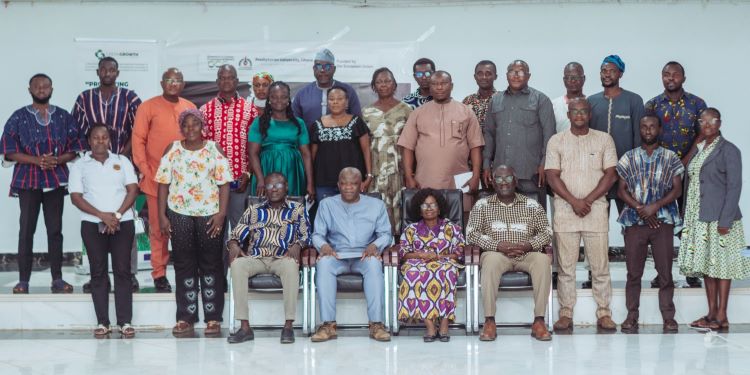
This was done through a series of provincial workshops to dismantle the “skills-mismatch” that has long paralyzed the Northern economic corridor, convening over 80 policymakers, TVET institutions, and Small and Medium-Scale Enterprises (SMEs) across Wa, Tamale, and Bolgatanga.
The GNCCI positioned green skills as the primary engine for inclusive growth, specifically targeting the latent industrial potential of women and youth. Mr. Kabutey Caesar, the National Treasurer of the GNCCI, has framed the project as a defensive maneuver against unemployment and industrial obsolescence.
“The project is a strategic intervention designed to align vocational training with industry demand in the green economy. The initiative seeks to bridge the long-standing gap between skills acquisition and labor market needs, especially in emerging sectors such as sustainable agriculture and circular production”
Mr. Kabutey Caesar, National Treasurer of the GNCCI
The GreenGrowth Ghana Project, launched in late 2024, represents a shift from traditional donor-funded training to a market-led reform model. For the GNCCI, the objective is to ensure that the Technical and Vocational Education and Training (TVET) system is a responsive supplier of human capital for the green transition.
As Ghana pivots toward sustainable agriculture and circular production, the demand for a workforce proficient in waste-to-value processes and resource-efficient manufacturing has reached a critical peak.
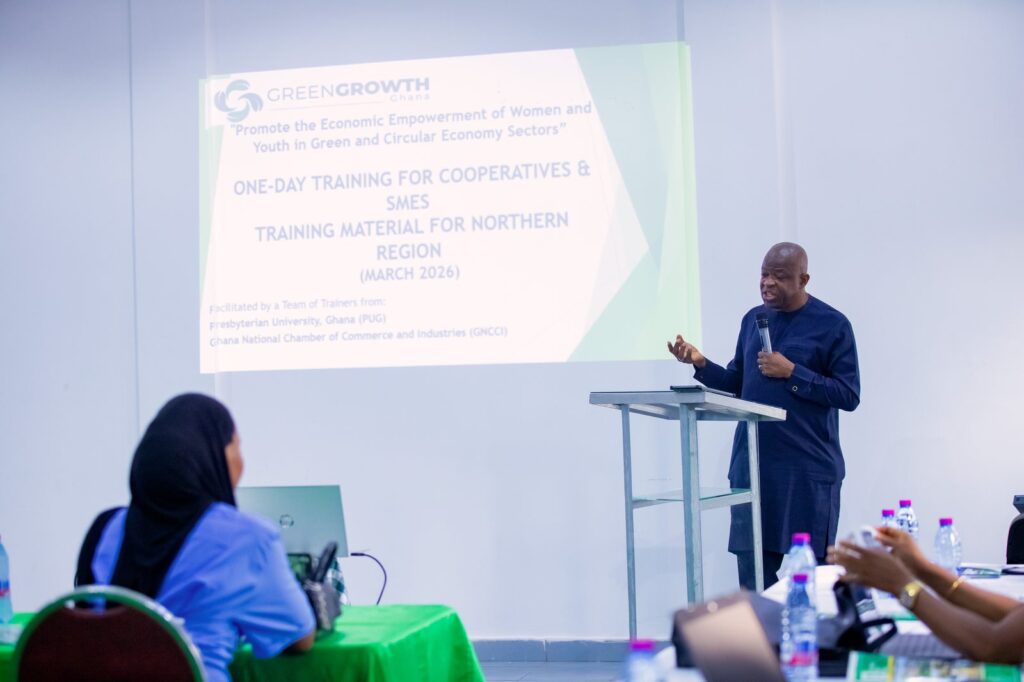
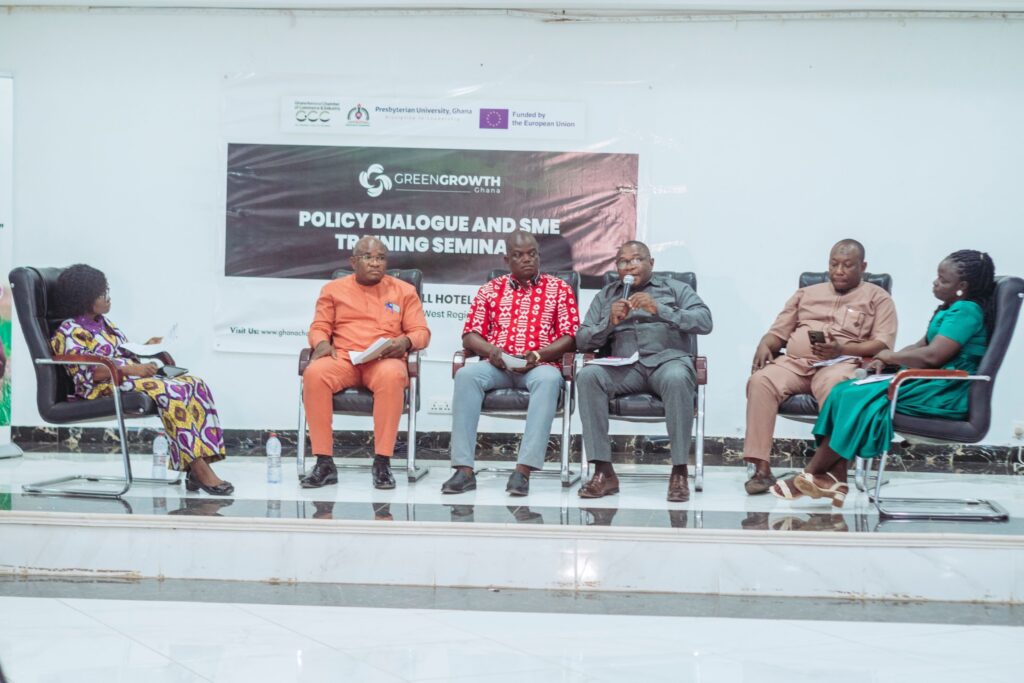
The Bolgatanga dialogues served as a diagnostic summit, identifying the structural clogs – outdated equipment, weak industry linkages, and financing deficits – that have historically stifled the region’s agro-industrial output. The core of the GNCCI strategy lies in “industry-vetting” the TVET curriculum.
Through engaging directly with vocational institutions in the North, the GNCCI ensured that the next generation of technicians is equipped for the specific requirements of green growth sectors, moving away from generic training toward specialized competency in sustainable production.
This alignment is being reinforced by the academic rigor of the Presbyterian University of Ghana. Rev. Dr. Christiana Amarchey, representing the institution, emphasized that the TVET ecosystem must become a hub for innovation and practical research.
For PUG, integrating circular thinking into the classroom is essential for preparing learners to navigate an economy where resource efficiency is the ultimate competitive advantage. This academic-industrial synergy is the “software” that will power the Northern region’s green transition.
Dismantling Structural Clogs
The Bolgatanga summit did not shy away from the harsh realities on the ground, as stakeholders identified technological deficits as the primary barrier to TVET success. Outdated equipment in vocational labs means that students are being trained on machinery that has no place in a modern, green-certified factory.
This creates a secondary training cost for industries that must retrain graduates upon hiring. Furthermore, the lack of quality assurance mechanisms and the persistent gap in institutional financing have rendered many TVET programs incapable of scaling.
To address the financing gap, the project team introduced a technical session on Social Financing, which involves exploring blended finance models and Public-Private Partnerships (PPPs) as a sustainable alternative to traditional government funding.
The GreenGrowth Ghana Project aims to create a financing shield that protects TVET institutions from the vagaries of national budget cycles by inviting private sector capital into vocational training spaces.
The practical dimensions of the GNCCI’s intervention were best illustrated by the field visit to “Good and Goodness Enterprise,” a woman-led agro-processing firm in the Upper East.
According to the GNCCI, the enterprise serves as a microcosm of the Northern industrial challenge: it possesses a strong business model, a dedicated network of local farmers, and a high-demand product line – rice, millet, maize, and spices – yet is crippled by a machinery gap.
The lack of critical roasting and grinding equipment acts as a hard ceiling on its production capacity.
Project leaders indicated that targeted equipment support would significantly improve productivity, increase output, and strengthen the local value chain. They noted that financial assistance under the Project’s grant window would be tied to clearly defined use cases and strict monitoring mechanisms to ensure accountability.
It was also noted that while the direct beneficiaries of the project are 1,000 women and youth, the ripple effect is designed to reach two million people across Ghana, triggering a wider industrial transition. In the Upper East, this means creating a localized circular economy, where agricultural waste from one farm becomes the input for an agro-processing firm, all managed by a workforce trained under the reformed TVET system.
The GNCCI noted that the success of this macro-objective depends on a coordinated united front involving the state, academia, and the private sector. The Bolgatanga, Tamale, and Wa engagements have laid the groundwork for this coordination, moving the conversation from abstract green ideals to the realities of industry alignment.
As the project moves into the next phase of practical training and equipment deployment, the GNCCI is effectively building the foundation for a Northern industrial base that is both resilient and environmentally responsible.
READ ALSO: PHDC Targets Total Control of Local Energy Supplies