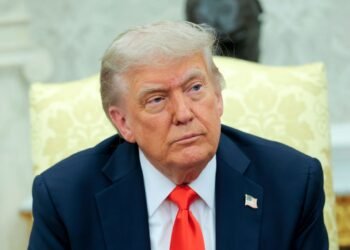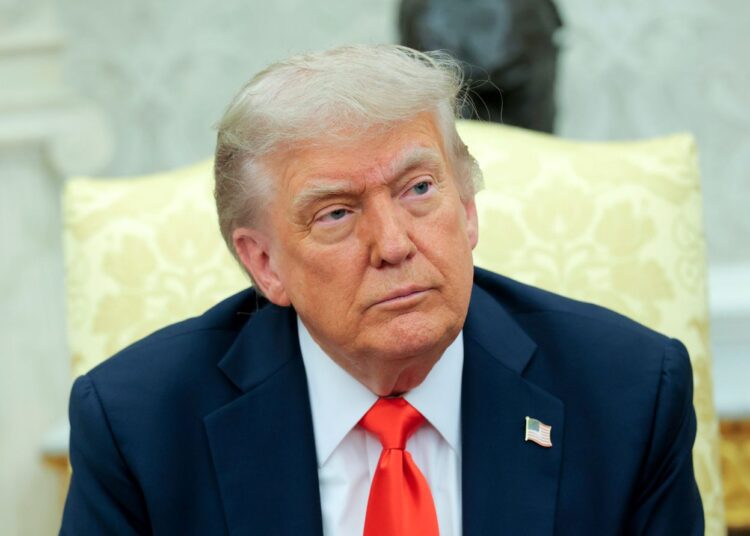
US President, Donald Trump has announced a naval mission, dubbed Project Freedom, to guide stranded ships out of the Strait of Hormuz, with operations set to begin today, Monday, May 4, 2026.
Trump said that he was launching the campaign, dubbed Project Freedom, at the request of countries whose vessels are stranded in the strait, whom he referred to as “neutral and innocent bystanders.”
In a timeline of key events in the Strait of Hormuz, on March 4, days after the US-Israel war on Iran began, the Islamic Revolutionary Guard Corps announced it was taking “complete control” of the Strait of Hormuz. It later said that the critical waterway was open to the world but closed to Iran’s enemies, and imposed a de facto “toll booth,” requiring vessels to obtain clearance and, in some cases, pay fees in Chinese yuan.

On April 8, the US and Iran agreed to a ceasefire, but Tehran kept the strait closed, citing continued Israeli attacks on Lebanon. On April 13, after peace talks in Pakistan ended without a deal, the US imposed its own blockade, targeting all ships leaving and entering Iranian ports. Since then, the US military says it has redirected at least 49 Iranian-linked commercial vessels in the Gulf of Oman and captured at least two Iranian-linked oil tankers in the Indian Ocean.
Iran, too, has declared the Strait of Hormuz closed to all ships and captured two foreign commercial vessels. Currently, Trump has announced the launch of Project Freedom to escort ships struck in the Strait of Hormuz.
Without specifying which countries called for Washington’s help, Trump said in a social media post, “For the good of Iran, the Middle East, and the United States, we have told these Countries that we will guide their Ships safely out of these restricted Waterways, so that they can freely and ably get on with their business.”
He stated that many of these Ships are running low on food, and “everything else necessary for largescale crews to stay on board in a healthy and sanitary manner,” adding that any interference in the operation would “unfortunately, have to be dealt with forcefully.”
Trump suggested on Sunday that the path to a diplomatic resolution to the crisis remained open.
“I am fully aware that my Representatives are having very positive discussions with the Country of Iran, and that these discussions could lead to something very positive for all. The Ship movement is merely meant to free up people, companies, and Countries that have done absolutely nothing wrong — They are victims of circumstance.”
Donald Trump
It is unclear how the campaign, which Trump described as a humanitarian gesture, will proceed, or whether it will involve coordination with Tehran.
US Central Command (CENTCOM) said in a statement that it would begin supporting merchant vessels “seeking to freely transit” the strait from Monday. CENTCOM Commander Admiral Brad Cooper said, “Our support for this defensive mission is essential to regional security and the global economy as we also maintain the naval blockade.”
CENTCOM did not provide details about how it would ensure free passage for vessels in the waterway. The US military previously said that it was “not ready” to accompany vessels through the narrow waterway, where it could come under fire from Iranian territory.
Following Trump’s announcement, Ebrahim Azizi, the Head of the Iranian parliament’s National Security Commission, warned in a post on X that any “American interference” in the strait would be considered a breach of the truce.
“The Strait of Hormuz and the Persian Gulf would not be managed by Trump’s delusional posts! No one would believe Blame Game scenarios!”
Ebrahim Azizi
Iran’s Army Warns All Ships Must Coordinate With Forces In Hormuz Or Face Attack
Meanwhile, the Iranian army said that the security of the Strait of Hormuz “is in the hands of the armed forces of the Islamic Republic of Iran and that any safe passage and navigation in any situation will be carried out in coordination with the armed forces.”
The army asserted that it will maintain and manage the security of the Strait of Hormuz with all its “might.” It told all commercial ships and tankers to refrain from any action to transit without the coordination of the armed forces stationed in the Strait of Hormuz “so that their security is not jeopardised.”
It warned that any foreign armed force, especially “the aggressive US army, will be attacked if they attempt to approach and enter the Strait of Hormuz.”
READ ALSO: ACEP Boss Calls for Infrastructural Upgrade at Power Stations to Ensure Energy Resilience