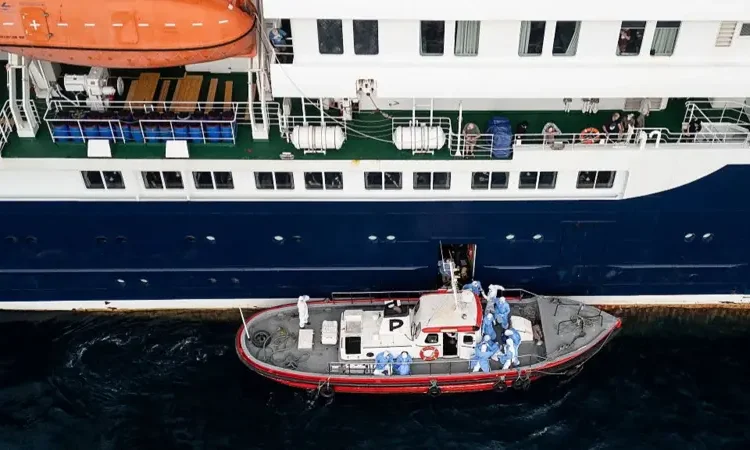
Three hantavirus patients have been evacuated from the MV Hondius and are being transported to the Netherlands for medical treatment.
According to WHO Director-General Tedros Ghebreyesus, WHO is continuing to coordinate closely with the ship’s operator, as well as the governments of Cape Verde, the United Kingdom, Spain, and the Netherlands, to ensure an effective response and safe handling of the situation.
He added, “WHO thanks all those involved. At this stage, the overall public health risk remains low.”
Earlier, the World Health Organization (WHO) confirmed that three individuals believed to be infected with the virus, two crew members and one additional person, were being prepared for evacuation to receive further medical care.
Health officials said the patients were in stable condition, although concerns remain over the potential spread of a rare strain of the virus. “The three of them are stable, and one of the three is asymptomatic,” Ann Lindstrand, the WHO representative in Cape Verde, stated.
The evacuations come days after the UN health agency was alerted to the situation, following the deaths of three passengers on board, with hantavirus identified as the suspected cause. The disease is typically transmitted through contact with infected rodents, particularly via urine, droppings, or saliva, but experts are closely monitoring the outbreak due to concerns about a strain capable of limited human-to-human transmission.
Oceanwide Expeditions, the operator of the vessel, confirmed that specialist medical support is being deployed to assist with the situation on board, stating, “two infectious disease physicians, currently en route from the Netherlands, will embark MV Hondius and remain with the vessel after its anticipated departure from Cape Verde.”
Additionally, the company said that as authorities arrange containment procedures and evacuation logistics, more medical staff are already on board and confirmed that “at this stage” the Canary Islands is still the destination for the Hondius following the medical evacuations.
Meanwhile, political tensions have surfaced in Spain’s Canary Islands over proposed arrangements involving the ship, with regional authorities voicing concern over public safety risks and what they say is a lack of consultation in decision-making.
Canary Islands President Fernando Clavijo warned that neither residents nor authorities “can rest easy because the risk to the Canarian population is clearly very real,” adding “We do not know the condition of the passengers or how many have been infected.”

Clavijo further indicated that the regional government has had to rely largely on media reports for updates and called on Spanish Prime Minister Pedro Sanchez to provide clearer information on any agreement reportedly reached regarding the vessel’s next steps.
Speaking to a media outlet, he said Sanchez made the decision “without consulting the Canary Islands.”
“If an agreement has been reached with the World Health Organization without consulting the Canary Islands, I ask him to explain the details of the agreement and the medical and technical criteria that differ from those agreed yesterday at midday.”
Fernando Clavijo
He also questioned the reasoning behind relocating the vessel from Cape Verde, where it is currently anchored, to the Canary Islands, which would involve a multi-day voyage while the health status of passengers remains uncertain.
“We wonder why, if it is anchored in a Cape Verde port – why does it have to be moved to the Canary Islands, a three-day voyage away, when the condition of the passengers is unknown?”
Fernando Clavijo
Rare Andes Strain Detected as Health Authorities Track Cruise Ship Outbreak
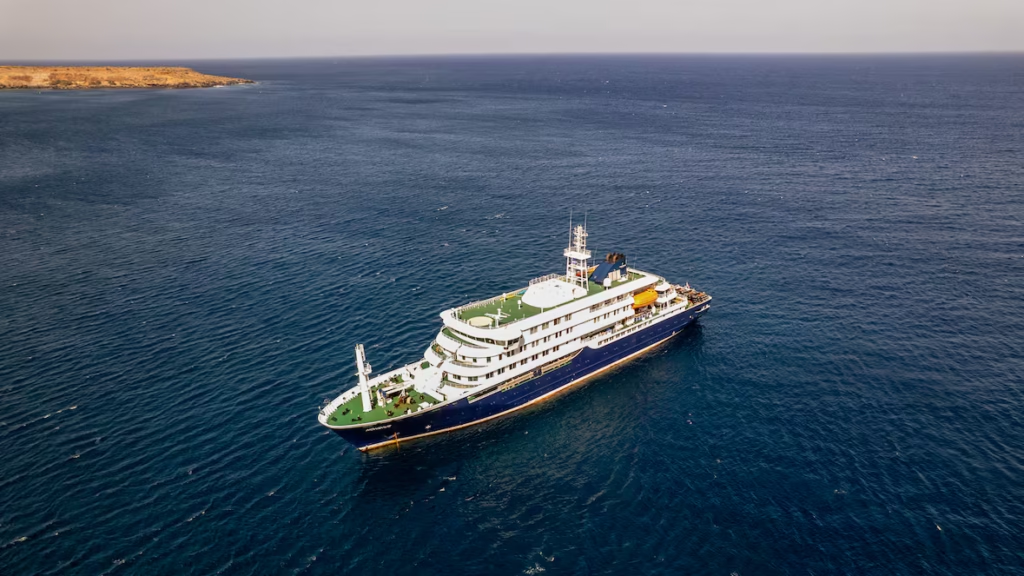
Health authorities have also confirmed that a rare strain of hantavirus capable of human-to-human transmission has been identified in patients linked to the MV Hondius, raising concerns over possible transmission among close contacts onboard the cruise ship.
The Swiss health ministry reported that a patient receiving treatment in Switzerland after travelling on the vessel has tested positive for the South American “Andes” variant of the virus. Officials said the individual sought medical attention after returning from the trip and was subsequently isolated upon admission to the University Hospital Zurich.
While the Andes strain is known to allow person-to-person transmission, health officials stressed that such spread is uncommon and typically requires very close contact.
Authorities in Switzerland have also indicated that the likelihood of further infections within the country remains low, noting that precautionary isolation measures were swiftly implemented after the diagnosis was confirmed.
Medical experts also highlighted that the strain has an incubation period of between two and eight weeks, making contact tracing and exposure timelines more complex.
The confirmation of the strain comes as international health monitoring continues around the MV Hondius, which has been linked to multiple suspected and confirmed hantavirus cases across several countries following travel on the vessel.
READ ALSO: Black Sherif Teases Epic Return to New York with ‘Popstar’ Performance