
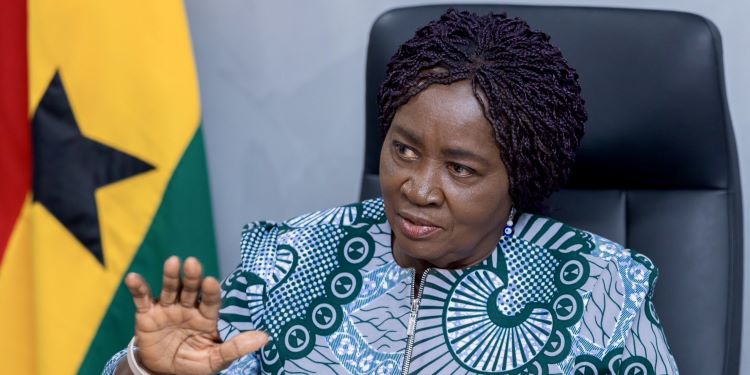
In a powerful keynote address at the 3i Africa Summit 2026, which sought to move Ghana beyond the traditional imagery of the “Gateway to Africa,” Vice President Professor Naana Jane Opoku-Agyemang laid out a blueprint for a continent that no longer waits for external validation but organizes itself to compete at a global scale.
The 3i Africa Summit 2026 has become the stage for a profound redefinition of African economic power, and the address, delivered in Accra, signals a transition from geographic proximity to functional digital integration, positioning Ghana as the architect of the systems that will determine how value is created, exchanged, and controlled across the continent.
This is a vision where sovereignty is about the digital rails on which modern commerce travels.
“It was Dr. Kwame Nkrumah who reminded us that Ghana’s independence must be linked to the total liberation of Africa. It is still valid; economic sovereignty now also depends on integration, particularly digital integration, because this is where value is created, exchanged, and controlled”
Vice President Professor Naana Jane Opoku-Agyemang
Professor Opoku-Agyemang was blunt about the history of Africa being described as a “frontier” by outsiders, suggesting that what matters now is not the label given to the continent, but how the continent organizes its own markets.
She challenged the audience to reconsider the “Gateway” label as a functional system rather than a vanity title. To her, a true gateway is measured by the clearing of transactions, the speed of business connectivity, and the absolute certainty of market operations.
This systemic approach is grounded in Ghana’s long-standing political stability and its role as the host of the AfCFTA Secretariat, yet the Vice President noted that being a host is insufficient if the rules and the infrastructure are not built and sustained by Africans themselves.

She noted that from urban software engineers to rural smallholder farmers, participation in the modern economy increasingly depends on the ability to transact and be identified across borders without friction.
Africa has already proven its capacity to leapfrog legacy systems through the widespread adoption of mobile money and fintech, but the task now is to move from these isolated pockets of success to a continental scale.
To achieve this, the Vice President detailed a framework that addresses the systemic friction currently hampering intra-African trade, emphasizing that the era of routing internal transactions through financial systems outside the continent and denominating them in third currencies must end, as the practice adds unnecessary costs and delays while undermining the very logic of a single market.
The objective is a streamlined, de-dollarized system where a Ghanaian enterprise can invoice a client in another African state and receive payments in Cedis directly and efficiently. This relies on the scaling of platforms like the “Pan-African Payment and Settlement System and the rigorous implementation of the 2024 AfCFTA Digital Trade Protocol.”
Interoperable Identity and Sovereignty
Trust remains the fundamental currency of the digital economy, and Professor Opoku-Agyemang argued that this trust begins with verifiable identity. She highlighted the millions of Africans who remain excluded from formal trade because they lack the digital credentials necessary to engage in cross-border systems.
Unlocking participation at scale requires interoperable identity systems that allow for seamless, mutual recognition of Know Your Customer (KYC) data across jurisdictions. Without this, the digital economy remains a gated community for the few.
“The integration of our digital economies requires these four things: payments, identity, regulation, and, of course, infrastructure. These systems we build will determine whether Africa participates in the global digital economy on her own terms or operates within frameworks defined elsewhere”
Vice President Professor Naana Jane Opoku-Agyemang

Furthermore, the Vice President argued that while integration does not require every country to have identical laws, it absolutely demands regulatory compatibility. The current fragmentation of regulatory environments acts as a hidden tax on innovation, discouraging entrepreneurs from scaling across borders.
Moving toward regulatory sandboxes and shared standards, African nations can create a compatible environment that makes integration real for the private sector. This coordination is the only way to reduce the cost of doing business and allow African innovation to compete with global incumbents.
The physical support for these digital ambitions remains a critical hurdle that was not ignored. The Vice President pointed out that too many Africans remain offline due to coverage gaps and high costs, while the continent itself represents only a small fraction of global data center capacity.
This has dire implications for data sovereignty. When African data is processed and stored in foreign jurisdictions, the continent loses control over how that data is used and protected. Investment in broadband, cloud infrastructure, and localized data systems must therefore accompany policy alignment to ensure that African participation in the global economy is not merely a performance on someone else’s stage.
“Ghana will work with everyone – Rwanda, Zambia, and other partners – to pilot a continental digital trade corridor. This pilot will focus on mobile money interoperability, mutual recognition of digital identity for cross-border KYC, and harmonized electronic invoicing”
Vice President Professor Naana Jane Opoku-Agyemang
This coalition, focusing on mobile money interoperability and harmonized electronic invoicing, is creating a digital bridge that will serve as a blueprint for the rest of the continent. The movement from theory to action underscores that integration is achieved through systems that work consistently across borders and at scale, rather than through policy documents alone.

The Vice President’s message was ultimately one of confidence rooted in the continent’s demographic and technological trends. Africa is currently the youngest continent on the planet, and its adoption of new technology is accelerating faster than in many developed markets.
Hon. Opoku-Agyemang argued that the next phase of global digital growth will be shaped in these emerging markets, and Africa is perfectly positioned to play a defining role, particularly in applying technology to agriculture, healthcare, and education.
As the 3i Africa Summit continues, the focus remains on ensuring that the digital integration discussed in the high-level meeting rooms of Accra is demonstrated in every market and community across the continent.
For Ghana, Zambia, Rwanda, and other partners, the systems built today will determine the degree of independence Africa enjoys in the global economy of tomorrow.